Exam Strategy · 10 min read
The Final 4 Weeks: a Subject-by-Subject PSLE Checklist
By now the orals are behind you. The listening paper is close, the written papers are a few weeks out, and the house has gone quiet in a particular way — the way it does when everyone knows the big thing is almost here. A parent caught me at exactly this point one year and asked the question I get every September: "Teacher, what should we actually be doing now? There's so much, and so little time left."
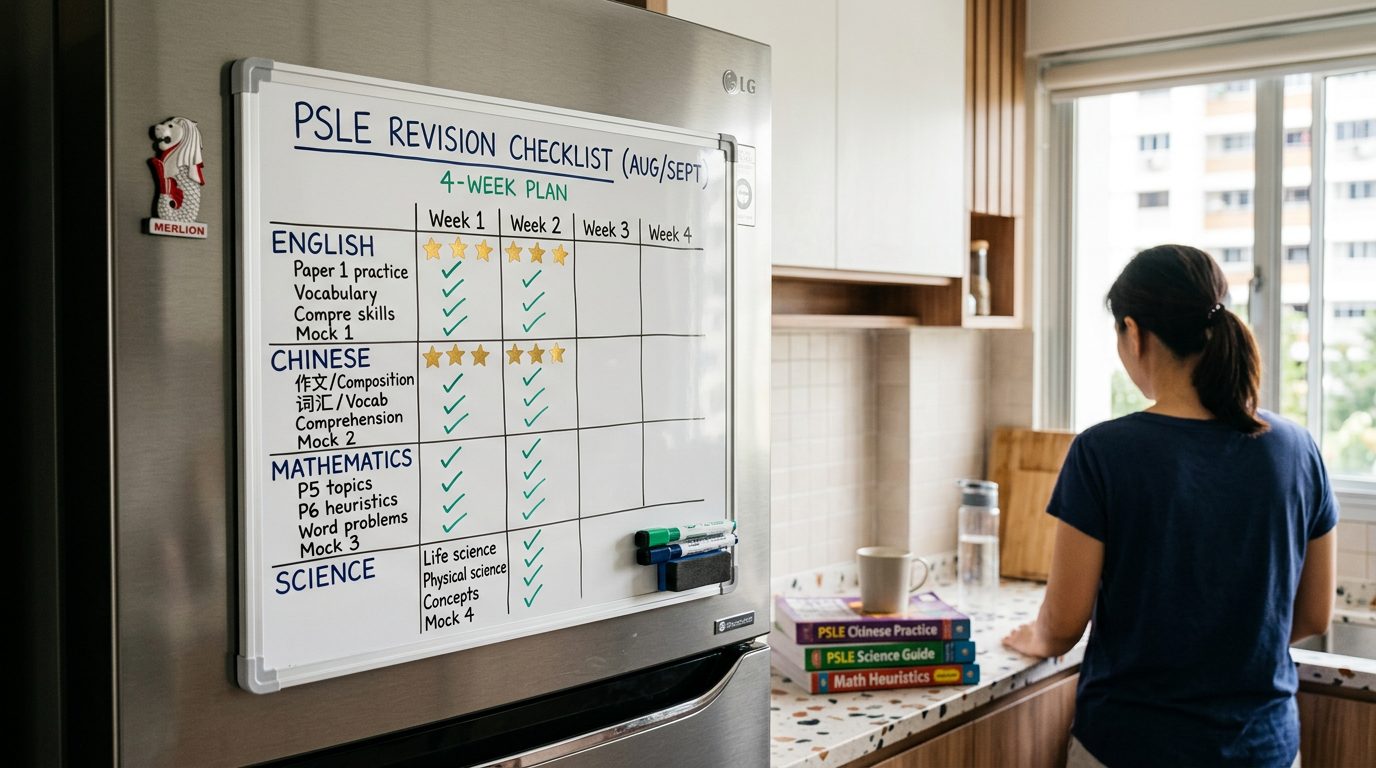
That's the right question, and the answer is narrower than most families expect. The last four weeks are not for learning. They're for consolidating what's already there and stopping the small, repeatable leaks that cost a capable child whole bands. This is a PSLE final weeks checklist built around that idea — subject by subject, with the band boundaries in mind, and the logistics you'll otherwise forget at the worst moment. If you're picking up the season earlier than this, our realistic last-100-days revision plan sets up the months that lead here; this article is the final-stretch close-out.
Resist the urge to teach anything new now. A half-learned heuristic or a fresh comprehension technique introduced in the last fortnight does more harm than good — under pressure the child reaches for the shaky thing, and the familiar thing wobbles with it. If you take one instruction from this article: consolidate, don't cover.
Aim at the boundary, not the mark
Before the subject lists, the single most useful mental shift for the final stretch. Under the PSLE Achievement Level system, your child's grade for each subject is a band, not a raw mark — and pushing a score from, say, 81 to 84 changes nothing, because both sit inside the same AL. Effort spent there is effort wasted.
So spend the last four weeks aiming at the nearest boundary above where your child currently sits. If they're scoring in the low 70s in a subject, the prize is the line into the next band up, not a few cosmetic marks within the band they're already in. Our guide to the PSLE AL scoring system shows exactly where those lines fall and how the four subject ALs combine into the final score. Read it, find each subject's nearest boundary, and let that decide where the hours go.
Maths: tighten method, then race the clock
Maths rewards consolidation more than any other subject, because most of the marks a strong child loses in the last month aren't knowledge — they're timing and slips. Paper 1 has no calculator and rewards speed and accuracy; Paper 2 allows a calculator and is where the heavy, multi-step problem sums live.
- Drill the high-frequency topics, not the whole syllabus. Fractions, ratio and percentage together make up a large slice of the paper, and they recur in combination — a single problem sum will fold ratio into a before-and-after change. Get these airtight first. Speed, rate and area-and-perimeter are the other reliable mark-earners.
- Rehearse the core heuristics until they're automatic. The model (bar) method, working backwards, the assumption/guess-and-check method, and the units-and-parts approach for ratio. The child shouldn't be deciding which to use under pressure — the trigger should be instant. If the model method is still shaky, our step-by-step problem-sums guide is the place to firm it up.
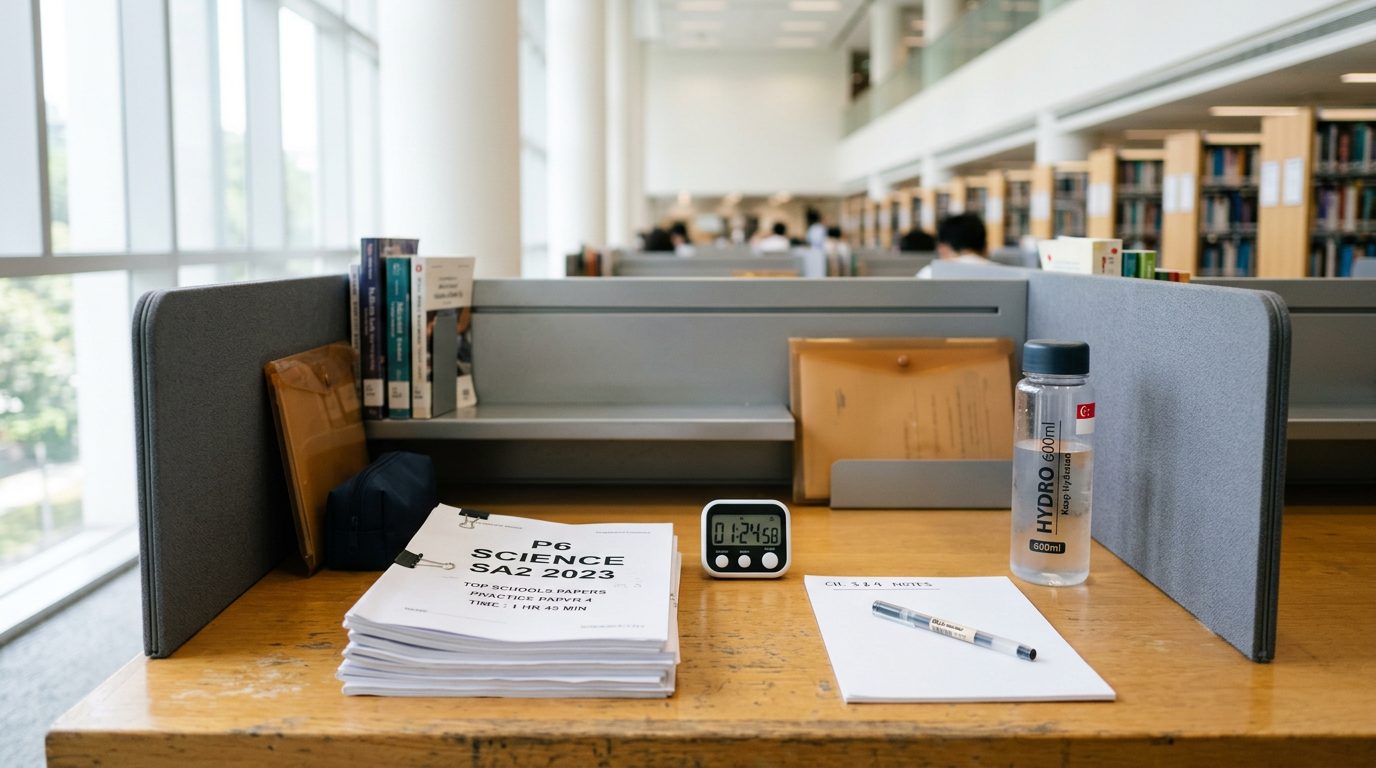
- Do full, timed papers — both papers, properly timed. This is non-negotiable in the final weeks. A child who can solve every question at home but runs out of time in the hall has a timing weakness you can only find with a clock running and the phone away.
- Run a units-and-question-word check on every answer. The two cheapest marks in Maths: writing the unit, and answering what was actually asked ("3 units", not "1 unit"). Make it a fixed last step.
- Keep an error log and redo wrong questions cold. Not the same evening — a day or two later, from scratch. If the method doesn't survive the gap, it never went in.
Science: process skills and the exact keyword
Science is where I see the widest gap between what a child knows and what they're credited for. The knowledge is in their head; the mark is lost in the phrasing. Booklet A is multiple choice and rewards careful reading of the diagram or graph; Booklet B is open-ended and is marked against a scheme that wants specific scientific language.
- Drill the process skills, not just the facts. Reading a graph, interpreting a results table, comparing a fair test's variables, inferring from a diagram. These cut across every topic and appear in both booklets. A child strong on facts but weak on "what does this graph tell you" leaves marks everywhere.
- Practise answering with the scheme's keyword. A child who writes "the plant will grow" when the mark scheme wants "the plant gains more food / energy for growth" knows the science and loses the mark anyway. Open-ended marks live in precise terms — evaporation not "drying up", gains heat not "gets hot". Hunt the imprecise word and swap it for the scientific one.
- Cover the five themes for gaps, not for completeness. Diversity, Cycles, Systems, Interactions and Energy. Don't re-read everything — find the one or two topics that are genuinely shaky and shore them up.
- Answer the whole question. "State and explain" wants both. "Give two reasons" that gets one reason earns half. A surprising number of Booklet B marks are lost not to wrong science but to half-finished answers.
English: composition and comprehension are the prize now
The orals are done, so the last four weeks of English are about the written components. Paper 1 is the writing paper — situational writing against a stimulus, then a continuous composition. Paper 2 is the language and comprehension paper, where the synthesis-and-transformation items and the open-ended comprehension carry real weight.
- Bank two or three flexible composition plans. Don't memorise whole essays — the picture prompts won't cooperate. Instead, have a few versatile storylines and strong opening-and-ending techniques ready to adapt. A child who walks in with a tested structure writes calmly; one improvising from scratch burns ten minutes deciding what to write.
- For situational writing, lock the format and purpose. Get the register right (formal email vs. friendly note), address every bullet in the task, and hit the audience. These are the easiest marks to secure and the easiest to throw away on format.
- Practise comprehension open-ended answers, in full sentences, with evidence. The common leak is lifting a phrase that doesn't actually answer the question, or giving a one-word answer where the marks want a reason. Inference questions especially need the child to explain, not just point at a line in the passage.
- Keep synthesis & transformation warm. A handful of grammar patterns recur every year. Ten minutes a few times a week keeps them automatic — these are precise, learnable marks.
Mother Tongue: keep it ticking over
Mother Tongue deserves a mention even though the oral and listening portions are typically done by now, leaving the written paper. Keep it warm rather than cramming: a daily dose of reading in the language, light revision of composition phrases and vocabulary, and a couple of timed comprehension passages. The goal is to stop the skill going cold, not to overhaul it — spare hours are better spent shoring up a weaker subject elsewhere.
The logistics nobody remembers until it's too late
Marks aren't only lost on the paper. Every year a child arrives flustered because something administrative went wrong, and a rattled child marks lower. Sort these now, calmly, well ahead.
- Confirm the exam timetable. Check the official SEAB candidate timetable for the exact dates and reporting times — don't rely on what worked last year.
- Prepare an approved calculator and check the batteries. Paper 2 Maths allows it; make sure the model is permitted and works, and pack a spare.
- Pack stationery the night before, every night. Sharpened pencils, working pens, a clean eraser and ruler, the candidate's identity document.
- Lock the sleep schedule a week out. A rested brain retrieves; a tired one blanks. Sleep is part of the strategy in the final fortnight, not a reward for finishing.
- Plan the morning route and a traffic buffer. A child who arrives with ten minutes to spare settles; one who runs in late starts with a racing heart.
Common mistakes in the final four weeks
Cramming new content out of fear. The most damaging one. A half-learned method collapses under exam pressure and takes the familiar one down with it. After the prelims, the job is consolidation, not coverage.
Doing papers without marking them properly. A paper sat but not marked to the scheme — to the unit, to the keyword, to whether "give two reasons" actually gave two — is ninety minutes spent confirming what your child already knew. Marking like a real examiner, pointing at the precise spot a mark was lost, is exactly the kind of marking IllumiTutor was built to do.
Spreading effort evenly instead of at boundaries. Polishing a subject already safely in its band while a near-boundary subject goes untouched. Find each subject's nearest line up and aim there.
Neglecting the cheap marks. Units in Maths, keywords in Science, format in situational writing — these feel like formalities to a ten-year-old and get dropped first under pressure, yet they're often a whole band.
Carrying the parent's nerves into the room. A child reads your face faster than any mark scheme. Hovering, extra reminders, the comparison to the neighbour's child — all of it raises the very stress that depresses performance. Your calm is part of the plan.
What to do this week
Sit down with the last marked paper from each subject and do one thing: list the three cheapest marks your child lost — the missing unit, the imprecise keyword, the half-answered "give two reasons", the situational-writing format slip. Don't re-teach the content. Most of it was already right. You're building a one-page hit-list of leaks to plug, ordered by which subject is closest to a band boundary.
Then put two things on the calendar. One full, properly-timed paper this weekend — marked to the scheme, not "mostly right", with the wrong questions set aside to redo midweek from cold. And one logistics afternoon: confirm the timetable, test the calculator, lay out the stationery, and agree the sleep and morning routine for exam week.
A child who walks into that first written paper rested, with their two or three signature slips named and watched for, and nothing administrative going wrong, is already several marks ahead of the one who arrives frayed. That's not soft advice in the final stretch. It's the strategy.
Keep learning
Related PSLE guides
How to Use PSLE Past-Year Papers Properly
Most families do papers the way that feels productive and learns the least. Here's how to use PSLE past-year papers so each one is worth three sittings, not one.
30 Jun 2026 · 10 min read

The Last 100 Days: a Realistic PSLE Revision Plan
A calm, week-by-week plan for the final stretch — diagnosing weak topics, using past-year papers properly, and protecting sleep through orals and the written papers.
19 May 2026 · 9 min read

PSLE Exam Week: What to Do the Night Before Each Paper
A teacher's night-before-and-morning-of routine for PSLE exam week — what to pack, light review not cramming, sleep, breakfast, arriving early, and staying calm paper to paper.
8 Sept 2026 · 10 min read

Managing PSLE Exam Stress: a Calm Final-Stretch Plan
How to keep your child — and yourself — calm in the last few weeks before the PSLE: sleep, routine, realistic expectations, and the signs that worry has tipped past normal nerves.
18 Aug 2026 · 10 min read