
Exam Strategy · 8 min read
The PSLE AL Scoring System, Explained for Parents
Every year, on results day, a parent stops me in the corridor holding the slip and asks the same thing: "Teacher, is 9 good or not?" Then, before I answer, the follow-up — "My friend's boy got 8, so we are worse, is it?" The numbers are small, the stakes feel enormous, and almost nobody was ever taught how to read them.
So let's read them properly. PSLE AL scoring isn't complicated once you see what each piece is doing. It just looks strange the first time, because the good scores are the small ones, and that runs against every instinct a parent has after a decade of marks out of 100.
What "AL" actually means
AL stands for Achievement Level. Since 2021, each of the four PSLE subjects — English, Mother Tongue, Maths and Science — is given an Achievement Level from AL1 to AL8, where AL1 is the best. The AL a child gets depends only on their raw mark for that subject, against a fixed band. It does not depend on how the rest of the cohort did.
That last point is the big shift from the old T-score, and I'll come back to it, because it's the source of half the misunderstandings I hear.
Here are the bands. These are the marks that decide each Standard-subject AL:
| Achievement Level | Raw mark range |
|---|---|
| AL1 | 90 and above |
| AL2 | 85 – 89 |
| AL3 | 80 – 84 |
| AL4 | 75 – 79 |
| AL5 | 65 – 74 |
| AL6 | 45 – 64 |
| AL7 | 20 – 44 |
| AL8 | below 20 |
Look at the top of the table for a second. AL1 to AL4 are narrow — five marks each, give or take. AL5 onwards, the bands get wide. That shape is deliberate. The fine gradations are kept where they matter most for posting, so a child who scores 84 and a child who scores 80 both land on AL3 and are treated as the same. Four marks, no difference. That fact alone takes a lot of pressure off the "I lost two careless marks and ruined everything" panic.
How the PSLE Score is built
This is where parents trip, so go slowly.
Each subject gives you one AL number. You add the four AL numbers together. That sum is the PSLE Score.
A child with AL2 in English, AL1 in Mother Tongue, AL3 in Maths and AL2 in Science has a PSLE Score of 2 + 1 + 3 + 2 = 8.
Because the best AL in each subject is 1, the best possible total is 1 + 1 + 1 + 1 = 4. The weakest is 8 + 8 + 8 + 8 = 32. So the PSLE Score ranges from 4 to 32, and 4 is the best. There are 29 possible scores in between.
This is the line I have to repeat most often at consultations: a lower PSLE Score is a better PSLE Score. A 7 beats a 9. An 8 beats a 12. When that father in the corridor heard his friend's son got 8 to his son's 9, his instinct had it backwards — 8 is one notch stronger, but they're a single AL grade apart in one subject, which is nothing to lose sleep over.
Foundation subjects: how they fold in
Not every child takes all four subjects at Standard level, and the scoring has to account for that. A pupil offering a subject at Foundation level is graded on a different scale — AL A, AL B, AL C — and for the purpose of working out the overall PSLE Score, those grades are mapped onto the Standard ALs.
| Foundation grade | Raw mark range | Counts as (for the PSLE Score) |
|---|---|---|
| AL A | 75 – 100 | AL6 |
| AL B | 30 – 74 | AL7 |
| AL C | below 30 | AL8 |
So a Foundation A folds into the total as a 6. This isn't a punishment — it reflects that Foundation papers cover a lighter curriculum, and the mapping keeps the single PSLE Score fair across different subject combinations. For posting, what matters is the final number, and Foundation grades are converted before they reach it.
How that number turns into a school place
The PSLE Score gets a child considered for a school. It does not, on its own, get them in. Posting works like this:
Every pupil lists up to six secondary schools, in order of preference. Posting is then done by academic merit first — a better (lower) PSLE Score is considered ahead of a weaker one for a vacancy. The system works down the order of merit, placing each child in the highest available choice their score reaches.
When two or more children with the same PSLE Score are competing for the last seat in a school, tie-breakers kick in, in this order:
- Citizenship — Singapore Citizens, then Permanent Residents, then international students.
- Choice order — a school listed as the 1st choice is considered ahead of the same school listed as someone's 4th.
- Computerised balloting — a random draw, used only when the first two can't separate the candidates.
That last step is the one that makes parents anxious, but it's rare. In a typical year, only around one in ten of the students who need any tie-breaking at all reach the ballot — most are separated by citizenship and choice order long before luck enters the picture. Which is why the order you fill the choice form in genuinely matters: list the schools you actually want, in the order you actually want them.
Common mistakes parents make reading the AL system
Thinking a higher number is better. A whole decade of "85 out of 100, well done" rewires hard. But here the scale is inverted: AL1 over AL8, score of 4 over score of 32. If you take one thing away, take this.
Reading the AL like a T-score. The old T-score ranked your child against everyone else who sat the paper, so it moved with the cohort. The AL doesn't. Your child is measured against a fixed standard. A "strong year" or a "weak year" changes nothing about their band. Comparing this year's AL to a cousin's old T-score is comparing two different machines.
Chasing marks inside a band. I've watched families pour weeks into pushing a child from 81 to 84 in a subject. Both are AL3. The effort changed the report card mark and not one thing about the PSLE Score. Know where the band edges are — 90, 85, 80, 75, 65 — and aim effort at crossing one, not at padding the middle of a band you're already safely inside.
Forgetting the whole point of the redesign. The narrow top bands and the small range of total scores exist to make small mark differences matter less, so a child isn't defined by two careless slips. Parents who treat the AL like the old fine-grained ranking re-import exactly the pressure the system was built to remove.
What to do this week
Pick one subject and find the nearest band boundary above your child's current standing. If they're sitting around 72 in Maths, the target isn't "do better" — it's the 75 line that turns an AL5 into an AL4. Concrete, reachable, worth the effort.
Then look at where the marks are actually leaking. Pull out the last marked paper and read the working, not just the score in the corner. In Maths, is it a method gap or careless arithmetic? In Science, is the answer correct in the child's head but missing the keyword the marker needs? Those leaks are usually the cheapest marks in the whole paper to win back — and they're exactly the band-crossing kind.
One honest, well-marked practice paper a week, read properly, will tell you more about your child's real AL than any amount of comparing slips in the corridor — and if you're mapping out the final stretch, a realistic last-100-days revision plan turns that habit into a weekly rhythm.
Keep learning
Related PSLE guides

PSLE 2026 Marks: What Each Paper Is Really Worth
How the marks are split across every PSLE 2026 paper, which papers pull the most weight, and the spots where careless slips cost more than parents expect.
19 Jun 2026 · 10 min read

PSLE Exam Week: What to Do the Night Before Each Paper
A teacher's night-before-and-morning-of routine for PSLE exam week — what to pack, light review not cramming, sleep, breakfast, arriving early, and staying calm paper to paper.
8 Sept 2026 · 10 min read
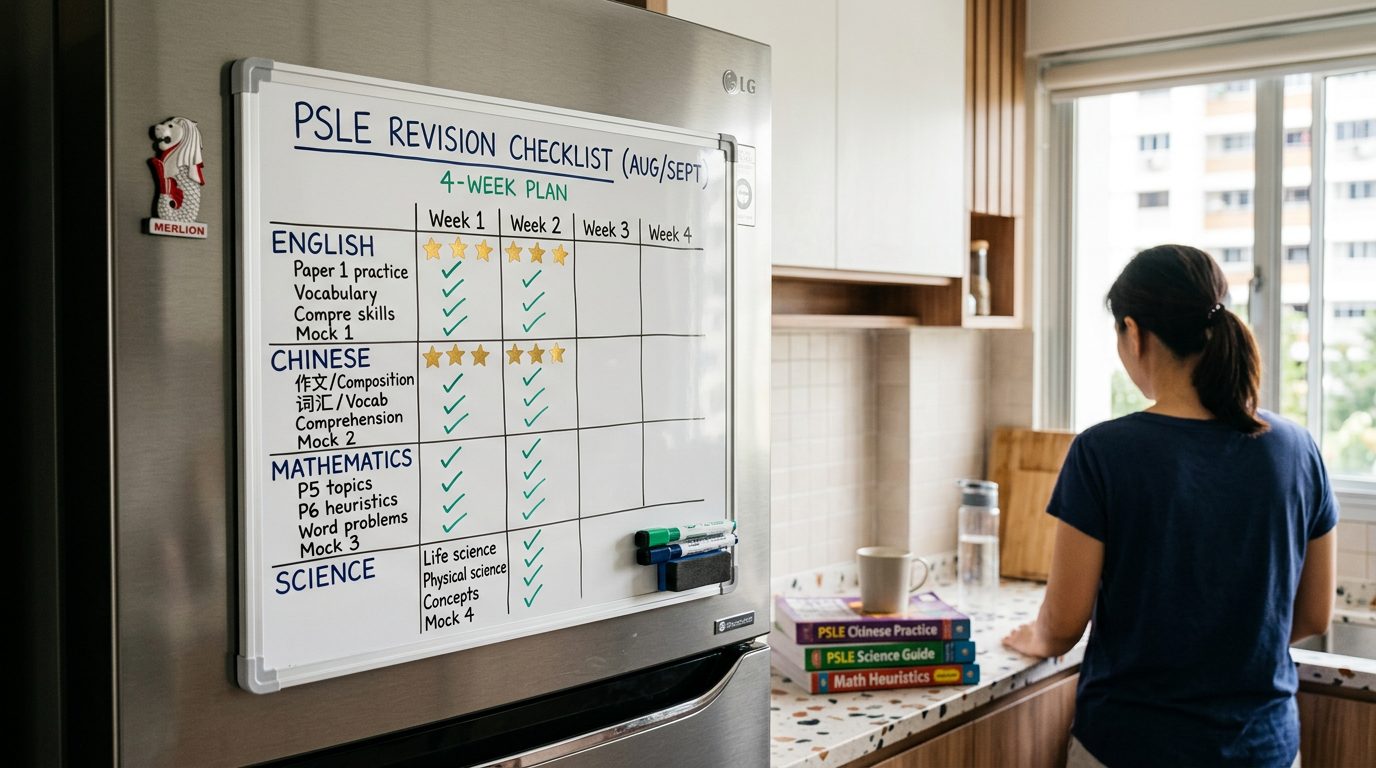
The Final 4 Weeks: a Subject-by-Subject PSLE Checklist
With orals done and the written papers weeks away, this is consolidation season, not new-content season. A subject-by-subject checklist for the last month — and the band-boundary targeting that actually moves a score.
1 Sept 2026 · 10 min read

Managing PSLE Exam Stress: a Calm Final-Stretch Plan
How to keep your child — and yourself — calm in the last few weeks before the PSLE: sleep, routine, realistic expectations, and the signs that worry has tipped past normal nerves.
18 Aug 2026 · 10 min read