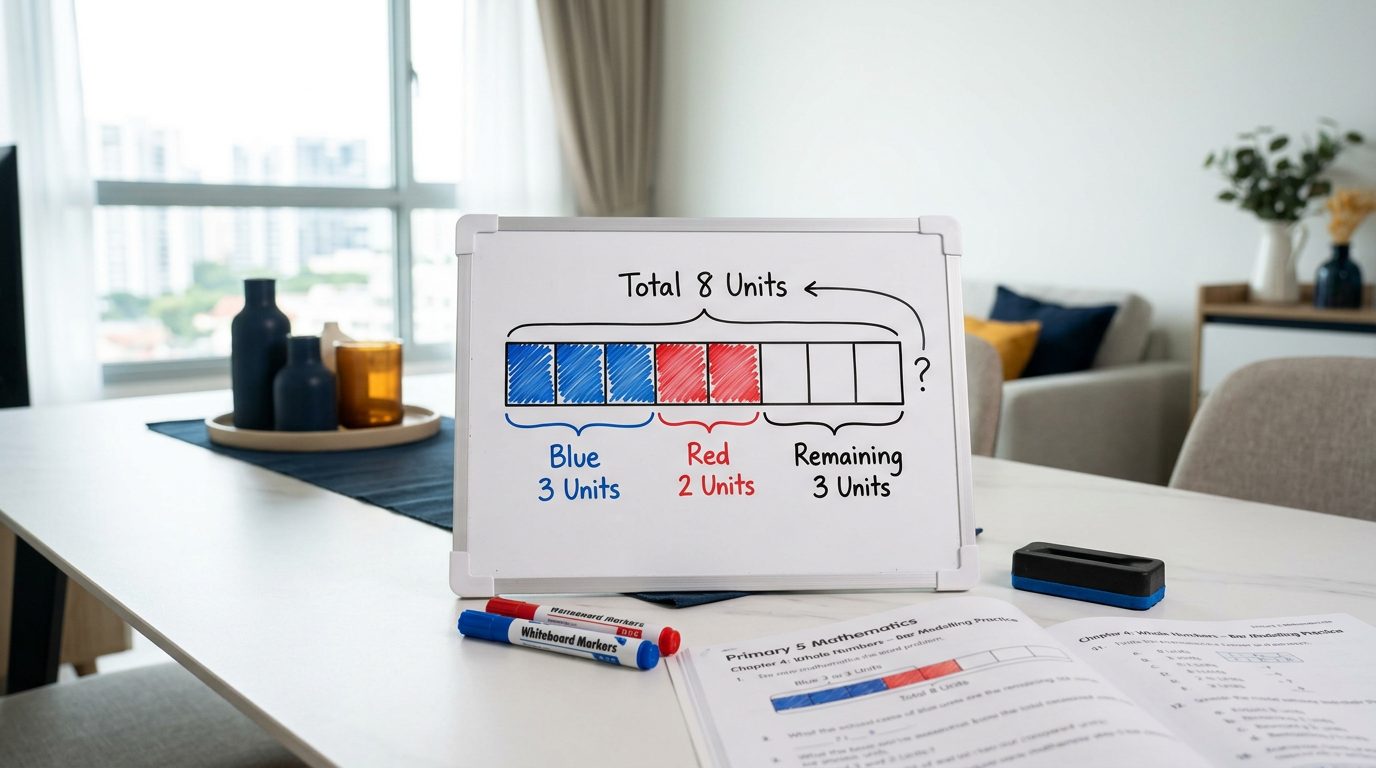
PSLE Math · 9 min read
Solving PSLE Math Problem Sums: the Model Method, Step by Step
Hand a P6 child a problem sum and watch the first ten seconds. The strong ones don't reach for a number — they reach for a pencil and start drawing a bar. The ones who struggle stare at the words, hunt for a keyword, and ask the question every teacher dreads: "Is this a plus or a times?"
That gap is where most of the marks in Paper 2 are won and lost. It isn't a maths gap. It's a method gap — and method can be taught. The model method, or as most parents know it, the bar model, is the single most useful tool a Singapore child has for PSLE math problem sums, and it's the thing I spent the most time drilling because it pays back so reliably.
Why a picture beats a guess
A problem sum is a story. The trouble is that a story arrives as a wall of words, and a ten-year-old's working memory can only hold so much before something slips. The model method does one job, and does it beautifully: it turns the words into a picture you can look at all at once. Once the relationships are drawn, the arithmetic is usually the easy part.
There are really only two base models, and almost everything else is a variation on them.
A part-whole model is for when smaller parts make up a total. Three children share 240 stickers; a tank holds water that is then split into bottles; a sum of money is spent in pieces. You draw one bar, divide it into the parts, and you're looking at the whole and its pieces together.
A comparison model is for when you're comparing two or more quantities — this one has more than that one, by some amount or by some multiple. You draw the bars stacked, lined up at the left edge, and the difference becomes a gap you can see and measure.
That's the whole foundation. Part-whole for "what makes up the total", comparison for "how do these stack up against each other". A child who can decide, in the first ten seconds, which of those two pictures the question is asking for is already most of the way to the answer.
Worked example 1: a comparison model
Let's do one properly, because the method only convinces when you watch it work.
Raju has 3 times as many stickers as Mei. Together they have 48 stickers. How many stickers does Raju have?
The phrase "3 times as many" is the tell — this is a comparison. So I draw Mei as one unit, and Raju as three units of the same size, stacked underneath and lined up at the left.
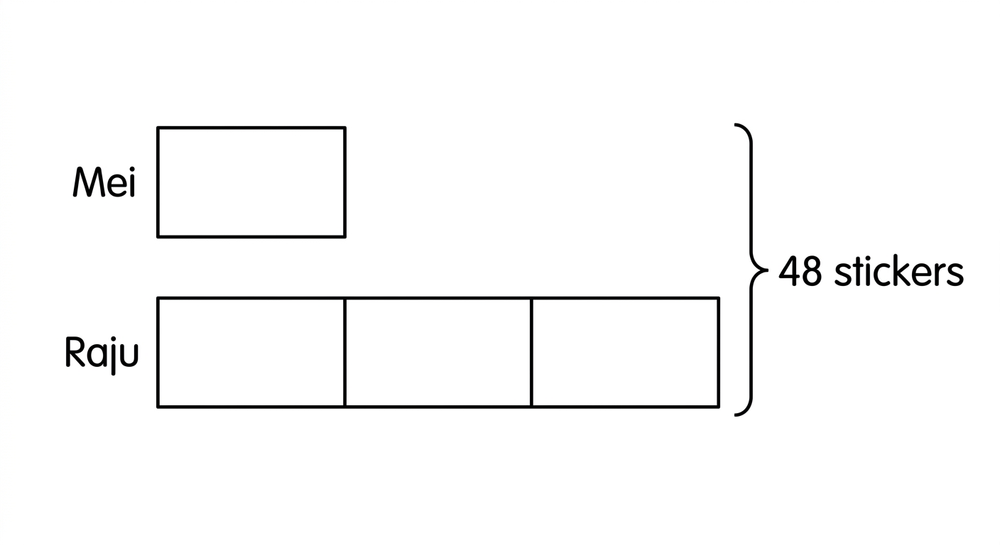
Now read the picture. Mei's bar plus Raju's bar is 4 equal units in total, and those 4 units are the 48 stickers.
- 4 units = 48
- 1 unit = 48 ÷ 4 = 12
- Raju has 3 units = 3 × 12 = 36 stickers
Notice that the child never had to decide "plus or times". The diagram decided it. Four equal boxes share 48, so each box is 48 ÷ 4. The division falls out of the drawing, not out of a guess. That is the entire point.
Worked example 2: a part-whole model with a fraction
Fractions are where I see the most panic, and the bar model is exactly what calms it down. A P5 pupil will confidently write 2/5 of something without ever picturing what 2/5 is. The model fixes that.
Aisha spent 2/5 of her money on a book and $14 on a pen. She then had $40 left. How much money did she have at first?
The "2/5 of her money" tells me the whole is divided into 5 equal units. So I draw one bar, split into 5 equal parts. Two of those parts are the book. The other three parts are everything else — the pen and the money left over.
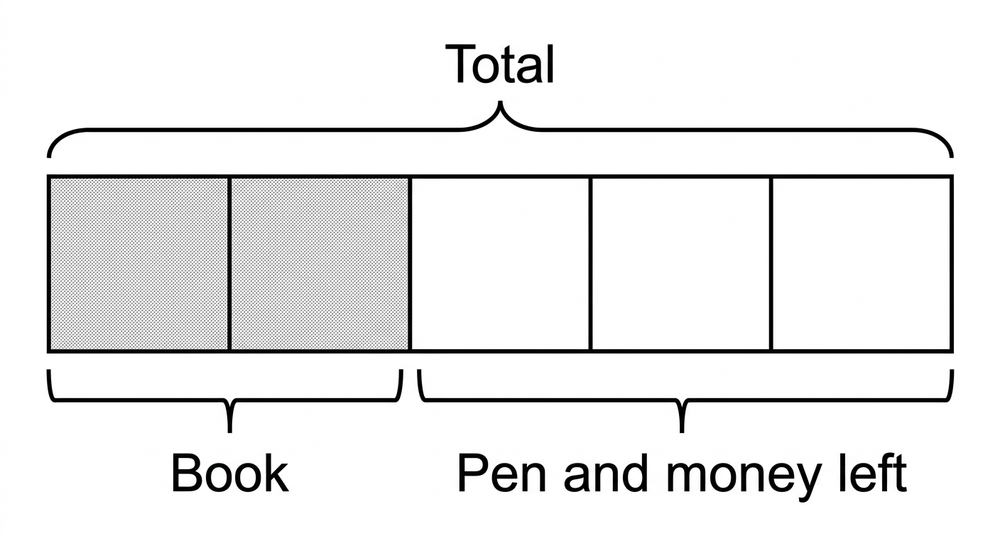
Now the picture does the talking. The book took 2 of the 5 units, so 3 units are left. Those 3 units are the pen plus the money remaining:
- 3 units = $14 + $40 = $54
Here's the spot where careful children pull ahead. $54 is three units, not one. Divide before you multiply:
- 1 unit = $54 ÷ 3 = $18
- The whole is 5 units = 5 × $18 = $90
So Aisha started with $90. Quick check against the story: 2/5 of $90 is $36 on the book, $14 on the pen, leaving $90 − $36 − $14 = $40. That matches, so the model holds.
The takeaway isn't this one problem. It's the move: a fraction of a quantity becomes "divide the bar into that many equal units", and from there you're counting boxes, not wrestling with fraction rules. And it's the order — find 1 unit first, then multiply up to the whole. A child who jumps straight to "the answer is $54" has stopped one unit short.
The before-after twist: find what doesn't change
Once children are comfortable with the two base models, the PSLE turns up the difficulty with problems where something changes. Money is transferred, ages tick forward, ribbons are cut. These are the famous "before-after" problems, and they cause real trouble because the bars from before no longer match the bars from after.
The trick the strong pupils know — and that I'd put at the top of any revision list — is this: in a before-after problem, look for the thing that stays the same.
When two people share money and one gives some to the other, the total between them never changes. When you're told a difference in ages, that age gap stays constant forever — your child is always the same number of years younger than you, this year and in twenty years. Anchor your model on whatever is unchanged, keep that quantity the same size in both the "before" and "after" pictures, and the problem suddenly has a fixed point to solve around. Miss the unchanged quantity and you're modelling two unrelated pictures.
This is also the kind of multi-step reasoning that Paper 2 is built to test. Paper 2 allows a calculator and is the long-answer paper precisely so the marks can reward thinking, not button-pushing. The bar model is what makes that thinking visible.
Where this sits in the actual paper
A quick word on format, because it shapes where the model method earns its keep. PSLE Maths (Standard) is two papers, 100 marks, 2 hours 30 minutes in total. Paper 1 (45 marks, no calculator) is split into Booklet A — multiple-choice — and Booklet B — short-answer, no working space to speak of. Paper 2 (55 marks, calculator allowed) is the long-answer paper: a handful of short-answer questions followed by the multi-mark structured problems worth up to 5 marks each.
The model method matters across both, but Paper 2 is where it converts directly into marks. Those 4- and 5-mark questions award method marks for a clear, correct model and working — so a child who draws the bar can pick up partial credit even when the final number slips. (For how those marks roll up into the overall grade, see the PSLE AL scoring system, explained.)
Common mistakes I see again and again
Drawing units that aren't equal. The entire model depends on every unit being the same size. A child who eyeballs the boxes and makes one wider has broken the maths before they've started. Equal units, every time — neatness here is not fussiness, it's the method working.
Forgetting to label the bars. An unlabelled bar is a guess waiting to happen. Two minutes later the child has forgotten whether the long bar was Raju or Mei. Write the name or the quantity on every bar as you draw it.
Dividing by one unit, multiplying by the wrong number. This is the single most common slip in the worked examples above. The child finds 1 unit correctly, then writes the answer as 1 unit instead of multiplying up to however many units the question actually asked for. Always re-read the question after finding 1 unit: how many units do they want?
Not finding what stays unchanged in before-after problems. As above — model the constant first. Children who dive straight into "before" and "after" without anchoring the unchanged quantity end up with two pictures that don't talk to each other.
Skipping the model under time pressure. Near the exam, anxious pupils start "saving time" by doing problem sums in their head. They lose far more time un-jamming a tangled mental sum than they ever would have spent drawing a clean bar. The model is the time-saver.
What to do this week
Pull out your child's last marked maths paper and turn to the Paper-2 problem sums. For each one they got wrong, don't re-explain the answer. Instead, cover the solution and ask a single question: "Is this a part-whole or a comparison?" If they can name the right model, they're 80% of the way there and the arithmetic is a quick fix. If they can't, that's the gap — and it's a far more useful thing to practise than another twenty random sums.
Then give them three short problems and let them draw the bars only — no solving, just the diagram. You're training the first ten seconds. Once the picture is reliably right, the marks follow. And if you want a sense of how this same "show the working, find the missing step" thinking carries into other subjects, the open-ended Science questions reward exactly the same discipline.
Keep learning
Related PSLE guides
PSLE Math Speed & Rate Problems Made Simple
Speed questions aren't hard arithmetic — they're a handful of traps dressed up as word problems. Here's how I teach P6 children to walk past every one of them.
25 Aug 2026 · 9 min read
The 2026 PSLE Math Paper: the Questions That Trapped Kids, and the Method That Solves Them
The 2026 paper rewarded children who read the exact wording and named their method. Here are four questions worth studying, and how we would solve each one.
25 Sept 2026 · 11 min read
Careless Mistakes in PSLE Math — and How to Stop Them
The marks a strong P6 child loses are rarely about ability — they're a missing unit, a misread keyword, a "find 1 unit, forget to scale up". Here's how to stop them.
21 Jul 2026 · 10 min read
Fractions, Ratio & Percentage: the PSLE Topics That Trip Kids Up
Fraction-of-remainder, ratio-as-units and percentage change look like three separate topics. They're the same idea wearing three costumes — and here's where children lose the marks.
23 Jun 2026 · 10 min read