
Exam Strategy · 10 min read
Managing PSLE Exam Stress: a Calm Final-Stretch Plan
A few weeks out from the papers, the questions parents ask me change. Earlier in the year it's all method — how do I get him to label the bar model, why does she keep dropping the unit. By August it's quieter and more worried. "He can't sleep." "She cried over a practice paper she'd have aced in June." "I think I'm more nervous than my child, and I can see it's rubbing off." That last one is the most honest, and the most important, thing a parent has ever said to me across a table.
PSLE exam stress is real, and a certain amount of it is not the enemy. A child who feels nothing before a big paper usually hasn't engaged with it. The job in the final stretch isn't to remove every nerve — it's to keep the nerves at the level that sharpens, not the level that floods. Most of what does that has nothing to do with another assessment book.
A little stress helps. Too much floods the system
There's a well-worn curve in psychology that every teacher recognises without needing the textbook. A bit of pressure lifts performance — it focuses attention and brings energy to the desk. Push past a certain point and the line falls off a cliff: the same child who knew the work freezes, blanks, reads the question three times and still can't see it.
You've seen both. The child who's a little keyed-up on paper morning and does well. And the child so wound up that a Science question they could answer in their sleep suddenly looks like a foreign language. The aim of these last weeks is to keep your child on the rising part of that curve, not the falling part. Roughly two in five students report meaningful test anxiety, so if this is your household, you're in very ordinary company.
The practical signs that you've tipped over the top: careless errors multiplying on familiar work, a child who can't get to sleep or wakes at 4am, irritability over small things, stomachaches with no bug behind them, or the flat "I'm going to fail anyway" that's really fear wearing a disguise.
Protect sleep like it's a subject
If I could change one thing in the last three weeks of most households, it would be bedtime. Sleep is not time stolen from revision. It's the part of revision where the learning is actually filed.
The memory you build during the day gets consolidated — moved into durable, retrievable storage — largely while a child sleeps. Skimp on it and you don't just get a tired child; you get a child whose brain has had less chance to lock in the very things they studied. The research is unkind about cramming through the night: sleep deprivation is linked to sharp drops in the ability to retrieve learned information, more careless mistakes, and worse emotional regulation — the exact trio you least want walking into an exam hall.
In practice: hold a steady bedtime even on weekends, put screens away 30 to 60 minutes before lights-out, and let the last revision of the evening be light — a read-through of summary notes, not a fresh timed paper that leaves the mind racing at 11pm. A short wind-down ritual that has nothing to do with the PSLE — a shower, a chapter of a story book, a few quiet minutes — tells the body the day is closing.
Keep the ordinary days ordinary
Stress feeds on disruption. The household that cancels every meal out, suspends the Saturday football, and turns the dinner table into a rolling progress review has, with the best intentions, removed exactly the things that were regulating the child.
Keep the scaffolding of normal life standing. Physical activity isn't a distraction from revision — it burns off the stress hormones that otherwise sit in the body all evening, and a child who has run around for an hour sleeps better and concentrates harder the next day. Keep one or two things on the calendar that aren't revision: a walk, a normal Sunday lunch, time with a friend. These aren't rewards to be earned by finishing papers. They're part of how a child stays steady enough to use what they know.
Watch the kitchen too. Heavy caffeine and a sugar-heavy diet make anxiety worse and bring the energy crashes that wreck an afternoon's concentration. None of this is dramatic. Steady sleep, real meals, a bit of exercise, a predictable rhythm — unglamorous, and worth more than another late-night paper.
Don't cram new content this late
This one I'll say plainly because it does real harm. The final fortnight is not the time to introduce a brand-new heuristic, a fresh topic, or a method the child has never met. Fear drives it — the nagging sense that you "haven't covered everything" — but a half-learned new technique is worse than none. Under pressure the child reaches for the shaky thing, it collapses, and it can take the familiar thing down with it.
After the prelims, the work is consolidation, not coverage. Revisit what's nearly solid and make it reliable. If a whole topic is genuinely missing this late, the calm decision is often to let it go and protect the marks you can actually secure — and to make peace with that out loud, so the child isn't carrying a quiet sense of an unfinished, doom-laden gap. There's a fuller version of how to phase the run-in, including what to drop and when, in our guide to the last 100 days of PSLE revision.
Your calm is part of the plan
Here's the part nobody likes to hear, and the part that matters most. A child reads a parent's face faster than any mark scheme. Anxiety is, in a real sense, catching — and the research on this is sobering. Children pick up an anxious cognitive style from their parents partly by watching: the sigh over a practice score, the change in tone when the PSLE comes up, the hundredth "have you finished your corrections". Studies find that a parent's own exam anxiety, and high, critical expectations, are linked to more anxiety in the child and can blunt their performance on the day.
You don't have to fake serenity. But you can decide what your child sees and hears. Talk about the exam in a level voice. Cut the comparisons to the cousin or the neighbour's daughter — they land harder than you think and lift nobody. When you're worried, manage it where the child can't absorb it: talk it out with another adult, not at the dinner table. Modelling calm, including saying out loud how you handle your own nerves, teaches more than any pep talk.
Common mistakes in the final weeks
Trading sleep for revision. The late-night paper feels productive and quietly costs you the memory consolidation that paper was supposed to build. A tired brain stores and retrieves less, full stop.
Turning the home into an exam. Every meal a progress check, every weekend cancelled. You've removed the routine that was keeping the child regulated and replaced it with pressure.
Cramming a new method too late. A half-learned technique fails under exam stress and can drag a familiar one down with it. After prelims, consolidate — don't introduce.
Letting your own anxiety leak into the room. The sighs, the tone shifts, the comparisons. A child absorbs a parent's nerves faster than any content, and it depresses the very performance you're anxious about.
Treating every nerve as a problem to be fixed. Some butterflies are healthy and even useful. Hovering and over-reassuring can signal to a child that the exam really is something to fear — which makes things worse, not better.
When worry is more than nerves
Most exam stress, handled with sleep and steadiness, settles on its own. Sometimes it doesn't, and it's worth knowing the line. Ordinary nerves come and go and ease once the child is into the work. Watch more closely if you see persistent sleep trouble, panic-like symptoms — racing heart, shortness of breath, trembling — refusing or dreading going to school, stomachaches and headaches with no medical cause, or intense, sustained fear and dread that doesn't lift between papers.
What to do this week
Pick a bedtime and hold it — tonight, not the night before the first paper. Move screens out of the bedroom and let the last half-hour of the evening be calm rather than another timed paper.
Then take one thing off the revision pile. If there's a topic you're cramming out of fear, decide whether it's truly recoverable this late; if it isn't, let it go on purpose and aim that energy at the marks you can actually secure. Steady, well-marked practice on near-solid topics — the kind where you check the working, not just the score — does more in these weeks than chasing coverage. If you want a sharper read on exactly where marks are still leaking, working through a couple of past-year papers the right way will tell you more than another fresh stack ever could.
And book one ordinary, un-revision thing into the week. A walk, a film, a normal dinner where the PSLE doesn't come up once. The child who arrives at the hall rested and unhurried is already ahead of the one who arrives frayed — and so is the parent.
Keep learning
Related PSLE guides
PSLE Exam Week: What to Do the Night Before Each Paper
A teacher's night-before-and-morning-of routine for PSLE exam week — what to pack, light review not cramming, sleep, breakfast, arriving early, and staying calm paper to paper.
8 Sept 2026 · 10 min read
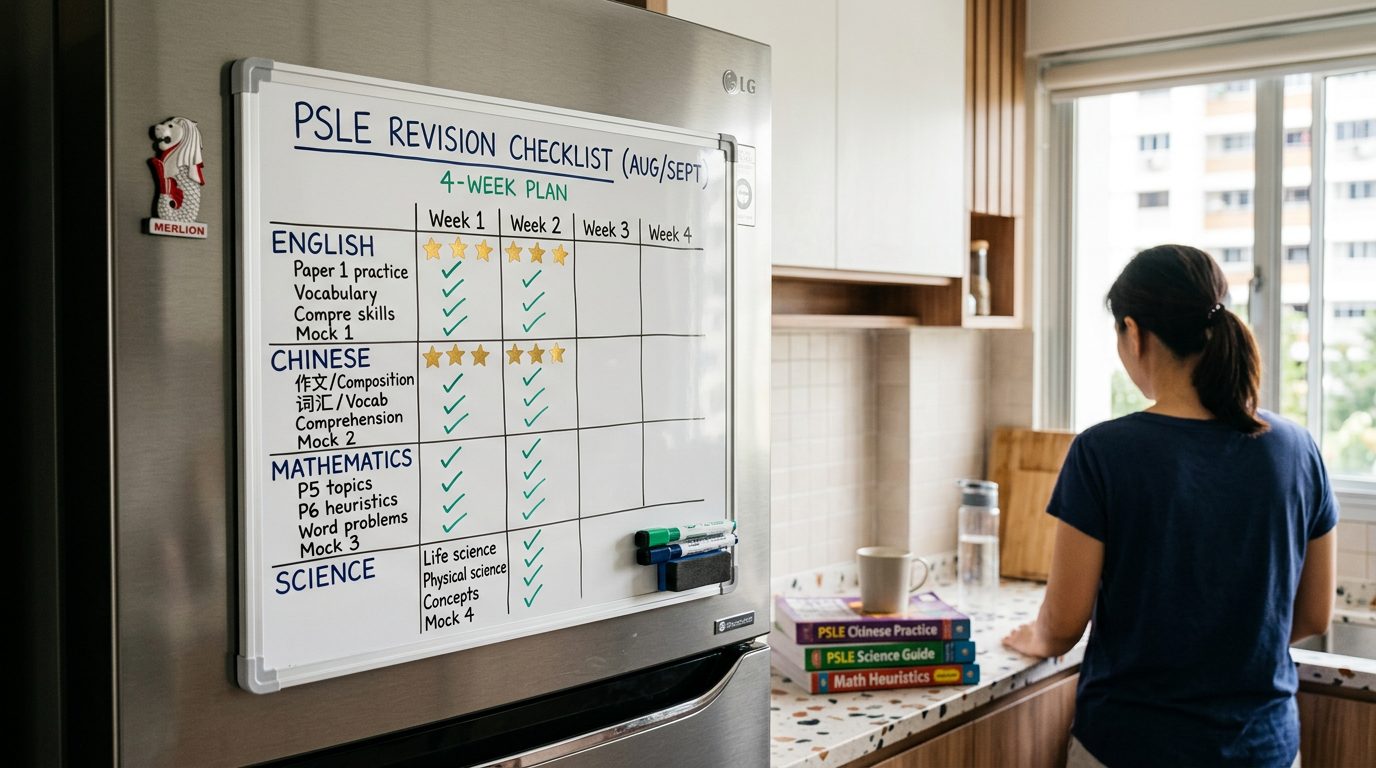
The Final 4 Weeks: a Subject-by-Subject PSLE Checklist
With orals done and the written papers weeks away, this is consolidation season, not new-content season. A subject-by-subject checklist for the last month — and the band-boundary targeting that actually moves a score.
1 Sept 2026 · 10 min read
How to Use PSLE Past-Year Papers Properly
Most families do papers the way that feels productive and learns the least. Here's how to use PSLE past-year papers so each one is worth three sittings, not one.
30 Jun 2026 · 10 min read
The Last 100 Days: a Realistic PSLE Revision Plan
A calm, week-by-week plan for the final stretch — diagnosing weak topics, using past-year papers properly, and protecting sleep through orals and the written papers.
19 May 2026 · 9 min read