Exam Strategy · 10 min read
How to Use PSLE Past-Year Papers Properly
A father once brought me a carrier bag. Inside were eleven PSLE past-year Maths papers, all done, all with a score scribbled in the corner, none marked properly. "He's done so many," the father said, half-proud, half-anxious, "but the marks aren't moving." I asked to see the working on three of them. Same mistake in all three — the boy was setting up the bar model right and then mislabelling the units at the end, every single time. Eleven papers, and nobody had caught the one thing that was actually costing him.
That bag is the most common revision mistake in Singapore, and it's worth saying plainly: a stack of completed PSLE past-year papers is not progress. It only feels like it. The paper is the easy half of the work. What you do with it afterwards is where the marks come from, and most families skip exactly that part. So let me walk you through how I'd have a parent use these papers — the way that's slower per paper, and far faster overall.
Why blindly drilling papers fails
Doing paper after paper feels productive because it's busy, measurable, and tiring — three things we mistake for learning. But think about what's actually happening. When a child does a fresh paper cold, they practise the questions they can already do alongside the ones they can't, in roughly the same proportion as their current ability. The score in the corner just confirms where they already are. It doesn't move them.
Worse, a child who does ten papers and never reviews the errors is practising those errors. The boy in the carrier bag wasn't getting better at labelling units — he was rehearsing the wrong habit eleven times and grooving it deeper. The research on this is unambiguous: the learning happens during the review, not during the attempt. A do-and-discard paper throws away the single most valuable thing it produced, which is the list of your child's specific mistakes.
There's a second trap, and it's the opposite of laziness — it's keenness. Parents who start full timed papers too early, before the child has actually finished learning the content, just pile stress onto gaps. The child does badly, feels defeated, and the paper teaches anxiety instead of method. Papers reward you only once the foundation is in. Before that, they punish you for not having built it yet.
A paper is worth three sittings, not one
Here's the reframe I want every parent to take away. One past-year paper is not one task. Done properly, it's three separate sittings spread across several days.
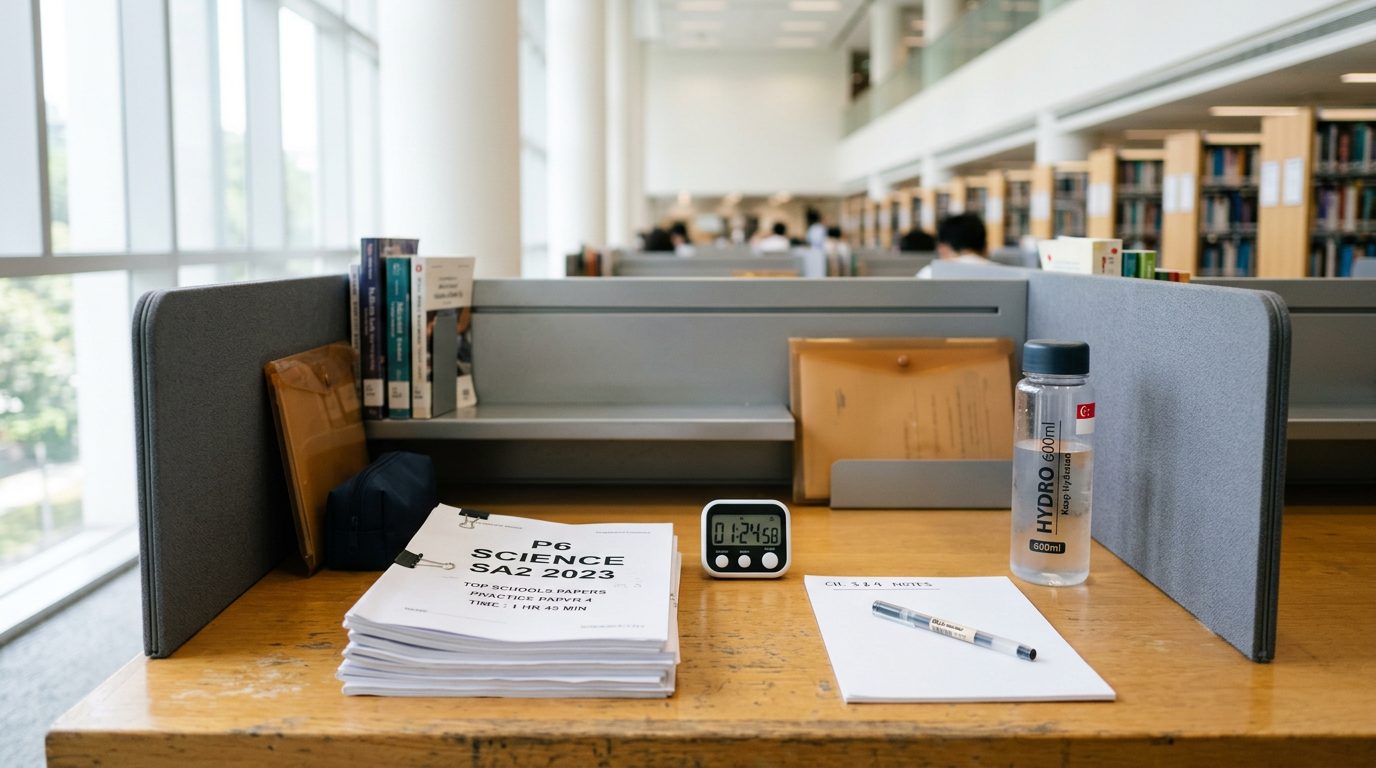
Sitting one — do it timed, under real exam conditions. Phone in another room, clock running, no peeking at notes, no "just checking one thing" mid-paper. The point isn't only to answer the questions — it's to rehearse the pressure. A child who solves every problem calmly at the kitchen table and then runs out of time in the exam hall has a timing weakness, and a timed sitting is the only way you'll ever find it. Untimed practice quietly overestimates how ready your child is.
Sitting two — mark it honestly, against the scheme. Not "mostly right." Not a generous tick because the idea was there. Mark it the way the PSLE marker will: Did the unit get written? Was the bar model labelled? Did a "give two reasons" answer actually give two, or did it stop at one? In Science, did the answer contain the keyword the mark scheme requires, or did the child write something true but un-creditable? A pupil who writes "the plant will grow" when the scheme wants "the plant gains more food and energy for growth" knows the science and loses the mark anyway. This honest marking is the whole game, and it's exactly what IllumiTutor was built to do — read a child's working like an experienced marker and point at the precise spot a mark was lost, rather than just totting up a number.
Sitting three — redo every wrong question, a day or two later. Not the same evening, when the answer is still warm in short-term memory and the redo proves nothing. Leave a gap. Then redo the wrong questions cold. If your child can reproduce the correct method after a day's delay, it has actually gone in. If they can't, it never did — and you've caught it with weeks to spare instead of discovering it in the hall.
Skip sittings two and three and you've spent ninety minutes confirming what your child already knew.
Keep an error log — it becomes your revision plan
If you do only one new thing after reading this, make it this one. For every paper, keep a running error log: a simple notebook or a single sheet per subject where you record each mistake. For each wrong question, write three things — the topic, the type of error, and one line on what actually went wrong.
The type of error matters more than parents expect, because different errors need completely different fixes. I sort them into four kinds:
- Conceptual — the child genuinely didn't know the method or the science. This needs reteaching, not more papers.
- Careless — the method was right, the arithmetic or the copying wasn't. This needs a checking habit, not reteaching.
- Time — the child knew how to do it but ran out of time. This needs speed and timing practice.
- Misread — the child answered a different question from the one asked. This needs slower, more deliberate reading of the stem.
A child with a marked-up error log has a map. A child "doing more papers" has a treadmill. By the final few weeks, the highest-yield revision your child can do is to work straight off that log — revisit the exact topics and question types where marks keep leaking, and leave alone the things they already get right.
Space it out — don't cram papers into the last fortnight
The instinct, especially as the exam looms, is to pile on papers in the final stretch. It's the kiasu instinct, and it backfires. A brain crammed in a single week forgets most of what it saw. The same total amount of practice, spread out over weeks with gaps between revisits, sticks far better — this is the spacing effect, one of the most robustly evidenced findings in cognitive science. Researchers have followed students taught with spaced retrieval and found they outperformed crammed peers not just on the immediate exam but on a cumulative one months later, in a follow-on course. Gaps feel uncomfortable because you forget a little between sessions — and that small forgetting, then re-retrieving, is exactly the effort that builds durable memory.
In practice this means two things. First, don't block one paper after another in the same week and call a topic "done." Cycle weak topics back in: a topic redone in week eleven should be revisited in week seven and again in week four. Second, mix your practice rather than doing six fraction questions in a row. When questions are jumbled, the child has to first recognise what kind of problem it is before solving it — which is precisely what the real paper demands. Blocking ten identical questions teaches a child to copy the last one's steps; mixing them teaches a child to choose the method.
For how many papers, resist the arms race. Across a PSLE subject, something like eight to ten papers worked through properly will teach far more than twenty done-and-discarded. Quality of review beats quantity of papers every time. Two papers fully marked, logged, and redone outvalue ten with a score in the corner and nothing else.
When to start, and in what order
Papers reward a built foundation, so the order matters. A sensible shape, working backwards from the exam: finish learning the content first; then do untimed, topic-by-topic questions to build accuracy on weak areas; then move to full timed papers under exam conditions, usually from around eight to twelve weeks out; and in the final two to four weeks, revise straight off the error log, targeting the question types where marks still leak.
The single most common timing error is jumping to full timed papers before the content is in. Timed conditions add pressure, and pressure on top of gaps just produces a low score and a discouraged child. Build accuracy first, then add the clock.
Common mistakes
Mistaking volume for progress. Eleven papers half-marked teach less than two fully worked through, logged, and redone. The corner score is the least useful mark on the page.
Never reviewing the errors. A paper done and not reviewed is half a paper. The mistakes are the product; the attempt is just how you generate them.
Doing everything untimed — or everything timed. Untimed practice flatters your child's readiness and hides timing problems; timed practice too early, before the content is solid, just teaches stress. Use untimed to build accuracy, timed to build stamina, in that order.
Redoing wrong questions the same evening. With the answer still fresh, a successful redo proves nothing. Leave a gap of a day or two, then redo cold — that's the only version that tells you whether it stuck.
Chasing a mark inside a band you already hold. Pushing a subject from 81 to 84 changes the report-card number and nothing else — both sit in the same Achievement Level. Aim your effort at the nearest band boundary above where your child is sitting, not at padding a score they already have. Our guide to the PSLE AL scoring system shows exactly where those lines fall.
What to do this week
Pick one past-year paper your child has already done and "finished." Mark it again, properly, to the scheme — no generous ticks. I'd wager you find at least one repeated, fixable mistake nobody noticed the first time. Write it at the top of a fresh error log.
Then run a single paper through the full three-step cycle: timed this weekend, marked honestly, the wrong questions set aside to redo midweek. Do it once and you'll feel the difference between practising and just doing papers — they are not the same thing.
If the exam is still some months out, sketch the shape of the run-in too, so papers land in the right order and at the right spacing rather than piling up in the last fortnight. Our last-100-days PSLE revision plan lays out that timeline week by week. Aim every hour at crossing a band boundary, work straight off the error log, and let the papers do what they're actually good for.
Keep learning
Related PSLE guides
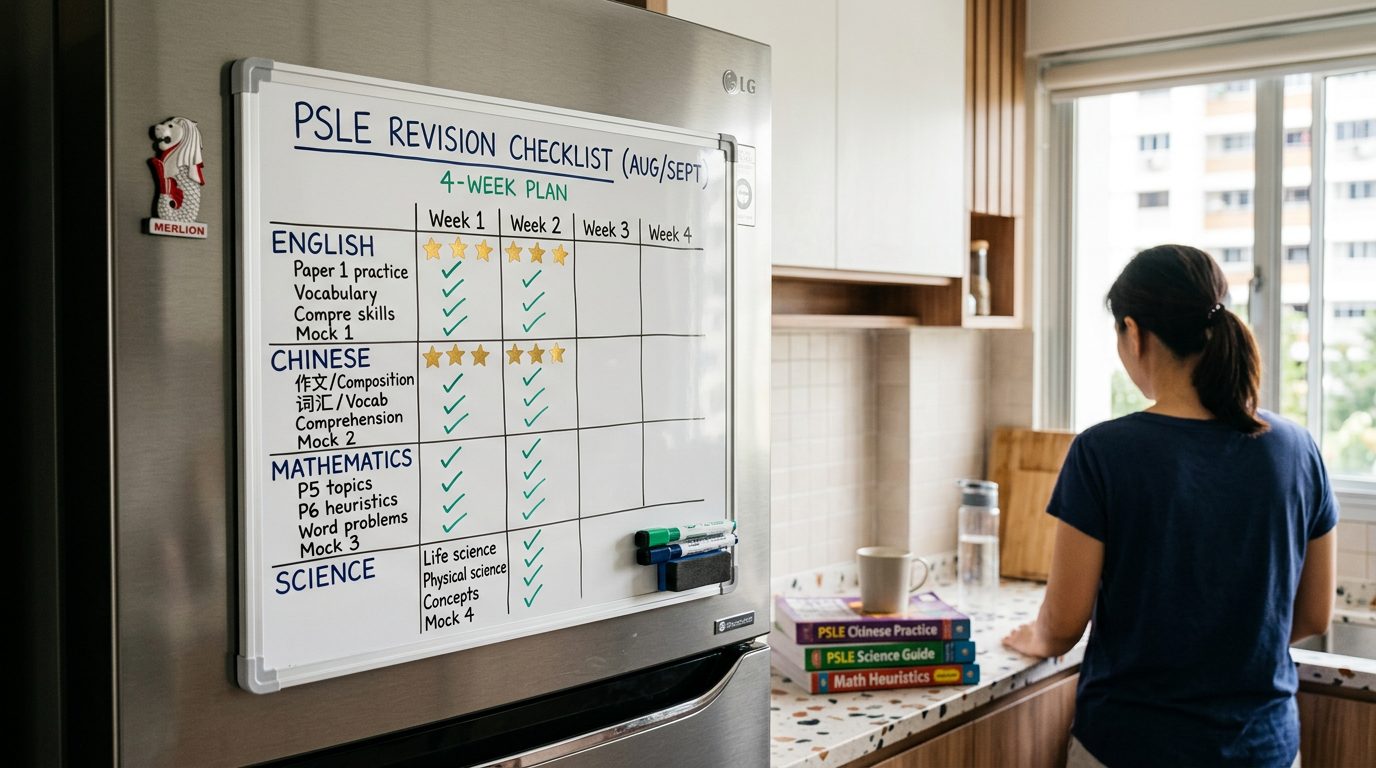
The Final 4 Weeks: a Subject-by-Subject PSLE Checklist
With orals done and the written papers weeks away, this is consolidation season, not new-content season. A subject-by-subject checklist for the last month — and the band-boundary targeting that actually moves a score.
1 Sept 2026 · 10 min read

PSLE Exam Week: What to Do the Night Before Each Paper
A teacher's night-before-and-morning-of routine for PSLE exam week — what to pack, light review not cramming, sleep, breakfast, arriving early, and staying calm paper to paper.
8 Sept 2026 · 10 min read

Managing PSLE Exam Stress: a Calm Final-Stretch Plan
How to keep your child — and yourself — calm in the last few weeks before the PSLE: sleep, routine, realistic expectations, and the signs that worry has tipped past normal nerves.
18 Aug 2026 · 10 min read
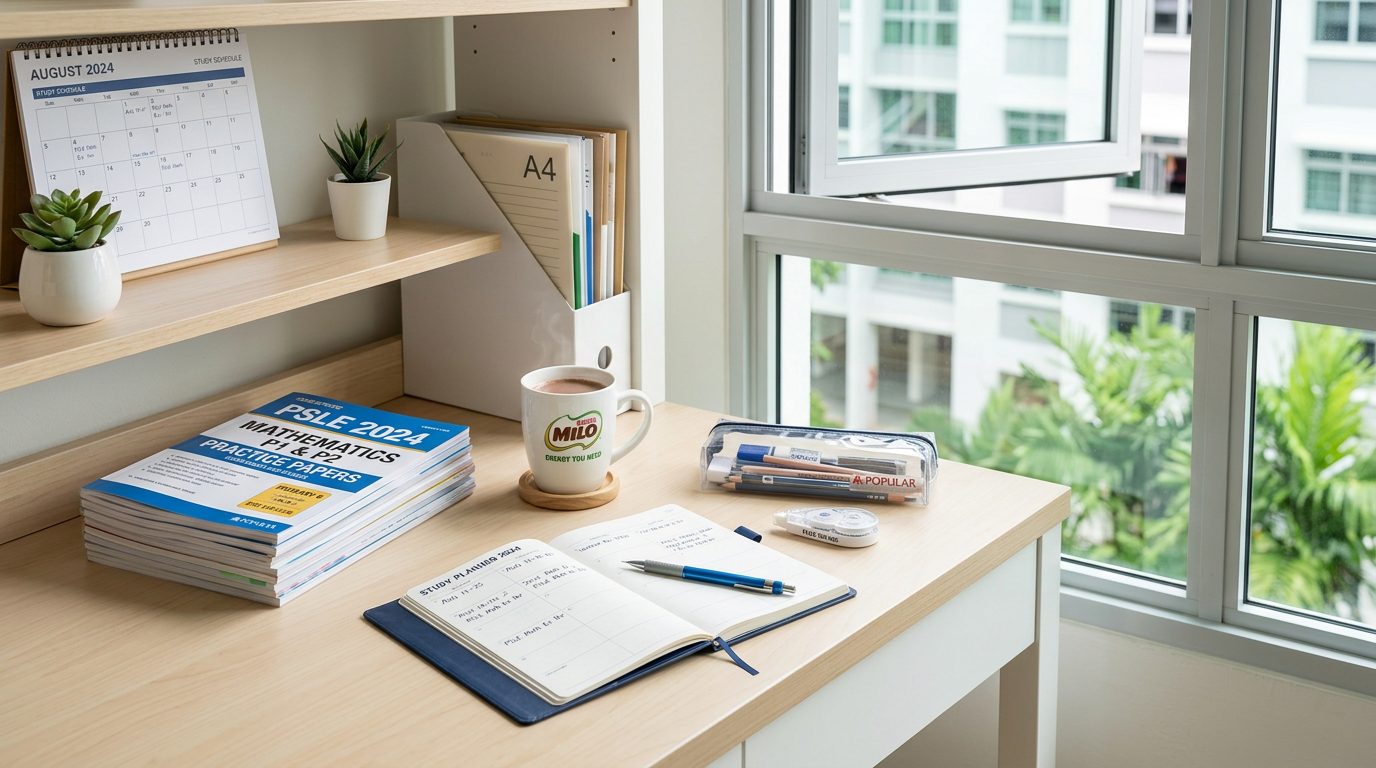
The Last 100 Days: a Realistic PSLE Revision Plan
A calm, week-by-week plan for the final stretch — diagnosing weak topics, using past-year papers properly, and protecting sleep through orals and the written papers.
19 May 2026 · 9 min read