Exam Strategy · 10 min read
The Truth About Learning Styles (and What Actually Helps Your Child Learn)
A mother slid her son's maths paper across the table to me and said, almost apologetically: "He just isn't a maths person. He's a visual learner — that's why he can't do word problems." She'd read it somewhere, taken a little online quiz with him, and it had clicked: visual learner. It explained everything. It also let her off a hook she didn't deserve to be on, because it meant the problem was just how his brain was wired, and there wasn't much anyone could do.
I understand why that label feels true, and why so many caring parents reach for it. It's tidy, it's sympathetic, and it turns a frustrating struggle into a fixed fact about your child. But I have to tell you, gently, what the research says — because it's been studied hard, and the popular version of learning styles doesn't hold up. The good news is that what does hold up is far more useful to you, and it points at things you can actually do this week.
What "learning styles" actually claims — and why it falls apart
The idea most parents mean by learning styles is the VARK one: every child is, by nature, a visual, auditory, reading/writing, or kinaesthetic learner, and you should teach each child in their matching channel. Show the visual learner pictures, let the kinaesthetic one move around, and learning improves.
The belief is everywhere. A well-known survey of UK and Dutch teachers found that more than 90% agreed that "individuals learn better when they receive information in their preferred learning style" — so if you believed it, you're in the company of most of the profession (Dekker et al., 2012). It feels obvious. The trouble is that "feels obvious" and "is true" part ways here.
The specific claim that breaks is called the meshing hypothesis — the idea that matching the teaching format to the child's style improves how much they learn. When four cognitive psychologists went looking for the experiments that would prove it, they found that almost nobody had run the test properly, and the few studies designed well enough to settle it came back negative: matching instruction to a supposed style did not improve learning (Pashler, McDaniel, Rohrer & Bjork, 2008). Children do have genuine preferences — your son may well say he prefers pictures. But a preference for how information is presented isn't the same as learning better when you get it that way. That's the gap the evidence simply doesn't bridge.
So when a paper says "visual learner", treat it the way you'd treat "lucky number". Harmless as a preference. Quietly misleading as a plan.
What genuinely shapes how your child learns
Clearing the myth out of the way is only worth doing because something better is standing behind it. Four things actually move the needle, and not one of them is a fixed "type".
Where your child is developmentally
A Primary 3 child and a Primary 6 child are not the same learner, and that difference is real in a way "visual vs auditory" is not. Younger primary children think best about concrete, tangible things — objects they can see, count, and move. The ability to reason about abstract, hypothetical ideas comes later, strengthening as a child moves through the upper primary years (Piaget's stages, summarised).
This is why the same concept needs handling differently at P3 and P6. Take "3 times as many". For a P3 child, you put it on the table: three groups of counters next to one group, so "three times" is something they can point at. For a P6 child you can write it straight as a bar model and talk in units, because they can hold the abstraction. Hand the P3 child the units-and-algebra version too early and they'll stall — not because they're the wrong "type", but because you've skipped the stage they're actually standing on.
What your child already knows
This is the big one, and it's almost always the thing hiding behind "he's not a maths person". Far more than any style, a child's prior knowledge decides whether the next thing lands.
The boy who "can't do word problems" usually can read perfectly well and can do the arithmetic. What he's missing is one earlier rung — he never got fully solid on what "times as many" means, or on turning a sentence into a quantity. Every word problem then feels like a wall, and from the outside it looks like a style problem or a "not a maths person" problem. It's a knowledge gap wearing a costume. Find the missing rung, reteach it plainly, and the word problems that were impossible last month start falling.
Words and pictures — for every child, not a chosen few
Here's the finding that quietly demolishes the visual-learner idea while rescuing what's useful in it. We process verbal information and visual information through two partly separate mental channels, and a concept presented through both — words plus a diagram — is generally learned and remembered better than either alone. This is dual coding (Paivio's theory; see Clark & Paivio).
Notice what it does and doesn't say. It does not say "give the visual child the picture". It says everyone benefits from words and a picture together. That's exactly why the bar model is such a workhorse in Singapore maths: it's not a crutch for "visual learners", it's a second channel that helps the whole class, the confident and the struggling alike.
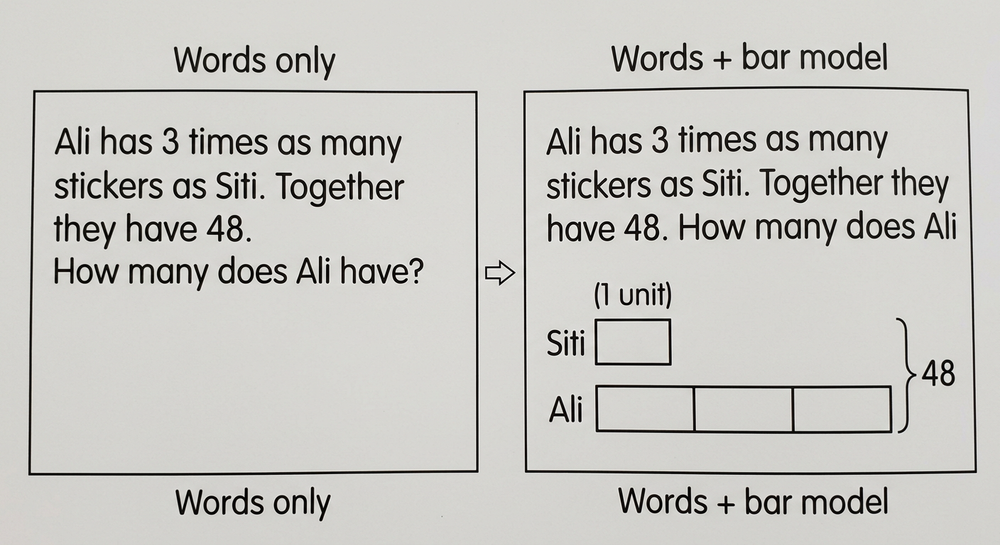
So the boy with the word problems doesn't need a picture-only diet. He needs the words and the model, taught together, until he can move between them himself.
Scaffolding to where the child actually is
The last piece is about load. Working memory — the small mental workspace where a child holds numbers while juggling them — is easily overwhelmed. A multi-step PSLE problem can ask a ten-year-old to hold the numbers, recall the method, track partial results, and remember what was actually asked, all at once. Tip that over, and accuracy collapses (the same overload that drives many careless mistakes).
The fix the research keeps pointing to is the worked example — showing a fully solved problem, step by step, before asking the child to fly solo. It lightens the load while the method is still new, and it's one of the better-evidenced moves in teaching (cognitive load theory, Sweller). You scaffold to the child's current level: more worked steps when it's new, fewer as they get steady, until the support comes away. That's real personalisation — fitted to this child's level and pace, not to a label.
Where personalisation is real — and where IllumiTutor fits
When IllumiTutor's live AI tutor "adapts to how your child learns", it does not quietly decide your child is a visual or kinaesthetic type and then pour everything down that one pipe. There's no VARK quiz, because there's nothing reliable to detect.
What it actually does is the thing the evidence supports. When a child is stuck, it switches representation — restates the idea in plainer words, then draws it as a bar model, then walks a worked example. It adjusts the pace, slowing down and adding steps when a child is wobbling. It scaffolds to the child's current level rather than the level the worksheet assumes. And it reaches for examples that fit — re-explaining "times as many" with the football stickers a particular child cares about. That's the honest, defensible meaning of "personalised to how your child learns": personalising how a concept is explained, how fast, and with which examples — not sorting a child into a fixed bin. The same principle is why, when papers come back wrong, studying the mistakes beats simply doing more papers.
Common mistakes I see
Labelling a child a "visual learner" and only ever showing pictures. The label was shaky to begin with, but acting on it does real harm: a child who's only ever fed diagrams never builds fluency with the words, and PSLE papers are full of words. Give both channels, always.
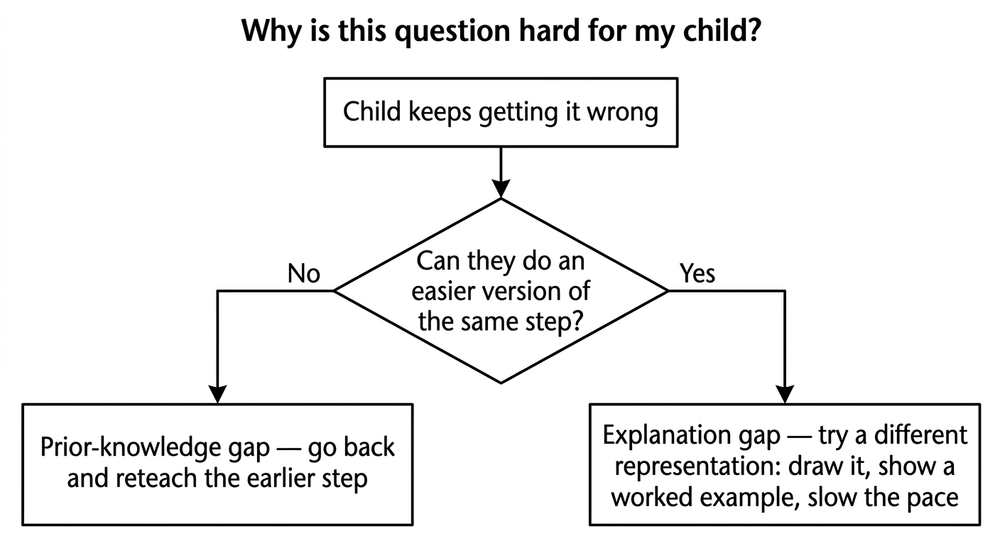
Mistaking a knowledge gap for a style. "He's just not a numbers person" almost always means an earlier step was never made solid. Before you accept a verdict on your child's brain, check whether they can do an easier version of the same step. If they can't, you've found a gap, not a type.
Pitching at the wrong developmental stage. Pushing abstract units-and-algebra onto a P3 who needs counters on the table — or babying a P6 with picture-only explanations they've outgrown. Match the explanation to where the child actually is, and move it up as they grow.
Treating a preference as a prescription. Your child saying "I like videos" is fine information. It is not an instruction to remove reading, writing, and worked practice from their week.
Reaching for a "style" instead of feedback. A child improves fastest with clear, specific feedback on this attempt — not by being re-sorted into a learning category. Tell them exactly where the unit was dropped or the keyword misread, and let them try again.
What to do this week
Take the subject your child "isn't good at" and run the one diagnostic that beats any style quiz. Pick a question they got wrong, then hand them a clearly easier version of the same step. If they can do it, the issue is the explanation — try a second representation (say it in words, then draw it, then show a worked example), and slow down. If they can't do the easier version, you've found the real culprit: a prior-knowledge gap. Go back one rung and reteach it before touching the hard question again.
Do that across a week and you'll stop sorting your child into a box and start finding the actual gaps — which is the only thing that ever moves a mark. And as the exam gets closer and the panic to "do more" rises, keep this in your pocket: a calm, gap-by-gap last-100-days plan built on what your child specifically doesn't know yet will always beat a stack of papers aimed at a learning style that was never there.
Keep learning
Related PSLE guides
Why More PSLE Practice Papers Aren't Raising Your Child's Score
Fifteen assessment books and the score hasn't budged. Here's why more PSLE practice papers stop working — and what actually moves the mark.
14 Jun 2026 · 10 min read

PSLE Exam Week: What to Do the Night Before Each Paper
A teacher's night-before-and-morning-of routine for PSLE exam week — what to pack, light review not cramming, sleep, breakfast, arriving early, and staying calm paper to paper.
8 Sept 2026 · 10 min read
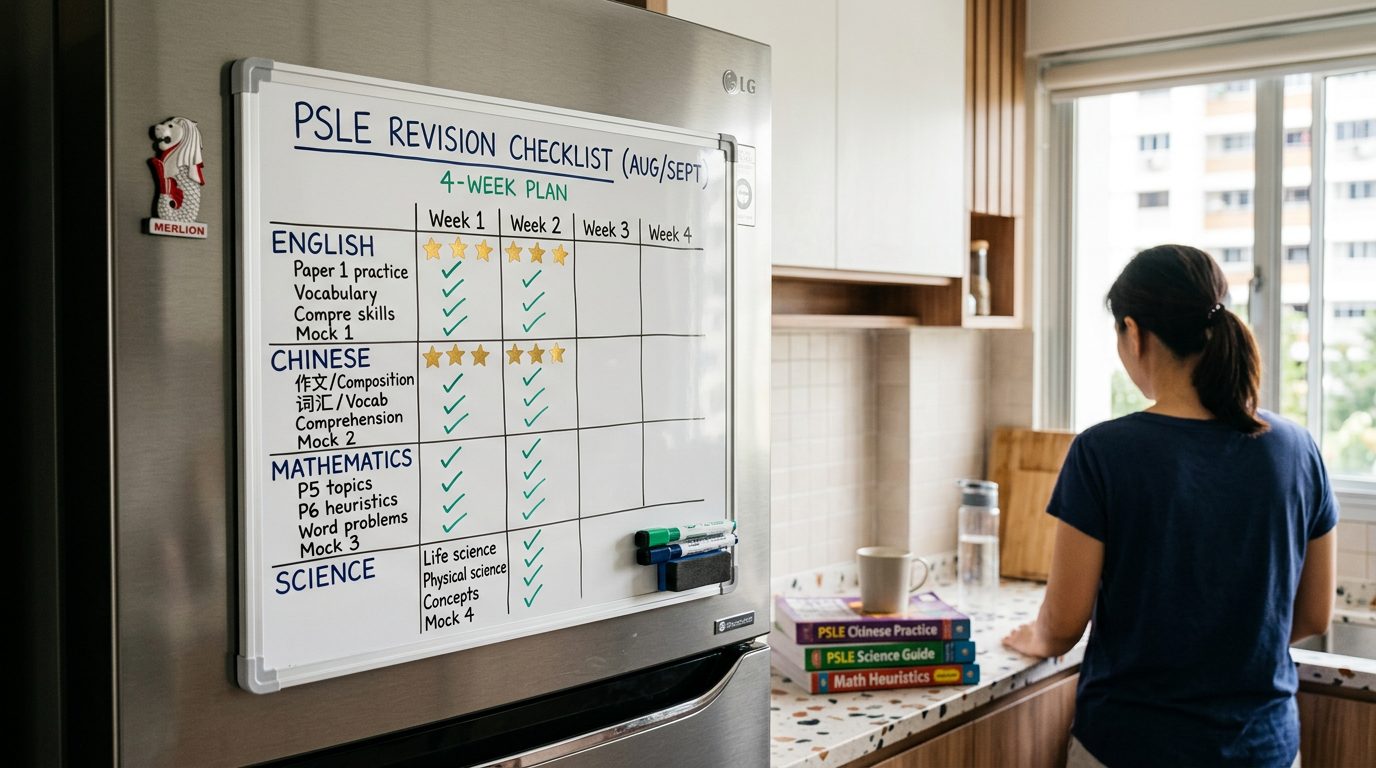
The Final 4 Weeks: a Subject-by-Subject PSLE Checklist
With orals done and the written papers weeks away, this is consolidation season, not new-content season. A subject-by-subject checklist for the last month — and the band-boundary targeting that actually moves a score.
1 Sept 2026 · 10 min read

Managing PSLE Exam Stress: a Calm Final-Stretch Plan
How to keep your child — and yourself — calm in the last few weeks before the PSLE: sleep, routine, realistic expectations, and the signs that worry has tipped past normal nerves.
18 Aug 2026 · 10 min read