Exam Strategy · 10 min read
Why More PSLE Practice Papers Aren't Raising Your Child's Score
A mother showed me a photo on her phone last year: a shelf of assessment books, fifteen of them, every one bought for her P6 daughter. "We've done almost all of them," she said. "Her Maths is still AL5. What more can I buy?" That last question is the one I want to take apart, because the honest answer is nothing — another book won't fix it, and a sixteenth practice paper is the least useful thing she could do next.
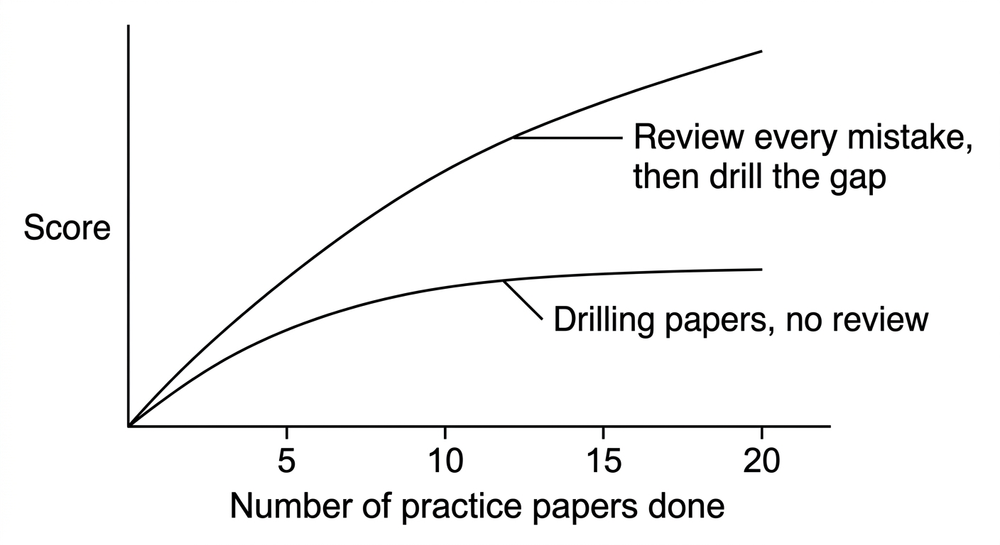
This goes against the grain of how revision works in most Singapore homes, so let me say it plainly. Past a certain point, more PSLE practice papers do not raise the score. The child who does ten papers and reviews none of them learns almost nothing from the tenth that they didn't already know at the first. The mark only moves when the practice is aimed — when a child finds out exactly which marks they keep losing, and then drills that, not another full random paper. The volume isn't the lever. The aim is.
Why more PSLE practice papers stop working
Think about what actually happens when a child sits a fresh paper cold. They meet a mix of questions — some they can already do, some they can't — in roughly the same proportion as their current ability. They get the doable ones right, get the hard ones wrong, write a score in the corner, and that score simply confirms where they already were. Nothing about the sitting targets the gap. You've spent ninety minutes re-measuring the problem instead of fixing it.
It gets worse if the wrong answers go unreviewed. A child who does ten papers and never looks back at the mistakes is rehearsing those mistakes ten times. They're not getting better at the thing they keep getting wrong — they're grooving the wrong habit deeper. This is the finding behind decades of memory research: the learning happens during retrieval and review, not during raw repetition. Henry Roediger and Jeffrey Karpicke's well-known experiments showed that students who were tested and then saw where they'd gone wrong retained far more than students who simply re-studied the same material the same number of times — even though the re-studiers felt more confident. Confidence and competence came apart. A paper done and discarded throws away the single most valuable thing it produced: the list of your child's specific errors.
The trap is that doing papers feels productive
Here is the part parents find hardest to accept, because it contradicts what their eyes are telling them. Doing papers feels like progress. It's busy, it's measurable, it's tiring — and we mistake all three for learning. Psychologists call this the fluency illusion: when something feels easy and familiar, we read that fluency as mastery. A child who re-does a paper they've seen before sails through it, feels sure, and reports that the topic is "settled." Robert Bjork's work on learning and metacognition shows exactly this — familiarity is a terrible signal for what you can actually reproduce under pressure. Recognising an answer is not the same as being able to produce it cold, three weeks later, in an exam hall.
So a child can do paper after paper, feel more and more confident, and be no readier. The good feeling comes from re-treading ground they already know. The marks they're losing sit in a small number of specific places — and those places never get touched, because a full random paper spends most of its questions on things the child can already do.
What actually moves the mark: aim, not volume
The research that explains the fix has a name most parents haven't heard: deliberate practice. Anders Ericsson, who spent his career studying how people get genuinely good at hard things, found that it's never mindless repetition that produces expertise. It's practice with a sharp, narrow goal — a specific weakness — done with immediate feedback, then repeated until the weakness closes. Not "do more." Do the right thing, on the exact gap, with someone showing you what went wrong.
There's a second pillar from the cognitive-science side. In 2013, John Dunlosky and colleagues reviewed the whole field of study techniques and ranked them by how much they actually help. Two came out on top for nearly every student, subject and age: retrieval practice (testing yourself, then checking) and spaced practice (spreading it out instead of cramming). Notice what didn't top the list — re-reading, and sheer hours. The win isn't volume. It's retrieving, finding out where you were wrong, and coming back to that exact spot after a gap.
Put those two findings together and you get the whole strategy: every wrong answer is a signpost to a specific weakness; the highest-yield thing your child can do is review why it was wrong, then practise that narrow gap — rather than reach for another full paper that's 80% revision of things they already know.
A worked example: the mark lost three times
Let me make this concrete with a real pattern I saw more times than I can count. A P6 boy, doing his Maths papers diligently. In a speed-and-distance question, the answer was 12 km/h. He wrote 12. No unit. The marker takes the method mark but withholds the final accuracy mark — minus one. The next paper, a different question, same shape: answer is 12, he writes 12, minus one. Third paper, same thing.
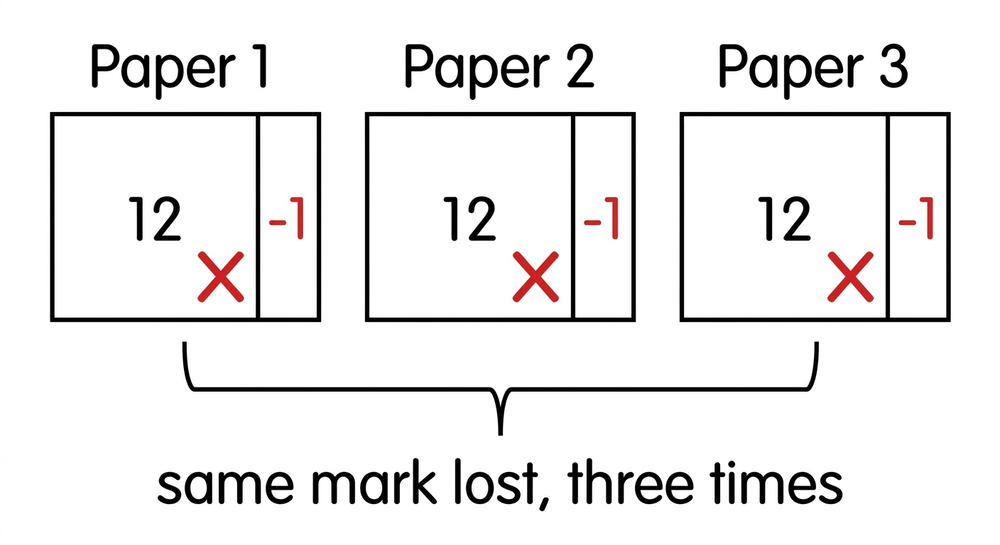
Across three papers he quietly lost three marks to the same thing — writing the number and forgetting the unit. Nobody caught the pattern, because nobody was reading across the papers; everyone was looking at the corner score, which bounced around for unrelated reasons. Three full papers, ninety minutes each, and the actual lesson — always write the unit — was sitting there in plain sight the whole time, costing a mark a paper.
Now do the arithmetic that matters. In Maths, the gap between AL5 (65–74) and AL4 (75–79) can come down to a handful of marks. A child leaking one mark a paper to a habit nobody's named could be a full Achievement Level lower than they should be — not because they don't know the maths, but because no one stopped to read across the mistakes and fix the one repeating habit. A sixteenth paper does nothing here. Five minutes spotting the pattern, and one week of deliberately writing the unit on every single answer, fixes it for good.
This is the kind of cross-paper pattern that's easy to miss at the kitchen table and easy to surface when something sits with the child on the exact questions they got wrong. It's the whole reason IllumiTutor's live tutor can work through a child's wrong answers with them — naming why the mark went, then generating a short, targeted set of questions on that one weak spot — instead of handing over another full random paper. The point isn't more practice. It's practice aimed at the gap the mistakes keep pointing to.
Common mistakes
Mistaking volume for progress. Fifteen assessment books, mostly done, score unmoved — that's the signature of this mistake. The number of papers completed is the least informative thing on the shelf. Two papers fully reviewed and drilled beat ten done-and-discarded.
Never reading across the errors. One wrong answer is data. The same wrong answer in three papers is a diagnosis — and you only see it if you look across papers, not at each score in isolation. The repeating mistake is the most valuable thing the papers produce.
Re-doing papers the child can already do. It feels great and teaches nothing. That fluent, confident run-through is the fluency illusion at work. Aim practice at what's missed, not at re-confirming what's already solid.
Treating careless and conceptual errors the same way. "12" with no unit is a careless slip — it needs a habit, not reteaching. Not knowing how to set up the model is conceptual — it needs reteaching, and more papers won't supply it. (We go deeper on the careless kind in our guide to learning from mistakes in PSLE Maths.) Sort the error first; the fix follows from the type.
Cramming papers into the final fortnight. The spacing research is blunt about this: the same practice spread over weeks, with gaps, sticks far better than the same practice piled into one week. Doing eight papers in the last fourteen days is close to the least efficient way to use them.
What to do this week
Pick one paper your child has already done and "finished." Don't do a new one. Re-mark it honestly to the scheme — the way the PSLE marker will, withholding the mark for the missing unit, the "give three reasons" answer that stopped at two, the un-labelled bar model. Then pull out two or three other completed papers and look for the same mistake repeating. I'd wager you find at least one, and that nobody had named it before.
Whatever you find, that's your week's revision plan — not another paper. If it's a careless habit, drill the habit: ten short questions where the only job is to write the unit every time. If it's a concept, reteach the concept, then practise a handful of questions on that one topic. Aim the practice at the gap and leave alone the things your child already gets right.
If the exam is still some months out, set the run-in up so papers land in the right order and at the right spacing rather than piling up at the end — our last-100-days PSLE revision plan lays out that timeline. And when you do return to full papers, use each one properly rather than racing to the next; our guide to how to use past papers properly walks through marking and reviewing each one so it's worth three sittings, not one.
Keep learning
Related PSLE guides
The Truth About Learning Styles (and What Actually Helps Your Child Learn)
"My son is a visual learner, that's why he can't do word problems." It's a kind thought and a tidy label — but the research doesn't support it. Here's what does.
18 Jun 2026 · 10 min read

PSLE Exam Week: What to Do the Night Before Each Paper
A teacher's night-before-and-morning-of routine for PSLE exam week — what to pack, light review not cramming, sleep, breakfast, arriving early, and staying calm paper to paper.
8 Sept 2026 · 10 min read
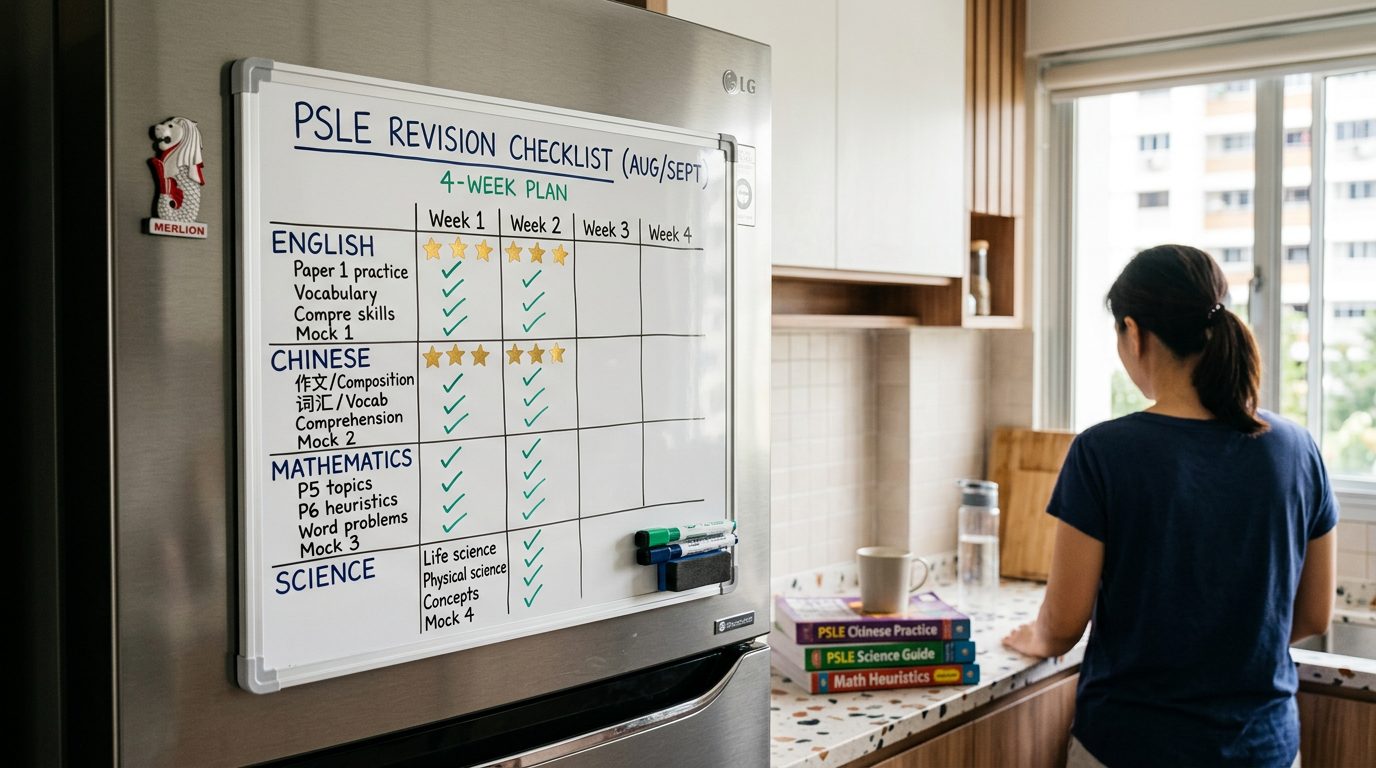
The Final 4 Weeks: a Subject-by-Subject PSLE Checklist
With orals done and the written papers weeks away, this is consolidation season, not new-content season. A subject-by-subject checklist for the last month — and the band-boundary targeting that actually moves a score.
1 Sept 2026 · 10 min read

Managing PSLE Exam Stress: a Calm Final-Stretch Plan
How to keep your child — and yourself — calm in the last few weeks before the PSLE: sleep, routine, realistic expectations, and the signs that worry has tipped past normal nerves.
18 Aug 2026 · 10 min read