PSLE Math · 10 min read
Careless Mistakes in PSLE Math — and How to Stop Them
The conversation I've had most often at the marking table goes like this. A parent points at a wrong answer where the working is almost entirely correct, and says: "But he knows how to do this one. He's just careless."
They're half right. The child does know how to do it. But "careless" is the wrong word, and it points parents at the wrong fix — usually "concentrate harder" or "slow down", neither of which a worried ten-year-old can act on. PSLE math careless mistakes are not a character flaw. They are a small set of predictable, repeatable slips, and almost every one has a specific cause you can name and a specific habit that closes it.
I've marked enough scripts to tell you the gap between a strong child's actual mark and the mark they should have got is rarely a maths gap. It's a checking gap. So let's stop calling it carelessness, name the real errors, and fix them one at a time.
The errors aren't random — there are about six of them
When you sort a stack of marked papers by what actually went wrong, the same culprits show up again and again. Knowing the list matters, because a child who knows which traps they personally fall into can watch for them. "Be careful" is useless advice. "Check your units" is not.
Mis-copying a number. The single most common slip. The question says 16, the child writes 19. Or the working is perfect and the child copies the correct answer onto the answer line wrongly — gets it right, writes it wrong. It also hides between lines of working: a carried digit lost on the way down, a 1,000 whose zeros are written like sixes and become 1,666 on the next line.
A missing or wrong unit. The number is right; the answer reads "30" instead of "30 cm", or "30 cm²" for a perimeter that should be "30 cm", or the working was in grams when the question wanted kilograms. Booklet B and Paper 2 both remind candidates in print to give units, so this is a mark the paper practically hands back if you ask for it.
Not answering what was actually asked. This one stings because the maths is usually right. The question asks how many sweets were left, the child gives the total. It asks for the cost of fencing the perimeter, the child finds the area. Or — the classic — the child correctly finds that 1 unit = 12 and writes 12, when the question wanted 3 units. The whole problem was solved; the last reading step was skipped.
An operation or sign slip. The child knows it should be a minus, writes a plus. Knows it's multiply, keys add. "John gave away 18" becomes 45 + 18 = 63 instead of 45 − 18 = 27. The method was sound; one symbol flipped.
A misplaced decimal point. Converting metres to centimetres, or working with money, the point lands one place off and the answer is wrong by a factor of ten or a hundred. $14.70 becomes $1.47, or $147.
A misread question. The child skims past one load-bearing word — remaining, each, altogether, not, how many more, estimate to the nearest ten — and solves a slightly different, neighbouring problem with total confidence.
Two more worth naming: a bar model with unequal or unlabelled units, where the child reads the wrong quantity off their own diagram (see the bar-model walkthrough); and a calculator mis-key in Paper 2, reading 69 off the screen and writing 96.
That's the whole zoo. Six or seven animals, and your child probably has two or three they meet again and again.
Why a capable child keeps making them
Here's the part that changes how you respond at home. These slips are not failures of effort. They're mostly failures of working memory — the small mental workspace where a child holds numbers while manipulating them.
Working memory has a hard, limited capacity, and the research on children's arithmetic is consistent: when the load gets too high, information is lost and accuracy drops. A multi-step PSLE problem sum asks a ten-year-old to hold the numbers, recall the right method, keep partial results in their head, and track what the question actually wanted — all at once. When that load tips over the edge, something falls out. The dropped unit, the lost carry, the forgotten "remaining" — those are the symptoms of an overloaded workspace, not a sloppy attitude.
Three other forces pile on. Time pressure clusters slips in the last few questions, when a child who spent too long on a hard one early is now rushing the easy marks. Shaky number facts — times tables that aren't automatic, fraction-to-decimal conversions that need thinking about — eat capacity that should go to the problem's structure. And checking wrong: a child who re-reads their working the same way they wrote it will cheerfully reproduce the original error. Re-reading is not checking.
The slips, with the fix written next to them
Here are the patterns with real numbers — the wrong version and the right one.
The "find 1 unit, forget to scale up" slip. A ribbon is shared so that 7 units = 84 cm; find the longer piece, which is 3 units.
- Careless: 1 unit = 84 ÷ 7 = 12, answer 12 cm. The child stopped one step short.
- Fix: Underline "3 units" when you read the question, and finish the multiply: 3 × 12 = 36 cm.
The missing unit. A rectangle is 9 cm by 6 cm; find the perimeter.
- Careless: 2 × (9 + 6) = 30, written as "30" — or worse, "30 cm²".
- Fix: A units-last check. Perimeter is a length, so the answer is 30 cm. Length is cm, area is cm², volume is cm³ — match the unit to the question.
The decimal that drifts. 3.5 m of cloth costs $4.20 per metre; find the total.
- Careless: the point lands wrong — "$1.47" or "$147".
- Fix: Estimate first. About 4 m at about $4 is roughly $16, so the answer should sit near $15. The real answer, $14.70, passes. $1.47 and $147 don't — the estimate catches them instantly.
The fraction added straight across. Compute 2/3 + 1/4.
- Careless: add tops and bottoms — 2/3 + 1/4 = 3/7. A P5 pupil will write this and feel completely sure.
- Fix: Common denominator of 12. 2/3 = 8/12, 1/4 = 3/12, so the answer is 11/12 — which is more than a half, a quick sanity check that 3/7 fails.
In every case the maths was within reach. What rescued the mark was a habit fired at the right moment — underline what's asked, check the unit, estimate, sanity-check the size.
Checking that actually works (not "check your work")
"Check your work" is the instruction every child has heard and none can follow, because it doesn't say how. A real checking routine is specific, teachable, and small enough to run under exam pressure. Here's what I drill.
Read in four moves, before any working. Read once for the picture. Read again and underline the given numbers. Circle the actual question word — left, remaining, each, altogether, how many more, estimate. Then note the unit you're finding. Most "answered the wrong thing" errors die right here.
Estimate first, sanity-check after. A rough guess before calculating gives you a yardstick. If the worked answer lands wildly off the estimate — the decimal-point disasters above — you know to redo it before you've even finished checking.
Re-do, don't re-read. When checking, re-work the calculation or mentally re-walk the steps. Don't skim the same line of working, because skimming reproduces the original slip. This is the single most important checking habit and the one children resist most.
Check units last, on every answer. Write the unit next to the number as you go, not only at the end — it doubles as a reminder of what the question asked. Final pass: confirm every answer carries the right unit.
Budget the time, and skip-and-return. Roughly a minute per mark. If a question runs past two or three minutes, mark it and move on — protect the easy marks and protect a five-to-ten-minute checking window at the end, and use it on every question, even the confident ones.
Common mistakes I see again and again
Doing multi-step sums in the head to "save time". Anxious children near the exam skip written working — then lose far more time untangling a jammed mental calculation than a clean line ever costs, and forfeit the method marks. The paper is there to hold the load. Use it.
Checking by re-reading. As above: re-reading the same working in the same direction confirms the original mistake. Redo the step, or work backwards from the answer.
Treating units as optional. Units feel like a formality to a ten-year-old, so they get dropped first under pressure. They are real marks, and Booklet B and Paper 2 ask for them in print.
Solving the wrong question with great care. A perfectly worked answer to "the total" when the question wanted "how many were left". The maths is faultless; the mark is gone. Circling the question word prevents it.
No record of which mistakes recur. Without an error log, every paper feels like fresh, random bad luck. It isn't — each child has two or three signature slips, and naming them is half the fix.
What to do this week
Pull out your child's last three marked maths papers and do one thing: sort the lost marks into the buckets above. Was it a missing unit? A misread keyword? A find-1-unit-stop-too-early? Don't re-teach the maths — most of it was already right. You're looking for the pattern. Almost every child has two or three recurring slips, and once you can name them ("you keep dropping the unit", "you keep answering the total instead of what's left"), your child can watch for them in a way that "be careful" never allowed.
Then, for the next week of practice, change one rule: every answer must carry its unit and a one-line working-out, and the last five minutes of every practice paper are spent re-doing — not re-reading — the trickiest two questions. That's it. You'll see the "careless" marks start coming back. And when you want a steady supply of real questions to practise this on, past-year papers are exactly the right grain — old enough to be tested, hard enough to surface the slips that matter.
Keep learning
Related PSLE guides

PSLE Math Speed & Rate Problems Made Simple
Speed questions aren't hard arithmetic — they're a handful of traps dressed up as word problems. Here's how I teach P6 children to walk past every one of them.
25 Aug 2026 · 9 min read
Fractions, Ratio & Percentage: the PSLE Topics That Trip Kids Up
Fraction-of-remainder, ratio-as-units and percentage change look like three separate topics. They're the same idea wearing three costumes — and here's where children lose the marks.
23 Jun 2026 · 10 min read

PSLE Math Heuristics Every P6 Should Know
The handful of problem-solving strategies that decide most of Paper 2, explained the way I'd explain them to a P6 child at the kitchen table.
16 Jun 2026 · 10 min read
Solving PSLE Math Problem Sums: the Model Method, Step by Step
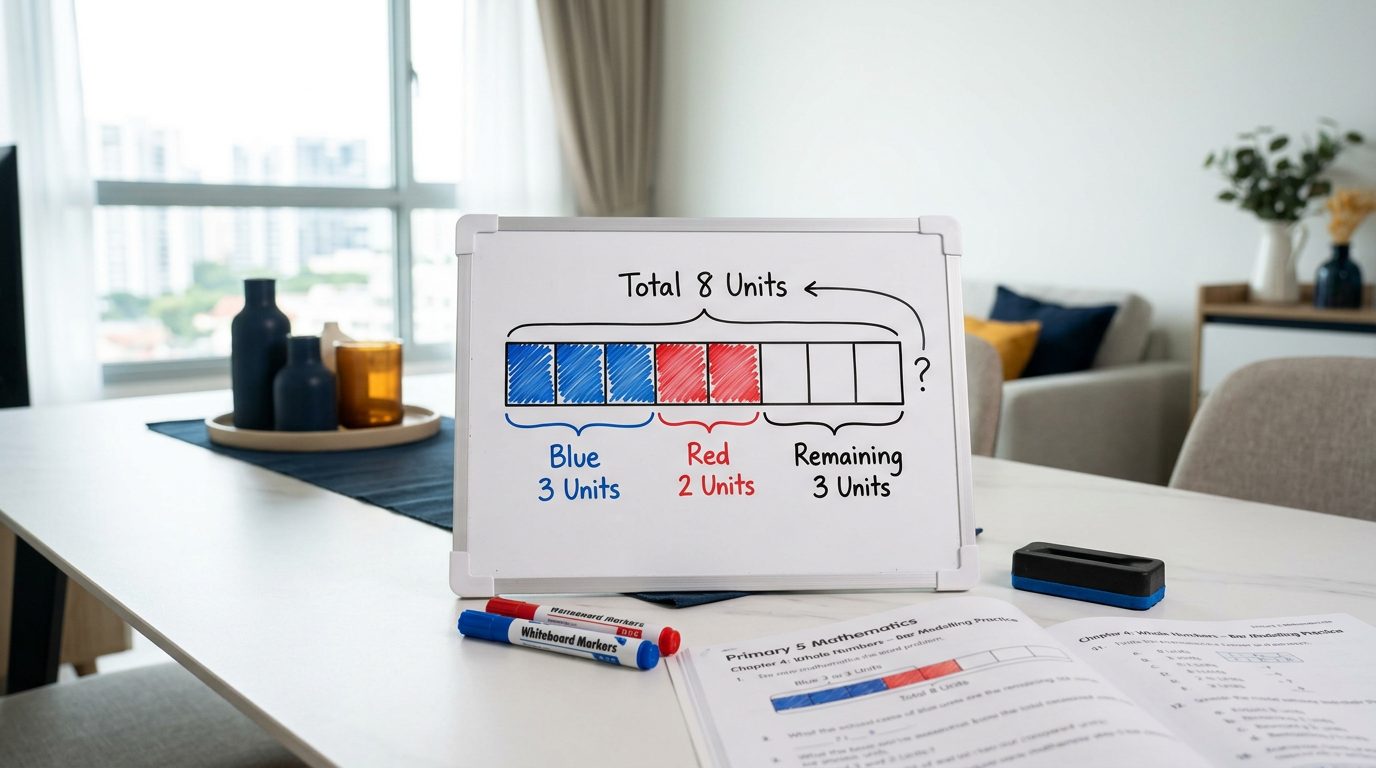
Why the strong P6 pupils reach for a pencil before a number, and how the bar model turns a wall of words into a problem a child can actually solve.
17 Feb 2026 · 9 min read