PSLE Math · 10 min read
Fractions, Ratio & Percentage: the PSLE Topics That Trip Kids Up
A parent showed me her daughter's marked paper last year, genuinely puzzled. "She's good at fractions. She can simplify, she can add them, she knows her times tables cold. So why is she losing four marks on every word problem?" I read the question her daughter had got wrong. It said one-third of the remainder. The girl had worked with one-third of the whole. Two words — "the remainder" — and the entire answer was off.
That's the thing about PSLE fractions, ratio and percentage. The arithmetic is rarely the problem. By P6, most children can do the sums. What trips them up is reading the relationship correctly, and then holding it steady while the numbers move around. These three topics cause more quiet, avoidable mark loss than any others in the paper, and the reason is the same reason for all three.
Why these three topics are really one topic
Here is the idea that unlocks everything: fractions, ratio and percentage are three ways of describing the same thing — parts of a whole.
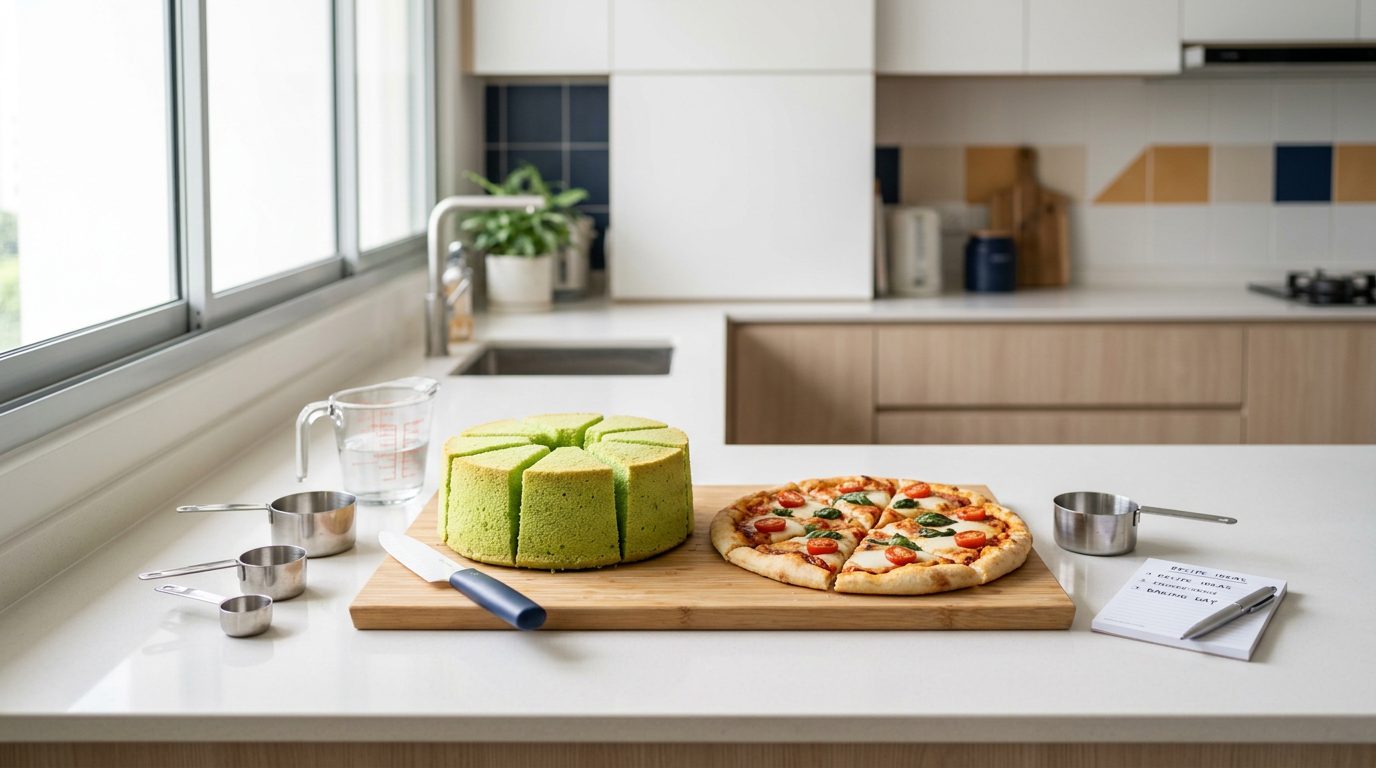
Cut a cake into 5 equal slices and take 2. You can say you took 2/5 of the cake. You can say the slices you took and the slices left are in the ratio 2 : 3. You can say you took 40% of it. Same cake, same cut, three languages.
The strong pupils know this in their bones, which is why they convert freely between the three without panic. "3/8 of the class are boys" and "the boys and girls are in the ratio 3 : 5" are, to them, the same sentence. Once a child sees that, half the difficulty drops away — because the moment any of these problems gets hard, the move is always the same: turn the fraction, ratio or percentage into equal units, then find what one unit is worth.
That's the engine under all of it. A fraction tells you how many units the whole splits into. A ratio tells you the units directly. A percentage is just units out of a hundred. Find the value of one unit, and the rest is counting boxes. If your child has met the model method for problem sums, this is the same machinery — the bar just gets relabelled.
Fractions: the "of the remainder" trap
Let me go back to that mother's question, because it's the single most common fraction error I saw, year after year.
There is a world of difference between these two sentences:
- "He spent 1/4 of his money on a book." → 1/4 of the total.
- "He spent 1/4 of the remainder on a book." → 1/4 of what was left after something else.
A child who reads too fast treats them as the same. They're not, and the bar model shows exactly why. Here's a full problem worth working through.
Daniel spent 1/4 of his money on a book. He then spent 2/3 of the remainder on a toy. He had $15 left. How much money did he have at first?
Draw one bar for all his money and split it into 4 equal units. The book is 1 unit. That leaves 3 units — and this is the remainder. The toy is 2/3 of those 3 units, which is 2 units. So the toy takes 2 of the 3 remaining units, and what's left is the last single unit.
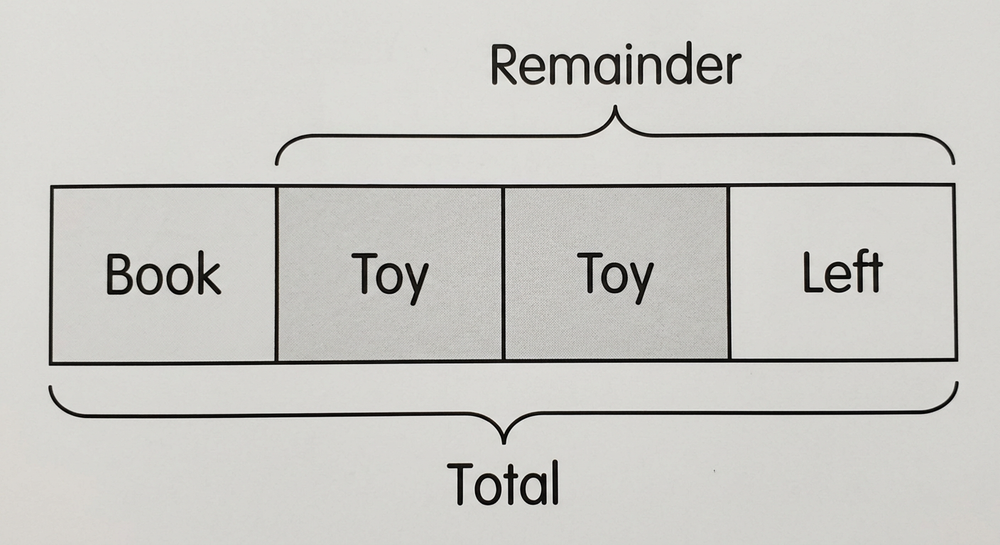
Now the picture does the talking. The $15 left over is 1 unit. So:
- 1 unit = $15
- Total = 4 units = 4 × $15 = $60
Quick check against the story: he starts with $60, spends 1/4 ($15) on the book, leaving $45. Then 2/3 of $45 is $30 on the toy, leaving $15. It matches. The trap was never the arithmetic — it was whether the child anchored the second fraction to the remainder (3 units) or wrongly to the whole (4 units). One careless reading and the toy becomes 2/3 of everything, and the answer collapses.
The other fraction tell I'd watch for: a pupil who can compute 2/3 + 1/4 on a bare-sums worksheet but freezes when those same fractions live inside a word problem. That's the signal that they've learned fractions as a procedure but not as units of a whole. The bar model is the bridge — it makes the denominator visible as "how many equal parts", which is the understanding the procedure was hiding.
Ratio: think in units, and watch what stays the same
Ratio is where the syllabus turns the screw. From 2026, ratio is consolidated entirely into P6 — the whole strand, from basic notation to the hard before-and-after problems, now lands in a single concentrated year rather than being spread across P5 and P6. That makes the term denser, and it makes getting the core idea early more valuable than ever.
The core idea is small: a ratio is just units. "Ali and Bala have money in the ratio 7 : 5" means Ali has 7 units and Bala has 5 units of the same size. The child's job is to find what one unit is worth, exactly as with fractions. Most ratio mistakes come from skipping that step and treating the ratio numbers as if they were the actual amounts.
The genuinely hard ratio questions are the before-and-after ones, where the numbers change partway through. These cause real trouble, and the way through is one disciplined question: what stays the same? Three things commonly do.
The total stays the same when money or items are simply transferred from one person to another — nothing enters or leaves, it just moves. Here's one that computes cleanly:
Amir and Bala share some money in the ratio 7 : 5. Amir gives Bala $24, and now they have equal amounts. How much did they have altogether?
Nobody spent anything — the money only moved — so the total is constant at 7 + 5 = 12 units throughout. After the transfer they're equal, so they have 6 units each. Amir dropped from 7 units to 6 units, a fall of 1 unit, and that fall is the $24 he handed over.
- 1 unit = $24
- Total = 12 units = 12 × $24 = $288
Check it: Amir had 7 × $24 = $168, gives away $24, keeping $144. Bala had 5 × $24 = $120, receives $24, reaching $144. Equal, and the total $288 never budged. The whole problem turned on spotting that the total — not either person's share — was the fixed thing.
One part stays the same when only one person's quantity changes (Bala spends some money but Amir doesn't touch his). There, you make the unchanged part match across the before and after ratios, then read off the change. The difference stays the same in age problems — your child is always exactly the same number of years younger than you, this year and forever — so the gap is the anchor.
This is the same "find what doesn't change" discipline the P6 heuristics lean on so heavily — it shows up across the whole paper, not just in ratio.
Percentage: the same machinery, in hundredths
Percentage tends to feel like a third, separate topic to children. It isn't. A percentage is a fraction with a denominator quietly fixed at 100, so the same unit thinking carries straight over. 25% is 1/4 is the ratio 1 : 4 against the rest. Children who've been taught to see this stop being scared of percentage questions.
Two spots reliably lose marks. The first is percentage of a percentage — "20% of the remaining 80%" — which is the same "of the remainder" trap from fractions, just wearing a percent sign. The second is percentage change, where a child computes the change but then divides by the wrong number. The rule worth drilling: percentage increase or decrease is always change ÷ original × 100, and the original is the before value, not the after. A price rises from $40 to $50: the change is $10, over the original $40, which is a 25% increase — not 20%. Dividing by the new $50 is the classic slip.
Common mistakes I see again and again
Attaching a fraction or percentage to the wrong whole. "Of the remainder" and "of the rest" get read as "of everything". This one error probably costs more marks than any other in the topic.
Treating ratio numbers as actual amounts. Reading "7 : 5" as "$7 and $5" instead of "7 units and 5 units, and I must find one unit first." The unit step is the whole method; skipping it skips the maths.
Not finding what stays the same in before-and-after problems. Diving into the numbers without anchoring on the constant — the total, the unchanged part, or the difference — and ending up with two pictures that don't connect.
Dividing percentage change by the new value. Change over original, always. A rise from 40 to 50 is 25%, not 20%.
Stopping one step short. Finding 1 unit, then writing that as the answer — when the question asked for the total, or for one person's share, which is several units. After finding 1 unit, re-read: how many units do they actually want?
What to do this week
Skip the worksheet of bare fraction sums for now — your child can probably do those. Instead, pull out their last marked maths paper and find the word problems involving fractions, ratio or percentage that they got wrong. For each one, don't re-teach the answer. Ask two questions only: "How many equal units is the whole?" and, if it's a before-and-after problem, "What stays the same here?"
If they can answer those two reliably, the marks will come — the arithmetic was never the issue. If they stumble on them, you've found the real gap, and it's a far more useful thing to practise than another twenty random sums. Spend ten minutes a day for a week just on that reading-the-relationship step, bar model in hand, and watch how the careless four-mark losses start to disappear.
Keep learning
Related PSLE guides

PSLE Math Speed & Rate Problems Made Simple
Speed questions aren't hard arithmetic — they're a handful of traps dressed up as word problems. Here's how I teach P6 children to walk past every one of them.
25 Aug 2026 · 9 min read

Careless Mistakes in PSLE Math — and How to Stop Them
The marks a strong P6 child loses are rarely about ability — they're a missing unit, a misread keyword, a "find 1 unit, forget to scale up". Here's how to stop them.
21 Jul 2026 · 10 min read

PSLE Math Heuristics Every P6 Should Know
The handful of problem-solving strategies that decide most of Paper 2, explained the way I'd explain them to a P6 child at the kitchen table.
16 Jun 2026 · 10 min read
Solving PSLE Math Problem Sums: the Model Method, Step by Step
Why the strong P6 pupils reach for a pencil before a number, and how the bar model turns a wall of words into a problem a child can actually solve.
17 Feb 2026 · 9 min read