
PSLE Math · 10 min read
PSLE Math Heuristics Every P6 Should Know
A parent once slid a marked paper across the table to me and asked, almost apologetically, "He knows his times tables, he can do the sums in the practice book — so why does he freeze on the last few questions in Paper 2?" I've heard a version of that question hundreds of times. The honest answer is that the back end of Paper 2 isn't testing whether a child can calculate. It's testing whether a child knows which approach to reach for when the question doesn't tell them what to do.
That's what PSLE math heuristics are. Not tricks — they're the named problem-solving strategies the Singapore curriculum has taught since the 1990s, and they're the difference between a child who has a plan when a hard question lands and one who stares at it hoping the answer will surface. A P6 child who genuinely owns five or six of these walks into the exam calmer, because nothing on the paper is shapeless to them anymore.
What "heuristics" actually means in the Singapore syllabus
The word sounds grander than it is. MOE's mathematics framework groups its problem-solving heuristics into a few families — give a representation, make a calculated guess, go through the process, and change the problem — and lists around a dozen specific strategies underneath them. Your child doesn't need to recite the list. They need to recognise, fast, which tool a question is quietly asking for.
These are the ones that earn their keep at PSLE, the ones I'd make sure any P6 child could use without prompting:
- Draw a model or diagram — turn the words into a picture.
- Make a systematic list or table — when there are several cases, write them all out in order.
- Guess and check — make a sensible trial, test it, adjust.
- Make a supposition (the assumption method) — assume one thing is true, then fix the gap.
- Work backwards — start from the end and reverse the steps.
- Use the before-after concept — compare a quantity at two points in time.
Six strategies. Master those and you've covered the overwhelming majority of what the non-routine questions throw at a P6 child.
Draw a model: the strategy under everything else
I won't spend long here, because the bar model deserves — and has — its own piece. But it has to lead the list, because it's the heuristic that the others lean on. A problem sum is a story, and a ten-year-old's working memory drops things. The model turns the story into a picture you can hold all at once.
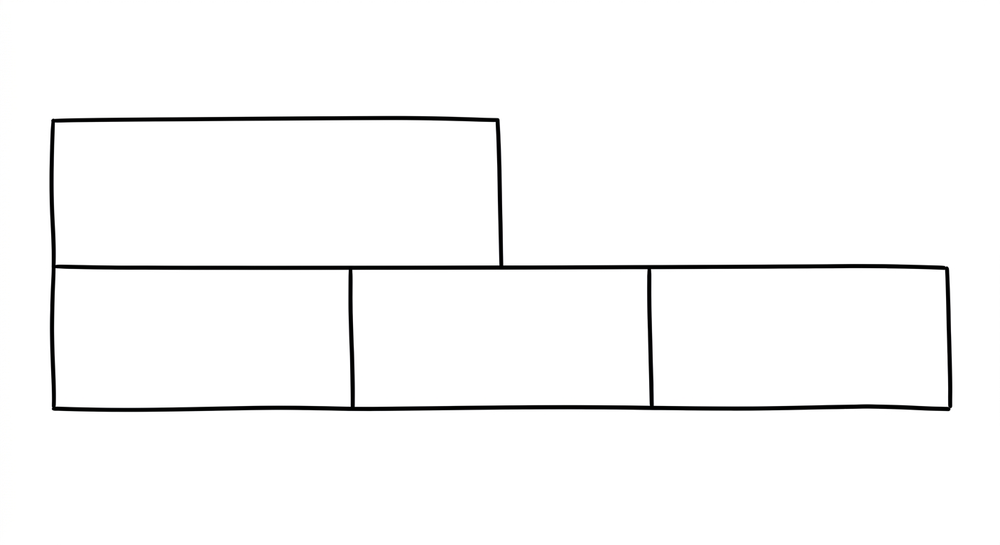
I rate it above every other heuristic because it makes the thinking visible. A child who draws the bar can pick up method marks even when the final number slips; a child who keeps everything in their head has nothing to show the marker. If your child is shaky on this one, start there — I've written the full step-by-step walkthrough in the model method, explained.
Guess and check: sensible trials, not wild ones
Some questions resist a clean model. The classic is the legs-and-heads type: a number of animals, a number of legs, find how many of each. Guess and check is exactly what it sounds like — but the marks are in the word check, and in keeping the guesses tidy in a table.
A farm has 12 animals, some cows and some ducks. Altogether there are 38 legs. How many cows are there?
A cow has 4 legs, a duck has 2. The child makes a first sensible guess — say 6 cows and 6 ducks — and tests it:
- 6 cows, 6 ducks → (6 × 4) + (6 × 2) = 24 + 12 = 36 legs. Too few.
Too few legs means too few cows, so nudge the cows up:
- 7 cows, 5 ducks → (7 × 4) + (5 × 2) = 28 + 10 = 38 legs. Correct.
So there are 7 cows. The skill I drill here isn't the guessing — it's reading the result. "Too few legs, so add cows" is the move that turns random trial-and-error into a method that converges in two or three steps. A child who guesses without using the previous result to steer the next guess can sit there for ten minutes.
Supposition: the faster cousin of guess and check
The same cows-and-ducks problem has a more elegant solution that older or stronger P6 children love, and it's worth teaching as a second gear. The supposition method — sometimes called the assumption method — means you assume something untrue, then correct for the gap.
Assume all 12 animals are ducks. Then there'd be:
- 12 × 2 = 24 legs.
But the problem says 38 legs, so we're short by 38 − 24 = 14 legs. Every time we swap a duck for a cow, we add 2 legs (a cow has 4, a duck has 2). So:
- 14 ÷ 2 = 7 cows.
Same answer, no table, far quicker once it clicks. I teach guess and check first because every child can do it, then offer supposition to the ones who are ready — it's the strategy that buys time on a paper where time is tight. The trap is the per-swap difference: children who divide 14 by 4 (a cow's legs) instead of by 2 (the difference between a cow and a duck) get it wrong every time. Anchor on the difference, not the total.
Work backwards: when the question hands you the ending
Some problems give you the final amount and a chain of things that happened to get there, then ask what you started with. The "at first" and "in the end" wording is the signal. The strategy is to reverse the story, step by step, undoing each operation.
Aiden had some marbles. He gave half of them to his brother, then bought 8 more, and ended up with 20 marbles. How many did he have at first?
Read it forwards and it's a tangle. Read it backwards and it unravels. He ended with 20. The last thing he did was buy 8, so before that he had 20 − 8 = 12. Before that he'd given away half, meaning 12 is the half he kept — so at first he had 12 × 2 = 24 marbles.
The whole method is doing the opposite operation in the opposite order: undo the last step first, work towards the start. Children who try to plough forwards from "some marbles" end up writing an equation they can't yet solve. Backwards, it's three small steps of arithmetic.
Before-after: anchor on what doesn't change
The hardest heuristic for most P6 children, and the one that separates the top band, is the before-after concept. These are problems where something shifts — money is transferred, a ratio changes after someone spends or gains, ages move forward. The picture from "before" no longer matches the picture from "after", and that's exactly what trips children up.
The key — the thing I'd write at the top of any revision card — is to find the quantity that stays the same. When two people share a pot of money and one gives some to the other, the total between them is unchanged. When you're told two people's ages, the gap between them never changes — your child is the same number of years younger than you this year and in thirty years. Pin the model to that unchanged quantity, keep it the same size in both pictures, and the problem has a fixed point to solve around. Miss the constant and you're comparing two unrelated drawings.
This is genuinely demanding multi-step reasoning, and it's deliberately so — Paper 2 allows a calculator precisely so the marks can reward the thinking rather than the button-pressing.
Make a systematic list: when "find all" is the real instruction
A quieter heuristic, but one that catches careless children out: questions that ask how many ways, or how many numbers, or to list all the possibilities. The instinct is to scribble a few and stop. The method is to be systematic — fix one thing, vary the rest in order, and you won't miss any or repeat.
Asked for all the two-digit numbers you can make from the digits 2, 4 and 6 with no repeats, a child who lists in order — 24, 26, then 42, 46, then 62, 64 — gets all six, cleanly. A child who lists at random writes 24, 46, 62… and either double-counts or stops at four. The order is the method.
Common mistakes I see again and again
Reaching for the wrong heuristic. A child who only knows the bar model will try to force one onto a guess-and-check problem and stall. Knowing which tool fits is the actual skill — that's why I drill recognition, not just execution.
Guessing without checking. In guess and check, children make a trial, get it wrong, and make another random trial instead of using "too high / too low" to steer the next one. The result never informs the next guess, so it never converges.
Dividing by the wrong number in supposition. As above — they divide by a cow's 4 legs instead of by the 2-leg difference. The supposition method lives or dies on subtracting the right gap.
Working forwards on a backwards problem. When a question gives the ending and asks for the start, children try to march forwards from an unknown and write an equation they can't solve. Undo the last step first.
Not finding the constant in before-after. Diving into "before" and "after" without anchoring the unchanged quantity — the total, or the age gap — leaves two pictures that don't talk to each other.
No working shown. A correct answer with no method can still drop the method mark in Paper 2, and a wrong answer with a clear table or model can still earn it. Heuristics aren't just for getting the answer — they're how the marks are awarded.
What to do this week
Pull out your child's last marked maths paper and look only at the questions they got wrong in Paper 2. For each one, don't re-teach the answer. Ask a single question: "Which strategy does this want — a model, a guess-and-check table, working backwards?" If they can name the right approach, the arithmetic is usually a quick fix and you've found that they just need practice executing. If they can't name it, that's the real gap, and it's far more useful to work on than another twenty random sums.
Then, in the run-up to the exam, weave a little heuristic naming into ordinary practice — a thirty-second "what kind of question is this?" before they touch a pencil. It costs almost nothing and it trains the most valuable instinct on the paper. If you want a fuller plan for fitting this into the final stretch, the last 100 days revision plan lays out how to spend the time.
Keep learning
Related PSLE guides
The 2026 PSLE Math Paper: the Questions That Trapped Kids, and the Method That Solves Them
The 2026 paper rewarded children who read the exact wording and named their method. Here are four questions worth studying, and how we would solve each one.
25 Sept 2026 · 11 min read
PSLE Math Speed & Rate Problems Made Simple
Speed questions aren't hard arithmetic — they're a handful of traps dressed up as word problems. Here's how I teach P6 children to walk past every one of them.
25 Aug 2026 · 9 min read
Careless Mistakes in PSLE Math — and How to Stop Them
The marks a strong P6 child loses are rarely about ability — they're a missing unit, a misread keyword, a "find 1 unit, forget to scale up". Here's how to stop them.
21 Jul 2026 · 10 min read
Fractions, Ratio & Percentage: the PSLE Topics That Trip Kids Up
Fraction-of-remainder, ratio-as-units and percentage change look like three separate topics. They're the same idea wearing three costumes — and here's where children lose the marks.
23 Jun 2026 · 10 min read