
PSLE Math · 9 min read
PSLE Math Speed & Rate Problems Made Simple
"Speed" is one of the few PSLE math topics that arrives late and leaves a mark. It only properly turns up in P6, so children meet it tired, already juggling fractions and ratio, and they meet it in the worst possible form — a wall of words about cars, trains and joggers. A parent emailed me a photo of her son's mid-year paper once with a single line: "He got the formula right and still lost three marks. How?" I knew the answer before I opened the image. He hadn't lost marks on the maths. He'd lost them on the traps — the average that isn't an average, the kilometres that should have been metres, the two cyclists he treated as one.
That's the thing about PSLE math speed problems. The arithmetic underneath is honestly not difficult. What's being tested is whether a child can read carefully, pick the right relationship, and handle units without panicking. Get those three habits in place and speed turns from a feared topic into a reliable source of marks. Let me show you how I teach it.
The one formula, and the three faces it wears
Everything in this topic grows from a single relationship:
Speed = Distance ÷ Time
That's it. The other two formulas aren't new facts to memorise — they're the same equation rearranged:
- Distance = Speed × Time
- Time = Distance ÷ Speed
I get children to anchor it to something concrete rather than chant it. If a car travels at 60 km/h, the "per hour" is the whole point: it covers 60 km in every hour. Drive for 2 hours and you've gone 60 × 2 = 120 km. Need to know how long 180 km takes at that speed? 180 ÷ 60 = 3 hours. Once a child can talk through it like that — in plain words, not symbols — they can rebuild any of the three formulas on the spot, which matters under exam stress when memory goes blank.
Units: the quiet mark-thief
Before any clever problem-solving, this is where the easy marks leak away. A speed question will happily mix km/h with minutes, or give a speed in m/min and ask for an answer in km. The numbers compute perfectly — but in the wrong unit, so the answer is wrong, and the child never sees why.
Three conversions cover almost everything at PSLE:
- Minutes to hours: divide by 60. So 45 minutes is 45 ÷ 60 = 0.75 h, not 0.45 h. This single slip costs more marks than any heuristic I know.
- km/h to m/min: a speed of 45 km/h is 45 000 m in 60 min, so 45 000 ÷ 60 = 750 m/min.
- km/h to m/s: 72 km/h is 72 000 m in 3600 s, so 72 000 ÷ 3600 = 20 m/s.
The rule I write at the top of every speed question for a struggling child is brutally simple: circle every unit in the question before you do anything else. If the speed is in km/h and a time is given in minutes, convert first, on the side, before it sneaks into a calculation. Most "careless" speed mistakes aren't careless at all — they're a unit that never got converted.
Worked example 1: a meeting problem
Here's a flavour that frightens children far more than it should — two things moving toward each other.
Two cyclists set off at the same time from two towns 210 km apart and ride straight toward each other along the same road. One rides at 45 km/h, the other at 60 km/h. How long before they meet?
The instinct is to solve two separate journeys, get tangled, and give up. The move that unlocks it is to stop thinking about two cyclists and start thinking about the gap between them.
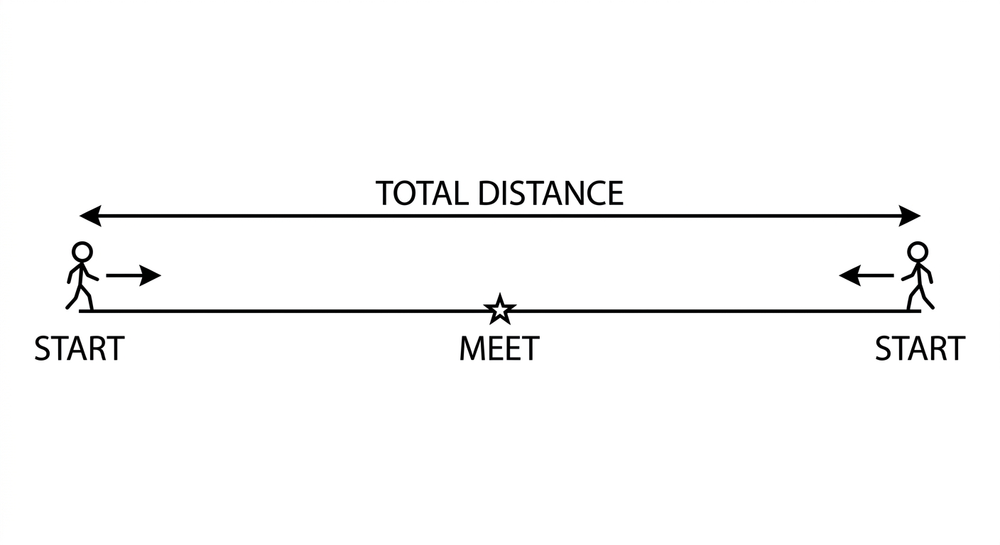
Every hour, the first cyclist covers 45 km and the second covers 60 km. So every hour, the distance between them shrinks by 45 + 60 = 105 km. That combined figure is the key. The 210 km gap, closing at 105 km each hour, takes:
- 210 ÷ 105 = 2 hours.
They meet after 2 hours. No need to track each cyclist separately — when two objects move toward each other, you add their speeds, because they're closing the gap together. (Same-direction overtaking is the mirror image, and I'll come to it.) Notice how the whole solution is one division once you've spotted the combined-speed idea. That's the pattern: the hard part is seeing it, not computing it.
Same direction: overtaking problems
The cousin of the meeting problem is overtaking — two objects moving the same way, one catching the other. A bus leaves before a car; the car is faster; when does it catch up?
The logic flips cleanly. When they move toward each other, you add the speeds. When they move the same way, you subtract — because the catch-up only happens at the difference between the two speeds. If a car does 90 km/h and a bus 60 km/h on the same road, the car gains 90 − 60 = 30 km on the bus every hour. If the bus had a 60 km head start, the car closes it in 60 ÷ 30 = 2 hours. Toward each other, add; same direction, subtract. Drilling that one distinction stops most of the confusion these questions cause.
Worked example 2: the average-speed trap
This is the single biggest banana skin in the whole topic, and it's worth slowing right down. Average speed has a precise definition:
Average speed = Total distance ÷ Total time
Read that twice, because it is not the average of the two speeds, and the difference is where the marks live.
Mr Tan drives 60 km to his mother's house at 60 km/h. On the way back along the same road he hits traffic and manages only 40 km/h. What was his average speed for the whole trip?
Almost every child writes (60 + 40) ÷ 2 = 50 km/h with total confidence. It feels right. It's wrong. Here's why, and here's the correct working.
The outward leg: 60 km at 60 km/h takes 60 ÷ 60 = 1 hour.
The return leg: 60 km at 40 km/h takes 60 ÷ 40 = 1.5 hours.
Now apply the real definition:
- Total distance = 60 + 60 = 120 km.
- Total time = 1 + 1.5 = 2.5 hours.
- Average speed = 120 ÷ 2.5 = 48 km/h.
Not 50. The honest average is 48 km/h, and the reason is subtle but worth explaining to your child: he spends more time crawling at 40 km/h than cruising at 60, so the slow speed weighs more heavily on the average. The slow leg drags it down further than the fast leg lifts it up. Averaging the two numbers silently assumes he spent equal time at each speed, which he didn't.
Common mistakes I see again and again
Averaging two speeds. The big one. A child sees 60 km/h and 40 km/h, writes 50, and moves on. Average speed is total distance ÷ total time — never the mean of the speeds. This is the costliest reflex in the topic.
Forgetting to convert units. A speed in km/h and a time in minutes, fed into the formula without converting, gives a confidently wrong number. Circle every unit first; convert before calculating.
Dividing minutes by 100 instead of 60. Time isn't decimal. 30 minutes is 0.5 h, not 0.30 h; 45 minutes is 0.75 h, not 0.45 h. This one slip undoes otherwise perfect working.
Treating two movers as one. In meeting and overtaking problems, children try to track each object's full journey separately and lose the thread. Add the speeds when they move toward each other, subtract when they chase in the same direction.
Mixing up the formula. A child who only memorised "Distance = Speed × Time" multiplies when a question wants a time. Rearranging from Speed = Distance ÷ Time avoids it.
No working shown. A bare answer with no steps drops the method marks in Paper 2. A labelled line of working — distance, speed, time, units — earns marks even when the final number slips. For more on how to lay working out so it scores, my piece on the model method, step by step covers the habit in full.
What to do this week
Pull out your child's last speed exercise — assessment book or marked paper — and sort the wrong answers into just two piles: unit slips and wrong approach. You'll almost certainly find the unit pile is bigger, and it's the quicker fix. For those, drill nothing but conversion: give them ten quick "45 minutes is how many hours?" and "60 km/h is how many m/min?" prompts until the answer is automatic. That alone recovers a surprising number of marks.
For the wrong-approach pile, ask one question per problem before they pick up a pencil: "Are the two things moving toward each other, the same way, or is this an average-speed question?" Naming the type is most of the battle — once they've named it, the formula to reach for is obvious. Speed rewards careful readers more than fast calculators, and careful reading is a habit you can build in a week of short, focused sessions. If you want to see exactly where the marks are slipping on a real script, the wider toolkit in the P6 heuristics every child should know sits alongside this neatly.
Keep learning
Related PSLE guides
Solving PSLE Math Problem Sums: the Model Method, Step by Step
Why the strong P6 pupils reach for a pencil before a number, and how the bar model turns a wall of words into a problem a child can actually solve.
17 Feb 2026 · 9 min read
The 2026 PSLE Math Paper: the Questions That Trapped Kids, and the Method That Solves Them
The 2026 paper rewarded children who read the exact wording and named their method. Here are four questions worth studying, and how we would solve each one.
25 Sept 2026 · 11 min read

Careless Mistakes in PSLE Math — and How to Stop Them
The marks a strong P6 child loses are rarely about ability — they're a missing unit, a misread keyword, a "find 1 unit, forget to scale up". Here's how to stop them.
21 Jul 2026 · 10 min read

Fractions, Ratio & Percentage: the PSLE Topics That Trip Kids Up
Fraction-of-remainder, ratio-as-units and percentage change look like three separate topics. They're the same idea wearing three costumes — and here's where children lose the marks.
23 Jun 2026 · 10 min read