
PSLE English · 14 min read
PSLE Vocabulary Cloze: Why All Four Options Look Right
A mother once put a marked Paper 2 in front of me, tapped one question, and said what half the parents I've met eventually say: "But he knows this word." She was right. He did know it — he could have given me a definition close enough to a dictionary's. He still lost the mark, and when I asked why he'd picked option 3, he shrugged and said the honest thing a ten-year-old says: "All four of them meant the same."
That isn't a child failing to know words. That's a child discovering what the section actually tests, and nobody had told him.
The PSLE English vocabulary cloze and the vocabulary MCQ beside it are built on near-neighbours. The four options usually sit inside the same patch of meaning. What separates them isn't what they mean; it's what they're allowed to sit next to, and which sentence shapes they accept. A child revising by memorising definitions is practising a skill the paper doesn't test.
Where the PSLE English vocabulary cloze sits in Paper 2
Paper 2 is 90 marks — 45% of PSLE English. Booklet A carries 25, and two of its four sections are vocabulary:
- Vocabulary MCQ — five separate sentences, four options each, five marks. One blank per sentence, no passage around it.
- Vocabulary cloze — a short passage with five blanks, four options at each blank, five marks. Here the sentences before and after the gap are part of the evidence.
Ten marks in a booklet worth twenty-five. But the marks aren't really the reason to care. These are the purest test in the paper of whether a child uses English or merely recognises it — and the same instinct pays out again in comprehension cloze, editing and composition.
A hundred and twenty-five answers, a hundred and twenty-five different words
We went through fourteen years of PSLE English papers — 2012 to 2025 — and captured every option that appeared in the vocabulary sections. Five hundred option appearances. One hundred and twenty-five of them were the keyed answers.
All 125 are unique. Not one target answer repeated in fourteen years.
Sit with that, because it settles an argument a lot of families are quietly having. There is no "top 200 PSLE vocabulary words" list that covers this section, because the section has never reused an answer. Whatever word your child meets on the day has almost certainly never been the answer before.
That sounds like bad news. It just moves the target. If the words don't repeat, the skill is the thing you build — and the skill repeats in every question, every year.
The skill: comparing near-neighbours by their neighbours
Across those fourteen papers the wrong options are consistently near-neighbours of the right one: complement against supplement, murky against misty, speculation against suspicion. Look them up and the definitions blur. Watch them behave in a sentence and they separate cleanly.
So stop comparing dictionary meanings. Compare two things instead: the sentence pattern each word accepts, and the words each one habitually sits beside. Three worked comparisons, in the shape I'd want a child saying out loud.
The chilli sauce ______ the fishball noodles beautifully.
Complement fits because it means two things suit each other, and it takes a plain object straight after it. Supplement does not fit, because it means adding to something that isn't enough on its own, and it normally arrives with with: you supplement a diet with vitamins. Nothing here is being added to fix a shortfall.
The water in the canal was too ______ for us to see the bottom.
Murky fits because it describes a liquid that is dark and dirty — murky water, a murky pond. Misty does not fit, because mist hangs in the air: a misty morning, misty hills, a misty window. The noun in front of the blank decides it. Water is murky; air is misty. That's a usage fact, not a meaning fact, and no definition will hand it to you.
His long, unexplained absences aroused her ______.
Suspicion fits because it points at a person, carries a hint of wrongdoing, and sits inside a fixed set of partnerships: arouse suspicion, raise suspicion, under suspicion. Speculation does not fit, because it's guessing about an outcome and blames nobody. You can arouse suspicion in a person; you don't arouse speculation in her.
Notice what the reasoning never does. It never says "murky sounds better". Every rejection names something checkable — the word after the blank, the fixed partner the word demands, the kind of noun it takes. That reasoning transfers to a word your child has never seen.
Phrasal verbs, where the particle is the vocabulary item
One family of questions punishes definition-memorising harder than any other, and it comes back year after year.
Knowing the word take is worth nothing here. Take on, take to and take after are three different vocabulary items sharing a first word. The particle is what's being tested. A working set, drawn from what these papers keep reaching for:
| Phrasal verb | What it means |
|---|---|
| take on | accept a responsibility |
| fall through | fail to happen |
| get by | manage with difficulty |
| get round | overcome a problem |
| let up | become less intense |
| step in | intervene to help |
| go under | fail financially |
| strike up | begin a conversation |
| ward off | keep danger away |
| look upon | regard or consider |
Now the part that turns a list into a method: the object tells you which particle is right.
Roles and duties are taken on — she took on the role of class monitor. Plans fall through — our beach plans fell through when the storm came. Businesses go under — the little bakery went under after two quiet years. Conversations and friendships are struck up, and almost nothing else is. Mosquitoes and colds are warded off. Rain and pressure let up, taking no object at all.
So: read the noun after the blank first, then ask which particle that noun belongs to. He took after more duties is wrong not because take after is rare, but because duties are the wrong object for it — take after means resemble a relative, and takes a person.
Six high-yield clusters, learned by their objects
Once a child sees that the object picks the particle, the efficient way to revise is by cluster — one common verb, its four or five particles side by side, and the nouns each one actually keeps company with. Six verbs carry an outsized share of what gets tested. Learn the right-hand column and the blanks start answering themselves.
Turn
| Phrasal verb | What it means | The objects it naturally takes |
|---|---|---|
| turn down | reject or decline | an offer, an invitation, a request, a suggestion |
| turn up | arrive, or appear unexpectedly | no object — a guest turns up; a missing wallet turns up |
| turn out | end up a certain way | no object — an event, a plan or a day turns out well |
| turn over | hand across, transfer control of | evidence, documents, keys, a business |
Bring
| Phrasal verb | What it means | The objects it naturally takes |
|---|---|---|
| bring about | cause something to happen | change, improvement, a reform, a result |
| bring up | raise a child, or mention a topic | a child; a subject, an issue, a point |
| bring round / bring to | revive someone who has fainted | a person — the medics brought him round |
| bring down | reduce, or overthrow | costs, prices, a fever, a government |
Set
| Phrasal verb | What it means | The objects it naturally takes |
|---|---|---|
| set in | something unpleasant begins and looks like staying | no object — panic, rot, infection or the rain sets in |
| set off / set out | begin a journey | no object — the hikers set off at dawn |
| set back | delay progress | a timeline, a project, plans, the building works |
| set aside | reserve for a purpose | time, money, an hour a day, savings |
Call
| Phrasal verb | What it means | The objects it naturally takes |
|---|---|---|
| call off | cancel | a match, an event, a search, a celebration |
| call for | demand or require | action, calm, patience, an investigation |
| call on / call upon | formally ask someone to act, or pay a visit | a person — the principal called on the prefect |
| call out | challenge, or draw attention to bad behaviour | an unfair decision, a lie, someone's rudeness |
Look
| Phrasal verb | What it means | The objects it naturally takes |
|---|---|---|
| look into | investigate | a complaint, a matter, an incident, a claim |
| look down on | regard as inferior | people — never things |
| look over | inspect or check quickly | a draft, a report, answers, a form |
| look up to | respect and admire | people — a teacher, an older sibling, a captain |
Put
| Phrasal verb | What it means | The objects it naturally takes |
|---|---|---|
| put off | postpone | a decision, a task, a visit, revision |
| put up with | tolerate or endure | noise, rude remarks, delays, inconvenience |
| put across | communicate an idea clearly | a message, an idea, a point, an argument |
| put out | extinguish | a fire, a blaze, flames, a cigarette |
Two of these carry a second meaning that the papers like: bring up is both raising a child and raising a topic, and set off is both starting a journey and triggering an alarm. The sentence around the blank decides which one is being asked for — a person as the object points at the child; a subject or an issue points at the conversation.
The elimination discipline: predict first, then test
The biggest change I've seen move marks here costs nothing and takes ten seconds:
- Read the whole sentence with the blank still empty. In the cloze passage, read the sentence before and after too.
- Say your own word out loud, before looking at the options. Any word that fits. This locks in the meaning the sentence needs, so the options can't drag the child around.
- Now look, and test each option against the frame — the words immediately left and right of the blank. Article + blank + noun wants an adjective. A blank followed by with or to is asking which word demands that partner.
- Say why each rejected option fails, in one of four words: form (wrong word type or tense), meaning (the sentence stops making sense), partnership (nobody says those two words together), or tone (right idea, wrong feeling — praise where the passage is complaining).
Step 4 is the one families skip, and the one that compounds. A child who copies the correct word has learned one word. A child who says "I chose supplement, but nothing was being added to fix a shortfall, and supplement wants with after it" has learned a rule still working in November on a word nobody has seen yet.
Common mistakes
- Revising by definition. A word list gives a child the meaning and none of the usage. They then meet four options that all share that meaning.
- Choosing the fanciest option. Name this one out loud at home. Children assume the impressive-sounding word must be the answer, because surely the paper wants big vocabulary. It doesn't. The section rewards the word that fits, and plain words are the answer constantly.
- Reading only up to the gap. The clue is often after the blank, especially the preposition. Read to the end of the sentence before choosing.
- Stopping at "it sounds right". Sounding right is a hypothesis. Point at the evidence — the noun before, the preposition after, the fixed partner.
- Ignoring tone. Frugal and stingy describe the same behaviour with opposite sympathy.
The cover-and-recall drill, and a words-in-partnerships notebook
Two cheap habits do most of the work.
Record every new word inside a phrase, never alone. Not attention — write pay attention to the instructions. Not granted — write take clean water for granted. A few pages of a cheap exercise book, added to whenever a word turns up in a paper or a story. After a term it beats any bought word list, because every entry came from something your child met.
Then cover the phrase and retrieve it. Write take ___ granted, cover the answer, produce for. That gap-and-retrieve movement is exactly what the exam asks for, and it's a different mental action from reading a completed phrase and agreeing with it.
What to do this week
I'm going to be honest about the effort, because the shortcut version doesn't work.
- Fifteen answer words a day, studied with their distractors — not a hundred definitions skimmed. For each, write one contrast sentence in the shape "X fits because…, Y does not because…". Fifteen with reasons beats a hundred without.
- Start the partnerships notebook tonight. Every new word goes in as a phrase. Nothing goes in alone.
- Mark by reason, not by word. Going over a wrong answer, the useful question is never "what was the answer" — it's "which of the four failed: form, meaning, partnership or tone?"
- Do one vocabulary section aloud each week. Your child predicts a word before reading the options, then talks you through rejecting the other three. That reasoning tells you more about their English than any score does.
- One phrasal-verb cluster a day. Six days covers turn, bring, set, call, look and put. Don't ask what each one means — ask her to name a noun that goes with it, then use it in a sentence about her own week.
- Ban the fanciest-word instinct. Say it plainly: the answer is the word that fits, not the word that impresses.
For the map of how the three cloze sections differ, start with the three sections hiding under one name. The grammar cloze piece is the natural companion — the same habit of naming your reason, applied to structure words instead of content words. And since these partnerships get written down as well as chosen, our spelling guide is the other half of the job.
Keep learning
Related PSLE guides
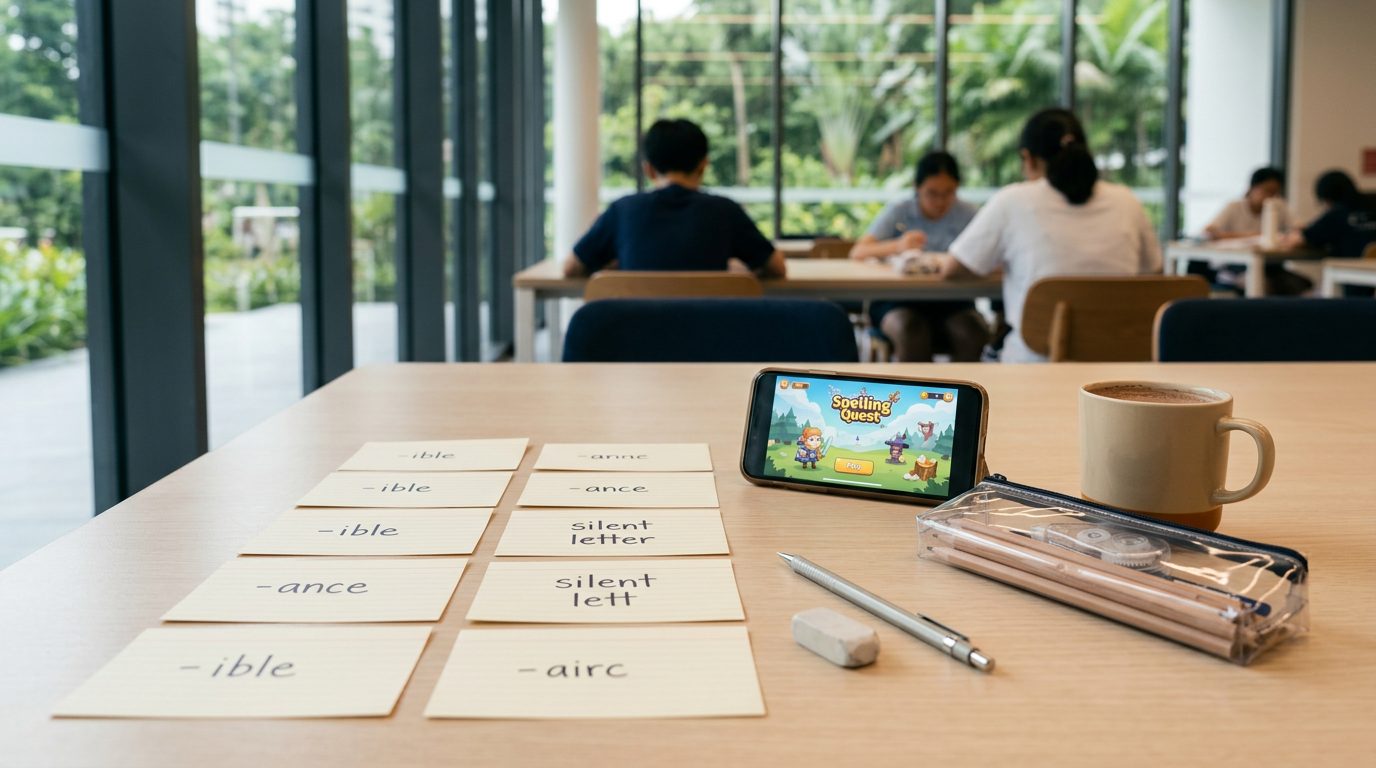
The Word Patterns That Decide PSLE English: From Editing Traps to Vocab Cloze
Why memorising random vocabulary lists fails upper-primary students, the word families that actually cost marks in Paper 2, and how to practice them actively.
7 Sept 2026 · 10 min read

PSLE English Cloze: The Three Sections Hiding Under One Name
Three different sections share the name "cloze", and most children revise for all three the same way — by memorising words. Our review of fourteen years of papers says the words almost never repeat, but the frames do.
30 Jul 2026 · 9 min read
PSLE Comprehension Cloze: How to Read Through the Blank
Why strong readers leak marks in the open cloze, and the three-pass routine that replaces "it sounds right" with evidence you can point at.
13 Aug 2026 · 11 min read
PSLE Grammar Cloze: 10 Marks That Are Really a Relationship Test
Almost every grammar cloze blank is a glue word. Teach your child to read the shape of the sentence on both sides of the gap, and the guessing stops.
6 Aug 2026 · 10 min read