PSLE English · 10 min read
The Word Patterns That Decide PSLE English: From Editing Traps to Vocab Cloze
Every July, parents show me the same thick notebook. It usually has "Vocabulary Log" or "My Word Bank" on the cover. Inside are fifty pages of alphabetical lists: words copied from a dictionary, definitions copied word-for-word, and perhaps a sample sentence copied from an assessment book.
The parent points at the book with pride. "He learns twenty new words every week," they tell me.
Then we look at the child's actual PSLE English spelling and vocabulary marks in Paper 2. In Editing for Spelling and Grammar, the child wrote accomodate with one m. In Vocabulary Cloze, they picked put off instead of put out because they knew "postpone" in isolation, but had never noticed how prepositions govern phrasal verbs. In Comprehension Cloze, they stared blankly at a gap where perseverance belonged.
The notebook had words. The child did not have the word patterns.
PSLE English does not test whether a child has memorised disconnected dictionary entries. It tests whether a child recognises how specific families of words behave in sentences, where English spelling consistently lays traps, and which words habitually keep company with each other. If your child is grinding through alphabetical lists, they are preparing for an exam format that Singapore primary schools retired decades ago.
Where words win and lose marks across Paper 2
To fix how children learn vocabulary, we have to look plainly at where words live in the exam. Paper 2 carries 95 raw marks (scaled to 45% of the total 200 marks for PSLE English). Words do not float in the air; they strike across three specific sections.
1. Paper 2 Booklet A: Vocabulary MCQ and Vocabulary Cloze (10 marks)
Booklet A carries five standalone Vocabulary MCQ items and five passage-based Vocabulary Cloze blanks.
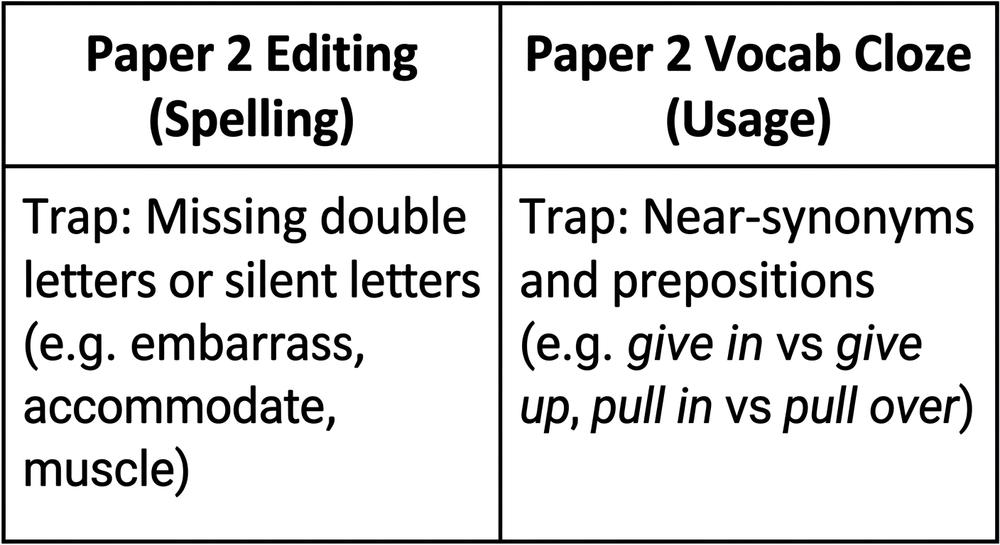
As we noted when analysing PSLE vocabulary cloze options, the setters almost never pair one sensible word with three obvious decoys. All four options are near-neighbours in meaning: pondered, speculated, debated, figured. Or they test phrasal verbs where the base verb is identical but the preposition alters the meaning completely: give in, give up, give away, give off.
A child relying on dictionary definitions alone will guess. A child trained in collocations spots immediately that you give in to demands, give up a habit, and give off a pungent smell.
2. Paper 2 Booklet B: Editing for Spelling and Grammar (10 marks)
Ten underlined words in a short passage: five grammar errors and five deliberate spelling traps. Each error carries one mark. There is no partial credit.
The words chosen for the spelling half are never obscure. They are high-frequency school words with predictable potholes: unnecessary, occurred, millennium, embarrassment, hindrance, privilege. A student either knows that embarrass doubles both the r and the s, or they drop that mark to the bell curve.
3. Paper 2 Booklet B: Comprehension Cloze (15 marks)
The most demanding fifteen marks in Paper 2. In PSLE comprehension cloze, there are no multiple-choice options or word banks. The child reads a continuous passage and must pull the exact target word out of memory.
When a blank requires an abstract noun or a specific phrasal particle, passive familiarity is not enough. Retrieval under exam pressure requires active recall.
The core word classes every Primary 4 to 6 student must master
When we compiled the 751-word master bank for our vocabulary engine, we combed through past-year papers from top primary schools, Singapore assessment benchmarks, and the recurring errors markers see year after year.
Those 751 words cluster into clear, trainable categories. When children understand which category a word belongs to, spelling and usage stop feeling like guesswork.
1. The double-letter traps (one set vs two sets)
Children know English doubles consonants, but they guess which ones:
- One set of double letters: apparent, balloon, committee, disappear, exaggerate, innocent, traffic, village. The classic error is doubling the wrong consonant (dissapear instead of disappear, or exxagerate instead of exaggerate).
- Two sets of double letters: Upper-primary staples like accommodate (two c's, two m's), embarrassment (two r's, two s's), millennium (two l's, two n's), possession (two s's twice), and accessories.
Chanting the rule ("two c's, two m's" for accommodate) turns a recurring trap into an automatic mark.
2. Suffix showdowns: -able vs -ible, -ance vs -ence
These sound identical in conversational Singapore English, so children writing phonetically guess blindly:
- Ending with -able: acceptable, admirable, dependable, fashionable, hospitable, remarkable. Most attach cleanly to a complete standalone root word (accept + able, depend + able).
- Ending with -ible: audible, credible, eligible, flexible, horrible, invisible, sensible. These rarely attach to a complete standalone English word.
- -ance and -ence: abundance, fragrance, nuance, perseverance, resemblance versus coincidence, independence, innocence, obedience, patience.
In Editing, spotting an underlined "independance" is an immediate mark if the child has drilled the -ence family.
3. Silent letters and tricky graphemes
When children spell by ear, silent letters vanish:
- Silent initials: knuckle, knight, wrestle, wrought.
- Silent interiors: muscle (the c), scissors (the c), fasten and glisten (the t), subtle and doubt (the b).
- Silent finals: autumn (the n), solemn (the n).
Markers see mucle and scisors every year. These visual memories must be built through active typing, not oral recitation.
4. Vowel team traps: ie vs ei, -ough, and soft c/g
Upper-primary students need to meet vowel patterns systematically:
- ie (/ee/ sound): achieve, belief, brief, fierce, shield, yield.
- ei (after c, or /ay/ sound): ceiling, deceit, receipt, freight, vein, weight.
- The -ough chameleon: One spelling with five sounds: although, thorough, drought, cough, rough, bought.
- Soft c and soft g: Letters sounding like /s/ or /j/: ceremony, cylinder, gymnasium, gesture, oxygen, region.
5. Commonly confused homophone pairs
These are especially dangerous because spellcheckers never flag them, and reading aloud gives no clue:
- principal (school head / main) vs principle (moral rule)
- stationary (standing still) vs stationery (pens and paper)
- complement (completes something) vs compliment (praise)
- practise (verb, British English) vs practice (noun)
- advise (verb) vs advice (noun)
- dessert (sweet treat) vs desert (dry land)
In Editing, an underlined stationary describing writing materials is a deliberate trap. The child must remember that stationery with an e is for envelopes.
6. Multi-word phrases, idioms, and phrasal verbs
Paper 2 Vocabulary Cloze frequently hinges on multi-word units:
- Everyday idioms: break the ice, break a leg, hit the sack, see eye to eye.
- Phrasal verb prepositions: give in (surrender), give up (abandon), give away (reveal or donate), give off (emit). Similarly, pull in, pull over, and pull away.
Treating these as isolated words guarantees confusion. Children need to practice phrases as unified lexical items.
7. Upper-primary evaluative vocabulary
Finally, Booklet A Vocabulary MCQ and Booklet B Comprehension Cloze demand words that describe character, reaction, and intensity:
- indomitable, ingenious, intuitive, discreetly, boisterous, incessantly, rigorous, revel, savour, encroachment.
When a question describes energetic, noisy children, a student who knows boisterous secures the mark while others hesitate over generic options.
Why copying lists fails (and how active recall works)
Why do children who copy vocabulary lists still stumble in exams?
Cognitive psychology calls it the illusion of competence. When a child copies a word from a list, their brain does almost zero cognitive processing. The eye glances at three letters, the hand writes them, and the memory trace dissolves by evening.
Lasting retention requires active retrieval under constraint:
- The student reads a sentence with a missing blank.
- A context clue triggers the target concept.
- The brain reconstructs the letter sequence from scratch, slot by slot.
- When an error occurs, the correct spelling is contrasted immediately against their attempt.
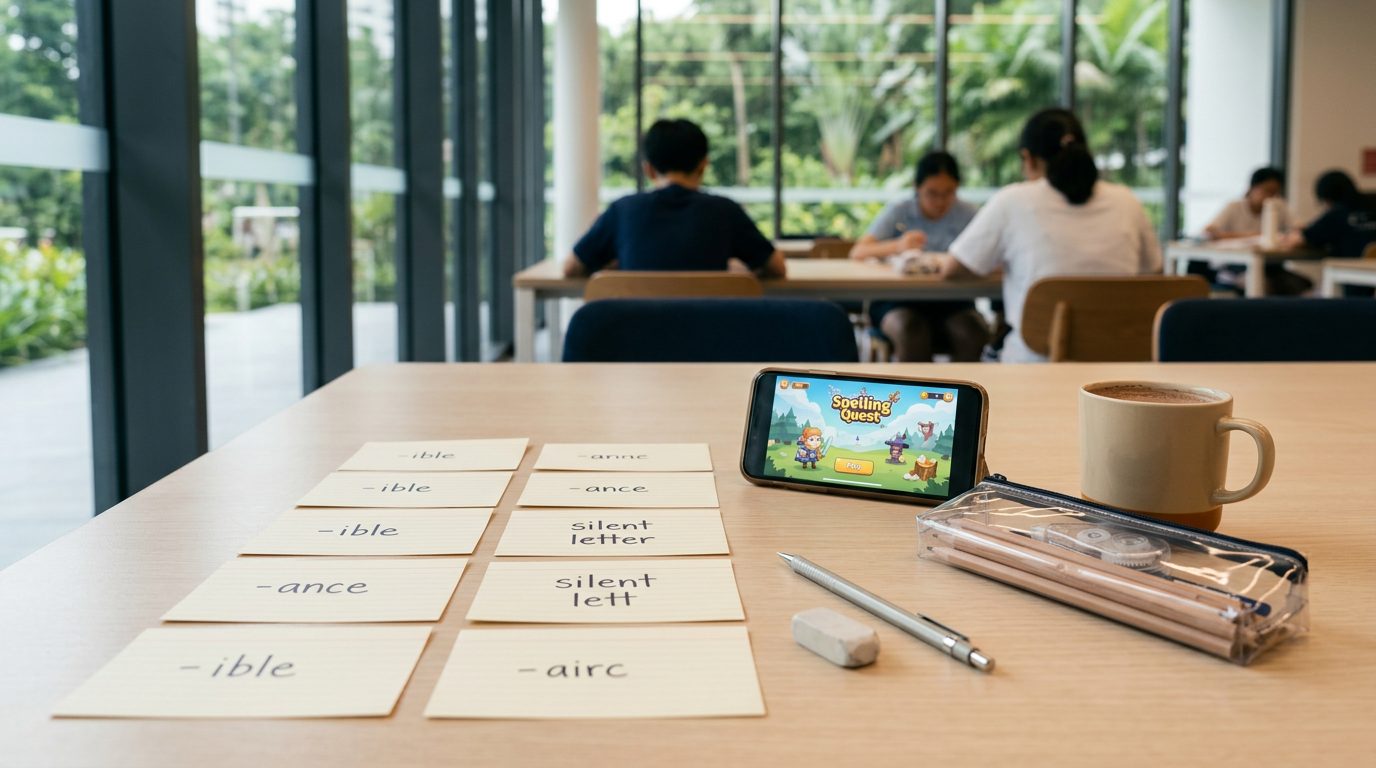
This is the mechanic behind SpellQuest, our free interactive spelling and vocabulary game.
In SpellQuest, children do not trace words. They face a timer (or unlimited mode for untimed learning), a clue, and a sentence context. When they misspell a word, a Pause Card holds the screen, displays their attempt side-by-side with the correct spelling, highlights the tricky letters, and lets the correction sink in before moving on.
Five minutes of active recall on SpellQuest before dinner builds sharper Editing and Cloze instincts than thirty minutes of passive copying.
From spelling recall to full-paper mastery: topical practice
Active recall is half the bridge. The other half is applying that vocabulary in real exam formats.
A child might spell independent correctly in isolation. But when they encounter it inside a dense 300-word passage in Booklet B, surrounded by distracting adjectives, will their eyes catch the error? When they see a Vocabulary Cloze question with four options, can they eliminate near-synonyms using grammatical clues?
This is where topical practice becomes essential.
Too many parents jump straight into full past-year papers. A child attempts ninety marks across an hour and forty-five minutes and receives a single aggregate score. But full papers are an inefficient diagnostic tool. If your child struggles with Editing and Vocabulary Cloze, completing fifteen comprehension passages will not fix their spelling traps.
On IllumiTutor, parents can assign focused topical practice papers drawn from authentic Singapore primary school exam questions:
- Targeted section drills: Isolate just Vocabulary Cloze, Grammar Cloze, Editing, or Synthesis & Transformation.
- Top school variety: Practice how different schools test the same word patterns—from Raffles and Nanyang to Rosyth and Henry Park.
- Instant AI marking with teacher-grade feedback: IllumiTutor marks student work like an experienced primary teacher. It explains why the preposition matters in a phrasal verb, and points out the exact missing double letter in an editing correction.
When daily five-minute recall on SpellQuest is paired with targeted weekly topical drills, Paper 2 mark leaks stop.
What to do this week
Do not buy another 300-page vocabulary assessment book this weekend. Instead, take these three practical steps:
- Audit their last two school papers. Look specifically at Booklet A (Vocabulary MCQ and Cloze) and Booklet B (Editing). Are marks dropping on spelling traps (Editing), phrasal verb prepositions (Cloze), or homophones?
- Start a 5-minute daily SpellQuest habit. Have your child play two quick rounds of SpellQuest. Let them select their primary level (P4, P5, or P6) and focus on learning from the Pause Cards whenever they miss a word.
- Drill the section topically. Once they are confident with word patterns, set up a targeted Vocabulary Cloze or Editing practice on IllumiTutor. Let them see those same words inside real exam passages—and watch the marks stay where they belong.
Keep learning
Related PSLE guides

PSLE English Spelling: The Quiet Marks Most Kids Lose
Where spelling actually costs marks in PSLE English, the word patterns that trip kids up, and a free game built to drill exactly those.
20 Jun 2026 · 9 min read

PSLE Vocabulary Cloze: Why All Four Options Look Right
The vocabulary options are near-neighbours separated by usage, not meaning. Why memorising definitions is the wrong drill, and what to do instead.
20 Aug 2026 · 14 min read
PSLE English Cloze: The Three Sections Hiding Under One Name
Three different sections share the name "cloze", and most children revise for all three the same way — by memorising words. Our review of fourteen years of papers says the words almost never repeat, but the frames do.
30 Jul 2026 · 9 min read
PSLE Comprehension Cloze: How to Read Through the Blank
Why strong readers leak marks in the open cloze, and the three-pass routine that replaces "it sounds right" with evidence you can point at.
13 Aug 2026 · 11 min read