PSLE English · 11 min read
PSLE Comprehension Cloze: How to Read Through the Blank
A boy I taught read constantly. Library books in the bag, novels under the desk during Maths, the kind of child who used "reluctantly" in conversation and meant it. He scored well on almost everything in Paper 2. Then his comprehension cloze would come back with five or six blanks crossed out, and he genuinely could not tell you why. Every word he'd written sounded fine to him. That was the whole problem.
The PSLE comprehension cloze is where strong readers leak the most marks, and it happens for a reason that has nothing to do with vocabulary size. There are no options to choose from. And the clue that decides the answer is usually not sitting in the sentence with the blank — it's a sentence earlier, or a sentence later.
What the comprehension cloze actually asks for
In the current format, Paper 2 (Language Use and Comprehension) is worth 90 marks and carries 45% of the subject. Booklet B holds the open-ended sections, and the comprehension cloze sits inside it: one passage, 15 blanks, 15 marks, one mark per blank, per SEAB's published format table. Three things follow:
- No word bank. Unlike the vocabulary cloze in Booklet A, nothing is supplied — your child produces the word from scratch. Hence the other name for it: the open cloze.
- The word must be exactly right. It has to fit the grammar, fit the meaning, and be spelt correctly.
- It's a sixth of the whole paper. Fifteen marks is more than editing, more than synthesis — it quietly outweighs sections families spend far more time drilling.
Why memorising cloze answers doesn't work
We went through the accepted comprehension cloze answers in the PSLE English papers from 2012 to 2025 — 210 of them — and counted the repeats.
184 of those 210 answers are unique across fourteen years. Not "rarely repeated". Almost never repeated. Whatever your child gains from memorising a list of past cloze answers, it is close to nothing.
What repeats is the kind of thinking. And the words themselves are a surprise if you've been buying vocabulary lists: they're plain. Make. Part. Risk. Follow. Only. Words a P4 child already knows, dropped into places where only one of them fits. The difficulty here is fit, not rarity — good news, because fit can be taught in a fortnight and a bigger vocabulary can't.
The habit that costs the marks
Watch a child do a cloze and you'll see it. Eyes travel along the line, hit the gap, stop. A word arrives, gets written, and the eyes move on.
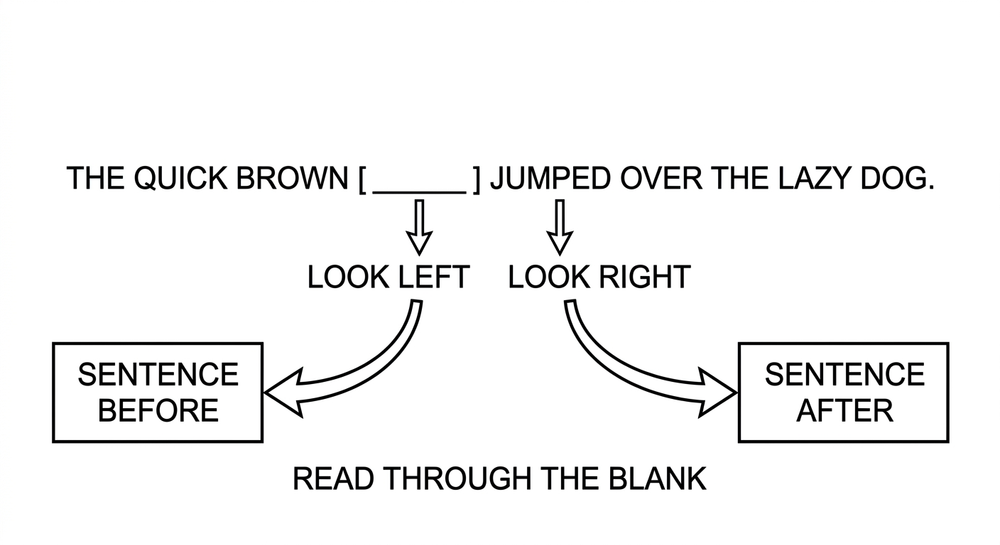
The stopping is the error. The sentence containing the blank often doesn't hold enough information to decide anything — it needs the sentence before it for contrast, or the one after it for evidence. Read through the blank, and the passage usually hands you the answer.
The three-pass routine for every blank
Every blank gets the same three passes, in this order. Ten seconds, once it's a habit.
Pass 1 — the grammar frame. Look only at the words immediately left and right. What kind of word can even go here? An article before the gap means a noun is coming. A full clause on the right rules out half the connectors. Your child hasn't chosen a word yet — she's narrowed the field.
Pass 2 — the meaning, across three sentences. Read the sentence before, the one with the blank, and the one after. What does this gap have to do? Contrast something? Explain a result? Point back at something already named?
Pass 3 — the partnership. Would a fluent speaker really put these two words side by side? Recover from, not recover of. Insist on, not insist at. This pass catches the word that survives grammar and meaning but still isn't English.
Here's a passage of the kind she'll meet — mine, not a past paper:
The old shophouse had stood empty for years. Last month a young couple took it ___. By the weekend the shutters had been repainted and there was a queue down the five-foot way.
Pass 1: after "took", with "it" in between and a full stop after — a small particle, not a noun. Pass 2: the evidence is in the next sentence. Repainted shutters, a queue, a business running. Somebody has assumed control of the place. Pass 3: took over is a real partnership; took up means started a hobby, took on means accepted a duty. The answer is over, and she can point at the words that prove it. A child who stopped at the gap had none of that — she wrote "took it back", because it sounded fine.
Name the clue type before you write the word
Six clue types account for nearly every PSLE English comprehension cloze blank. Teach your child to name the clue and underline the exact words that carry it — before writing anything in the gap.
- Definition — the words right after the blank explain it. "He kept a ___ of every cent he spent: a small notebook, the date on the left and the amount on the right." → record.
- Contrast — but, however, although, yet, despite. "The recipe filled two pages and looked impossible. ___, it took her twenty minutes." → Still / However.
- Cause and result — one thing produced another. "The tap had been dripping since midnight, ___ the pail was full by morning." → so.
- Example — for example, such as, like. "Some birds have done very well in the city — the mynah, for ___, will nest almost anywhere." → instance / example.
- Reference — this, these, they, which, both. "Two bicycles had been left by the lift landing. ___ were gone by the time we came down." → Both / They.
- Repeated idea — a synonym of the answer is already sitting nearby. "Nothing in that flat was ever thrown out. Every jar, every rubber band, every length of string was ___." → kept / saved.
Fixed frames: learn both sides of the gap
Of those 210 answers, 40 were chiefly a fixed partnership — the blank was one half of a set phrase whose other half sat right beside it. The word after the gap gives the answer away, if you're still reading when you reach it.
These are worth learning as whole chunks, both sides stored together:
make one's way (to) · pay attention to · take for granted · at a loss · on the move · earn a living · sense of belonging · in search of · risk of · no longer · make use of · in comparison with · up to
Don't practise them by reading the list. Write the frame with the gap in it — take ___ granted — cover the answer, and retrieve for from memory. That cover-and-recall movement is exactly what the exam asks for: producing a word into a gap with nothing offered. Reading the phrase off a page trains recognition, a much weaker skill.
He paid attention on the instructions is a real script error I've marked more than once. The child knew the phrase; she'd only ever stored half of it.
The leave-and-return tactic
Some blanks won't come, and a stubborn one can eat four minutes your child needs for the comprehension open-ended section later in the booklet. Pencil a light dot in the margin, leave it, keep reading, finish the passage — then come back. Later sentences routinely supply the clue for an earlier gap: a name gets repeated, a contrast resolves, a result explains a cause you'd already passed. Reading the whole passage first isn't lost time; in this section it's how the information arrives.
Common mistakes
Choosing a word because it matches the topic. The big one. The passage is about a hawker centre, so the child writes "sell" in a blank where the frame was earn a living. Topic-related, completely wrong. A word can be perfectly on-topic and still fail on grammar or partnership — the topic is not evidence.
Filling the gap from the sentence alone. Half the clues sit outside it. If she can answer without her eyes leaving that one line, she probably guessed.
Writing half a partnership. At a loss becomes in a loss. No longer becomes no more. The meaning is close, the mark is gone.
Ignoring the grammar frame. A noun phrase followed the gap and she wrote although, which needs a full clause after it. Despite was the word. Pure form, and the most fixable error in the section.
Leaving a blank empty. There's nothing to lose. An answer built from the three passes is often right; a blank never is.
Correcting the answer without recording the reason. Copying the right word into a notebook teaches almost nothing — as those 184 unique answers show, that exact word is unlikely to appear again.
Keep the error log by reason, not by word
This is the change that moves marks fastest, and it costs nothing. After every cloze, each wrong blank gets one letter:
- F — wrong form or agreement
- M — wrong meaning
- C — wrong collocation, the partnership isn't English
- R — missed reference or context, the clue was elsewhere
Then one sentence explaining it. The best log entry I've seen from a P6 child read: "I chose 'although', but a noun phrase followed, so I needed 'despite'." That prevents the next mistake. "Answer: despite" prevents nothing.
Within three or four papers the tally tells you what to teach. Mostly Cs? She needs frames, not comprehension work. Mostly Rs? She's still stopping at the gap. Mostly Fs? Half an hour on connectors and noun phrases beats any amount of reading.
What to do this week
- Take one cloze passage and do the evidence-only drill — underline the proof, name the clue type, write no answers.
- Do one full passage with the three passes said out loud, one blank at a time. Speed comes later; the order is what matters.
- Start the F / M / C / R log. One line per error, with the reason.
- Drill six fixed frames a day with cover-and-recall, not reading. Six, not twenty.
- On the next timed paper, make her pencil-dot and move on from any blank taking more than twenty seconds, then come back at the end.
The other two cloze sections reward different things — the cloze series hub lays all three out side by side, and the grammar cloze piece covers the connectors and reference words behind this section's F errors too. The same read-the-whole-passage habit carries into comprehension open-ended, a few pages later in the same booklet.
Fifteen marks, no options, plain words. Your child almost certainly has the vocabulary already — what she needs is to stop trusting her ear and start pointing at the proof.
Keep learning
Related PSLE guides
The Word Patterns That Decide PSLE English: From Editing Traps to Vocab Cloze
Why memorising random vocabulary lists fails upper-primary students, the word families that actually cost marks in Paper 2, and how to practice them actively.
7 Sept 2026 · 10 min read
PSLE Vocabulary Cloze: Why All Four Options Look Right
The vocabulary options are near-neighbours separated by usage, not meaning. Why memorising definitions is the wrong drill, and what to do instead.
20 Aug 2026 · 14 min read
PSLE Grammar Cloze: 10 Marks That Are Really a Relationship Test
Almost every grammar cloze blank is a glue word. Teach your child to read the shape of the sentence on both sides of the gap, and the guessing stops.
6 Aug 2026 · 10 min read
PSLE English Cloze: The Three Sections Hiding Under One Name
Three different sections share the name "cloze", and most children revise for all three the same way — by memorising words. Our review of fourteen years of papers says the words almost never repeat, but the frames do.
30 Jul 2026 · 9 min read