PSLE English · 10 min read
PSLE Grammar Cloze: 10 Marks That Are Really a Relationship Test
I once taught a P6 boy who read more than anyone else in the class — thick fantasy novels, the kind with a map printed inside the front cover. He could tell me what "nevertheless" meant. He could use it in conversation. And he scored four or five out of ten on the grammar cloze, week after week, and neither of us could work out why.
So I sat beside him and asked him to think out loud. "Despite… no. However… hmm, however sounds nicer." He was choosing by ear, one blank at a time, and he never once looked at the words on the other side of the gap.
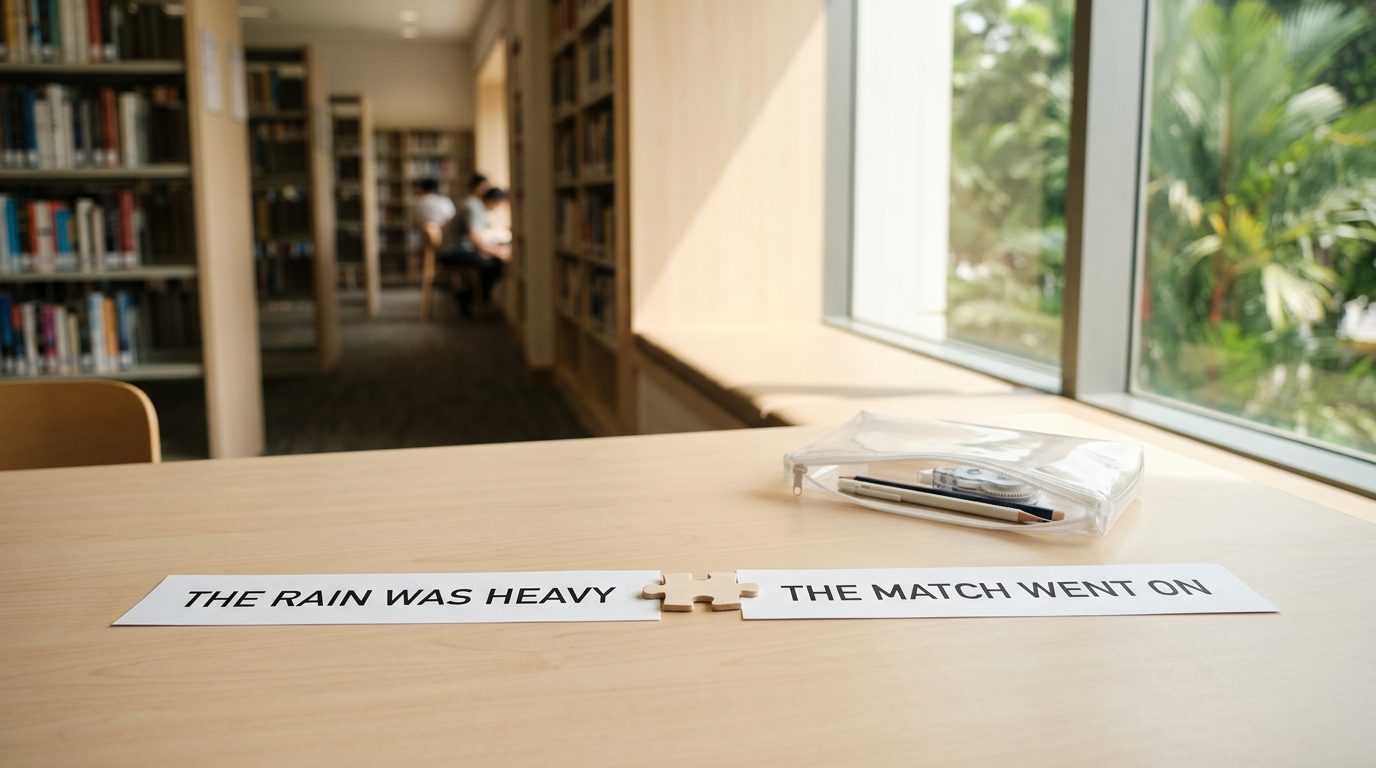
That is the whole problem with the PSLE grammar cloze, in one sentence. It looks like a vocabulary test. It behaves like a logic puzzle. Barely anything in it is a difficult word — what's being tested is whether a child can see how two ideas are joined, and then pick the word that joins them in the shape the sentence has already committed to.
What the grammar cloze actually asks for
It sits in Paper 2 — Language Use and Comprehension — which splits into Booklet A, 25 marks of multiple choice, and Booklet B, 65 marks of open-ended work. The grammar cloze opens Booklet B and carries 10 marks: one short passage, ten numbered blanks, one mark each.
You're given a lettered list of words — around fifteen of them, serving all ten blanks. Each word can be used only once, and the word is taken exactly as printed: no changing the tense, no adding an ending. So there will be leftovers, and those leftovers are deliberate. They are the wrong answers your child must actively reject. Check the instruction on the paper in front of her, too, since it tells her what to write in the blank — recent papers have asked for the letter rather than the word, and a child who writes the word where a letter was asked for has thrown the mark away on a technicality.
The good news buried in that format: because the answers come from a fixed list, a child who doesn't know a word can still get the mark by ruling out the nine or ten that can't fit. That is not true of the comprehension cloze, where nothing is given and every word has to be produced from scratch. The two sections share a name and almost nothing else — I unpack that in the overview of all three cloze sections.
What 140 answers across fourteen papers turned out to be
We went back through the 2012–2025 PSLE English papers and captured every grammar cloze answer — 140 of them. The breakdown is blunt enough to set a revision order by:
- 41 were connectors or adverbs — although, however, therefore, nevertheless, thereby
- 36 were prepositions or particles — to, with, from, against, upon
- 24 were reference words — which, who, whose, its, their
- The rest were verb helpers, articles and quantity words
Not one of those categories is a vocabulary category. They're all relationship words — glue. And the glue repeats. Of the 140 answers, only 72 were unique words; is, which and as each turned up six separate times across the fourteen papers.
That's a small, closed set to master. A child who genuinely owns contrast, cause, reference, agreement and the common preposition partnerships is not guessing at ten blanks. She's reasoning at ten blanks, and the ones she can't reason she can eliminate.
The five systems, in the order worth teaching them
1. Contrast: choose by what follows the blank
Four frames cover nearly all of it:
- although / though / while + subject + verb
- despite / in spite of + noun or -ing phrase
- clause, but / yet + clause
- sentence; however / nevertheless, sentence
The fast test: look at what comes immediately after the gap. A complete mini-sentence — something with its own subject and verb — points to although. A bare noun phrase points to despite.
Although the queue was long, we waited. → "the queue was long" is a full clause. Despite the long queue, we waited. → "the long queue" is a noun phrase. The queue was long; however, we waited. → however joins two complete thoughts and needs the punctuation on both sides.
The trap: despite cannot introduce a normal subject–verb clause. "Despite the queue was long" is wrong, and it's wrong in a way children can't hear — it sounds perfectly reasonable when read aloud. This is exactly why "which one sounds nicer" fails them.
2. Cause and result: decide which way the arrow points
Before choosing anything, ask one question: does this blank point backward to a reason, or forward to a consequence?
- because + subject + verb
- because of / due to + noun phrase
- cause, so + result
- cause. Therefore / Thus, result.
- action, thereby + -ing consequence
The same event, written four correct ways:
The bus was late because the road was flooded. The bus was late because of the flooded road. The road was flooded, so the bus was late. The road was flooded. Therefore, the bus was late.
The trap: because of must be followed by a noun phrase, never a clause. "Because of the road was flooded" is the single most common wrong answer I've marked on a grammar cloze. Same meaning, wrong shape.
3. Reference words: run the replacement test
Relative pronouns are chosen by three things — person or thing, subject or object, and ownership.
| Word | Replace it with | Points to |
|---|---|---|
| who | he / she | the person doing the action |
| whom | him / her | the person receiving the action |
| whose | his / her / its | ownership |
| which | it | a thing, or a whole earlier idea |
| that | — | a person or thing in an essential clause |
The fast test for who vs whom: answer the gap with "he" or "him". If "him" fits, the answer is whom.
The coach who planned the drills arrived early. → She planned them. → who. The coach to whom we passed the ball waved back. → We passed it to her. → whom. The girl whose water bottle was missing checked the office. → the bottle belongs to the girl. The rain stopped, which let the game restart. → which points back at the whole event, not at a noun.
The trap: which referring to an entire preceding idea. Children hunt for a single noun to attach it to, don't find one, and abandon a correct answer.
4. Quantity and agreement: find the true head noun
The nearest noun is usually a decoy. The word that controls the verb is often three or four words earlier.
- many / few + countable plural
- much / little + uncountable
- "The number of pupils is rising" — the head noun is number, singular
- "A number of pupils are waiting" — this one means several pupils
- "One of the reasons is…" — the subject is one, not reasons
Uncountables worth knowing cold, because they're tested repeatedly: advice, equipment, furniture, information, luggage, traffic, work. There is no such thing as "informations", and "the new equipments are expensive" should make your child wince.
The trap: "One of the boys ___ absent." Nearly every child I've taught writes were. The subject is one. The answer is was.
5. Preposition partnerships: learn the pair as one item
Here the preposition isn't chosen by logic at all — it's fixed by the word beside it. Treat the pair as a single vocabulary item, the way you'd treat a spelling word.
A high-return set drawn from the papers: according to, contrary to, preference for, recover from, refrain from, associated with, compared with, provide someone with, result in, result from, insist on, succeed in, warn against, frown upon.
Revise both directions, because the papers test both:
Heavy rain resulted in a two-hour delay. The two-hour delay resulted from heavy rain.
The trap: insist takes on. "She insisted to paying" is wrong; "she insisted on paying" is right. There is no rule to derive this from. It's learned, and it's learned in pairs.
Common mistakes I see on real scripts
- Choosing by sound. "It sounds better" is not evidence. Ask your child to point at the words that prove the answer.
- Reading only the left of the blank. Contrast and cause connectors are decided almost entirely by what comes after the gap.
- Ignoring the leftover words. If four words in the list are still unused at the end and none of them could ever have fitted, something has gone wrong upstream.
- Filling blanks in order and never rereading. A stubborn blank often resolves itself once the rest of the passage is in place. Leave it lightly pencilled and come back.
- Correcting the answer without correcting the reason. A child who writes the right word into the box and moves on has learned exactly nothing.
What to do this week
Redo only the grammar cloze from three past papers. Not the whole paper — twenty minutes, three sections, back to back. Doing the same section three times in a row is what makes the patterns visible.
Then, the part that actually does the work: for every blank, make your child say aloud why each rejected word fails. Not why the answer is right — why the others are wrong.
"I nearly wrote although, but a noun phrase came after the blank, so it had to be despite."
That sentence is the transfer. The answer alone doesn't survive to the next paper; the reason does. And keep the error log by reason, not by word — wrong shape, wrong meaning, wrong partnership, missed reference. Four columns will cover almost everything she gets wrong.
For the other half of Paper 2's accuracy marks, the same shape-first thinking runs through synthesis and transformation — it's the closest cousin to this section in the whole paper.
Keep learning
Related PSLE guides
PSLE English Cloze: The Three Sections Hiding Under One Name
Three different sections share the name "cloze", and most children revise for all three the same way — by memorising words. Our review of fourteen years of papers says the words almost never repeat, but the frames do.
30 Jul 2026 · 9 min read
The Word Patterns That Decide PSLE English: From Editing Traps to Vocab Cloze
Why memorising random vocabulary lists fails upper-primary students, the word families that actually cost marks in Paper 2, and how to practice them actively.
7 Sept 2026 · 10 min read

PSLE Vocabulary Cloze: Why All Four Options Look Right
The vocabulary options are near-neighbours separated by usage, not meaning. Why memorising definitions is the wrong drill, and what to do instead.
20 Aug 2026 · 14 min read
PSLE Comprehension Cloze: How to Read Through the Blank
Why strong readers leak marks in the open cloze, and the three-pass routine that replaces "it sounds right" with evidence you can point at.
13 Aug 2026 · 11 min read