
The Difference-Only Comparison Method
Remove what both sides share, then value the leftover difference.
⏱ 5 min · 🎯 4 things to master
Find the Difference Without Adding Everything | PSLE Maths
Video · 3:46
Some comparison questions list many contributions, but most are identical. Cross out the matching parts on both sides. The answer is carried by the unmatched part only, the .
Parents: ask your child to circle the common pieces before adding any prices. The shorter method is also the safer check.
By the end, you will be able to cancel common contributions, value the unmatched part, and state which total is larger.
Cancel the common part
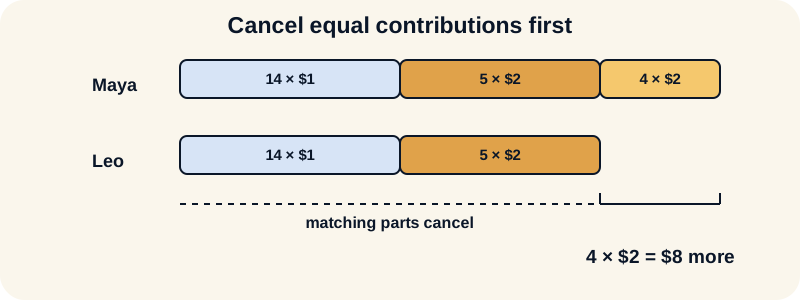
Maya and Leo each have fourteen one-dollar coins. Maya has nine two-dollar notes and Leo has five two-dollar notes. How much more money does Maya have?
The fourteen one-dollar coins cancel. Five two-dollar notes cancel too. Four two-dollar notes remain on Maya’s side, so those four notes are the entire difference.
Keep only the unmatched notes
Predict first: After common coins and notes cancel, what should you value?
Value the unmatched part
Compare repeated contributions
The same idea works when each side has a shared base plus one repeated contribution. Team A and Team B each make six three-point shots. Team A makes eleven two-point shots and Team B makes seven. The six three-point shots cancel; four two-point shots remain, worth eight points.
Working
If the unmatched contribution is on the second side, say that side has the larger total. Difference-only comparison is about structure, so no unnecessary total needs to be found.
Know when the method applies
Use this method when the question gives matching items or matching groups. If both totals change by the same amount over time, use constant-difference. If the items repeat in complete groups, use grouping and number-value.
Practice: strip away the common part
1. Aisha has twelve $3 notebooks and seven $2 pens. Ben has twelve $3 notebooks and ten $2 pens. Who has more, and by how much?
Working
2. Two pupils each have six three-point shots. A makes eleven two-point shots; B makes seven. How many more points does A have?
Working
3. Sam and Rui each buy four $5 tickets. Sam buys three $8 tickets; Rui buys one. How much more does Sam spend?
Working
Watch out — easily mixed up
Quick recap
🎯 Mastery check
Answer all 6 — your progress is saved on this device.
What should you do with contributions that have the same value and count on both sides?
Maya has nine two-dollar notes and Leo has five. How many notes remain after matching?
Four unmatched two-dollar notes are worth how much?
If the unmatched pieces are on Maya’s side, who has the larger total?
When can a contribution be cancelled?
Which method fits two ratios that keep the same gap while both quantities change?
Ready to compare cleanly? Cross out what matches, then let the leftover tell you the difference.