When two quantities grow by the same amount, their difference stays constant. That fixed gap lets you compare ratio bars at two moments and find one unit. The method works for ages, money, lengths, and scores. The source example below uses ages, where a year is the shared change.
Parents: ask your child to mark the unchanged gap before calculating. The model tip shows why the extra units must equal the shared change.
By the end, you will be able to align two ratios, use a fixed difference, and check the gap before and after a change.
Spot the invariant gap
Words such as always, still, or the difference remains signal an . If both quantities increase by the same amount, both bars receive the same extra length. The difference between them remains the same.
🤔 Predict first: Two ages differ by 9 years today. Five years later, what is their difference?
Match the ratio bars
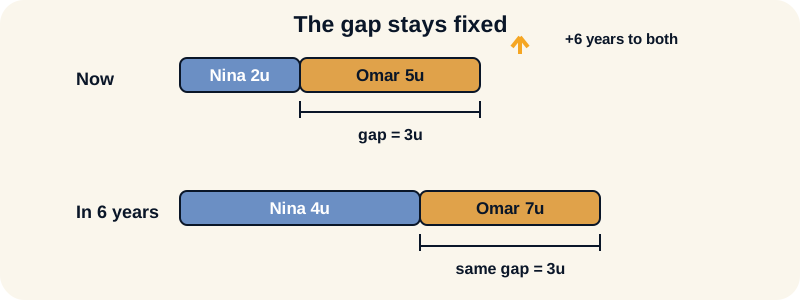
Nina and Omar’s ages are in the ratio 2 : 5. In six years, their ages will be in the ratio 4 : 7. The age difference stays constant. Find their ages now and in six years.
The difference is three units at both moments. The extra two units equal the shared increase.🔬
Keep the age gap fixed
🤔 Predict first: If both amounts increase by the same amount, what happens to their difference?
Find one unit
5−2=3 units now
7−4=3 units later
4−2=2 units added to Nina
2 units=6 years
1 unit=6÷2=3 years
Nina now=2×3=6 years
Omar now=5×3=15 years
Nina later=4×3=12 years
Omar later=7×3=21 years
Both differences are nine years, so the model is consistent. The gap itself is the invariant; the number of units on each bar changes.
Ratio bars can shrink too
The same reasoning works when equal amounts are removed. If ribbons begin in the ratio 5 : 8 and six centimetres are cut from each ribbon, the remaining ratio is 1 : 2. Align the remaining ratio with the original bars, then use the two-unit change.
Working
8−5=3 units
Aligned ratio=3:6
5−3=2 units cut from the first bar
2 units=6 cm
1 unit=6÷2=3 cm
Short ribbon=5×3=15 cm
Long ribbon=8×3=24 cm
Practice: keep the gap fixed
1. Jia and Ken have money in the ratio 3 : 7. After both receive $8, their ratio is 5 : 9. Find their amounts before and after.
Working
7−3=4 units
9−5=4 units
5−3=2 units=8 dollars
1 unit=8÷2=4 dollars
Before=3×4=12 and 7×4=28
After=5×4=20 and 9×4=36
2. Two ribbons are in the ratio 5 : 8. Six centimetres are cut from each, leaving ratio 1 : 2. Find their original lengths.
Working
1:2 aligns to 3:6
5−3=2 units=6 cm
1 unit=6÷2=3 cm
Short ribbon=5×3=15 cm
Long ribbon=8×3=24 cm
3. Arun and Bo have money in the ratio 3 : 8. After both receive $8, the ratio is 5 : 10. Find their amounts before and after.
Working
8−3=5 units
10−5=5 units
5−3=2 units=8 dollars
1 unit=8÷2=4 dollars
Before=3×4=12 and 8×4=32
After=5×4=20 and 10×4=40
Watch out — easily mixed up
Quick recap
🎯 Mastery check
Answer all 6 — your progress is saved on this device.
If two ages both increase by five years, what happens to their difference?
Nina and Omar have ages in ratio 2 : 5. What is the unit gap?
If two changed units represent six years, what is one unit?
Which quantities can use a constant-difference model?
If equal lengths are cut from two ribbons, which relationship stays fixed?
What should you check after finding the unit?
Ready to protect the gap? Mark the invariant difference, align the bars, and let the shared change reveal one unit.