The Grouping-and-Number-Value Method
Build one complete group, divide the total, then count the requested item.
⏱ 4 min · 🎯 4 things to master
Grouping: Find One Group’s Value First | Singapore Primary Maths
Video · 4:35
When the same collection is packed again and again, do not count every item separately. Find the value of one complete group, or , divide the total by that value, then multiply to find the item the question asks for.
Parents: ask your child to circle one complete group before dividing. The group must include every item that repeats.
By the end, you will be able to value one group, find the number of groups, and scale to the requested item.
Build one complete group
Each stationery bag contains three pencils at $2 each and one notebook at $5. The bags are identical, and the total value is $132. How many pencils are there altogether?
First find the value of one bag. Then find how many bags there are. Finally multiply by the number of pencils in one bag.
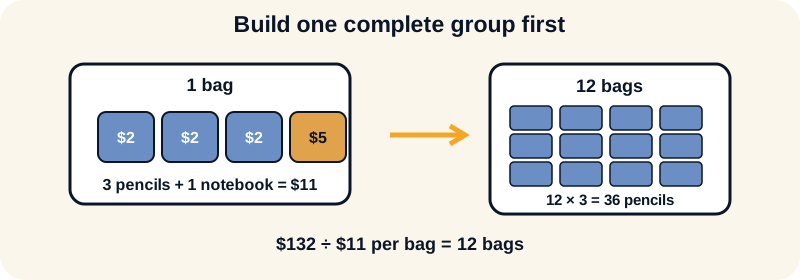
Build the stationery bags
Predict first: What should you find first?
Value one group
Check the total value: thirty-six pencils at two dollars and twelve notebooks at five dollars make one hundred and thirty-two dollars.
Grouping works with people and leftovers
The group does not have to be a shopping bag. If fifty-four pupils form teams of six, divide by six to find nine teams. If sixty-eight cards are packed five per packet, divide by five to find thirteen complete packets and a remainder of three cards. A remainder means the final group is incomplete.
Working
Practice: group, divide, and scale
1. Each snack pack has two drinks at $3 each and three buns at $2 each. The total is $96. How many buns are there?
Working
2. Fifty-four pupils form teams of six. Each team receives four maps. How many maps are needed?
Working
3. Sixty-eight cards are packed five per packet. How many complete packets and spare cards are there?
Working
Watch out — easily mixed up
Quick recap
🎯 Mastery check
Answer all 6 — your progress is saved on this device.
What should you find before finding the number of identical bags?
Each bag is worth $11 and the total is $132. How many bags are there?
There are three pencils in each bag. What do you do after finding twelve bags?
Fifty-four pupils form teams of six. How many teams are made?
Sixty-eight cards are packed five per packet. What does the remainder represent?
Why must every repeated item be included in one complete group?
Ready to make groups count? Build one complete group, divide the total, and scale only at the end.