
PSLE Science · 9 min read
2026 PSLE Science Predictions: What 10 Years of Past Papers Really Tell Us
“Teacher, what do you think will come out for Science this year?”
Every PSLE season, a parent asks me some version of that question. Usually it happens after the child has completed several school papers, the assessment-book pile is still growing, and there are only a few weekends left. The parent is not looking for a leaked paper. They are asking a more practical question: where should we put the remaining revision time?
That is the useful way to read 2026 PSLE Science predictions. Nobody outside the examination setters knows the questions in advance. But past papers can show us the scientific ideas and thinking moves that return in different disguises. So we reviewed ten years of actual PSLE Science papers, from 2016 to 2025, compared the questions, and built a focused 20-question practice paper from what we found.
Here is the honest version of that analysis—what repeated, what may be worth prioritising for 2026, and why a prediction should guide practice rather than become a bet.
What ten years of PSLE Science past papers showed us
The first finding was reassuring: PSLE Science does repeat.
Not word for word, and not in a way that rewards memorising a model answer. The surface story changes while the scientific mechanism remains familiar. A child who only remembers the picture may think it is a new question. A child who recognises the concept underneath has somewhere sensible to begin.
We found, for example, a three-spring force-and-extension graph in both the 2019 and 2022 papers. Questions involving a faulty electrical circuit and bulbs arranged in parallel appeared in 2023 and 2025. The familiar idea of warming a metal jar lid appeared in 2017 and then returned in 2025.
There were other near-pairs: digestive organs and undigested-food graphs; a cylinder and plunger involving air and water; and what happens to a circuit when a bulb blows. The props changed. The pupil still had to recognise the system, work out the relationship and apply the same core science.
That matters because a ten-year series is otherwise just a very tall stack of paper. If your child is working through one, use it as described in our guide to PSLE past-year papers: mark it properly, keep an error log and revisit the mechanism behind each lost mark. The year printed on the cover is less important than what the question made your child do.
Our 2026 PSLE Science predictions: six families to prioritise
After comparing the decade, we organised the remaining questions into six working families. These are broad on purpose. Predicting a narrow prop—“a spring question will appear”—encourages children to hunt for a memorised picture. A useful priority describes the concept and skill that travel from one context to another.
1. Electrical systems
Practise reading circuits as systems, not as drawings to copy. A pupil should be able to trace a complete path, reason about components in series or parallel, identify a fault, and explain what changes when a component is removed or stops working.
The trap is visual familiarity. Two circuits may look similar while making the bulbs behave differently. Ask your child to point to the current path and explain it before choosing an answer.
2. Forces, springs and energy
This family includes the effects of forces, spring extension, elastic potential energy and energy changes. Graphs matter here. A pupil may know that a larger force stretches a spring more, yet lose the mark because they read the wrong axis or compare two data points imprecisely.
Do not rehearse one “spring answer”. Mix diagrams, tables and graphs so the child has to rebuild the relationship each time.
3. Heat and changes of state
Heating a jar lid is one memorable example, but the transferable science is wider: heat gain and loss, conduction, evaporation, condensation, melting and factors affecting their rates.
These questions often look like daily life. That is exactly why pupils answer in daily-life language—“the lid became loose”—and stop before explaining the science. Train the full link: which object gained or lost heat, what changed as a result, and why that helped.
4. Plant processes
Photosynthesis, transport, reproduction and responses to conditions can be tested through set-ups rather than direct recall. Expect the plant to be placed inside an experiment, a graph or a comparison between conditions.
The child must separate observation from inference. “There were fewer bubbles” is an observation. “The rate of photosynthesis was lower” is the inference supported by it. Both may be needed.
5. Human systems and ecology
Questions can connect digestion, circulation, respiration, food relationships and the effect of environmental change. The challenge is often not naming an organ or organism. It is following the consequence through a system.
If one population decreases, what happens next—and why? If food is not fully digested or absorbed, which later step is affected? Make your child draw the chain rather than jump straight to the last effect.
6. Scientific inquiry
This is the family I would not leave until the final week. It cuts across every topic: identifying variables, judging whether a test is fair, reading tables and graphs, making a prediction, drawing a supported conclusion and suggesting an improvement to a set-up.
The official 2026 Science assessment objectives explicitly include applying facts and concepts, making predictions and hypotheses, interpreting information and evaluating methods. Inquiry is not one chapter to memorise. It is how Science questions make a familiar concept unfamiliar.
For targeted practice, our guide to PSLE Science experiment and variables questions shows how to identify the changed, measured and controlled variables without relying on a memorised template.
What changed in the 2026 PSLE Science paper
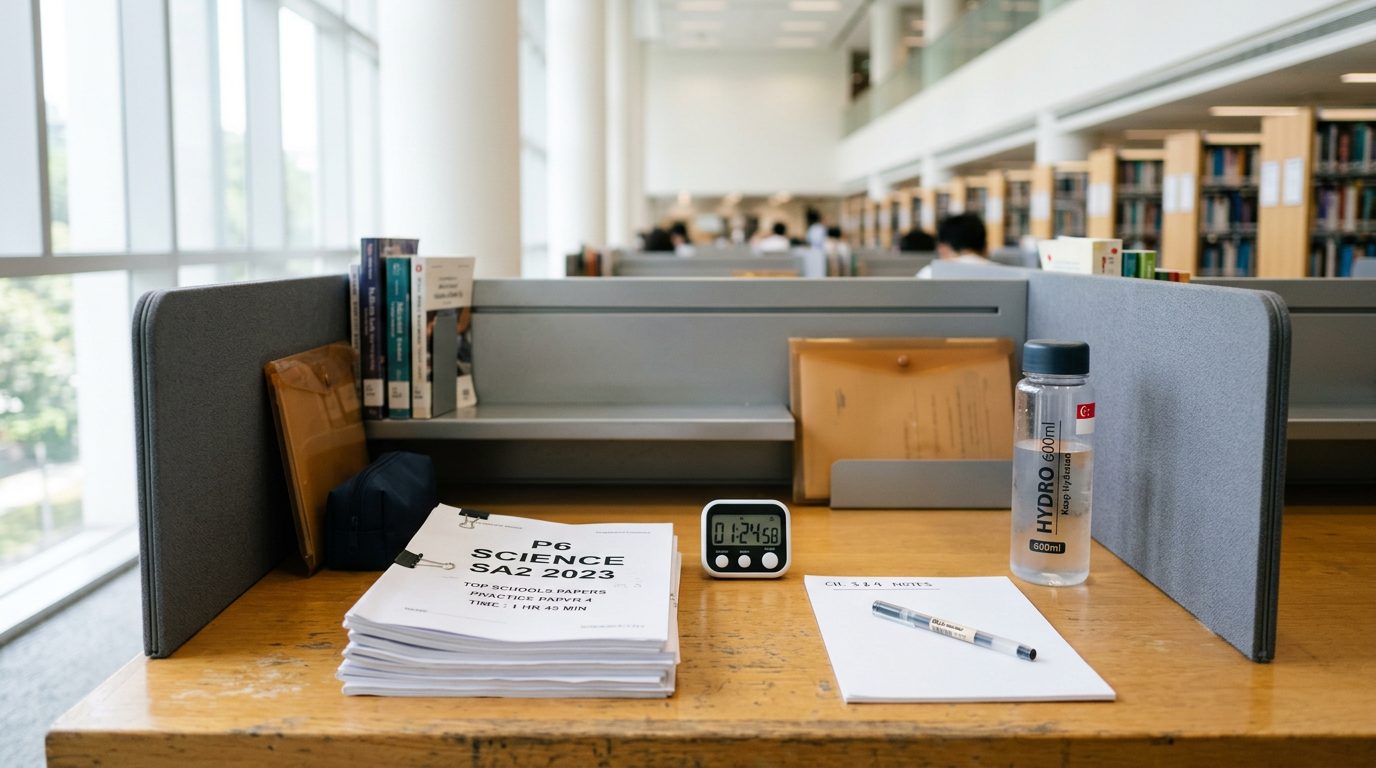
The revised format gives Booklet A 30 multiple-choice questions worth 60 marks. Booklet B contains 10 to 11 structured questions worth 40 marks. The full paper remains 1 hour 45 minutes, and pupils must answer every question.
That extra MCQ weight does not turn the paper into a recall test. SEAB’s published objectives cover both knowledge and the application of scientific inquiry. A pupil may meet those skills in a four-option question just as easily as in a written response: interpreting an unfamiliar graph, comparing two set-ups or deciding which conclusion the evidence supports.
There is also a syllabus filter to apply when using older papers. Detailed cell structure is no longer treated as the old standalone topic, although the idea of a cell as a basic unit of life remains within reproduction. We therefore did not fill our shortlist with old cell-structure recall questions. Our fuller guide to using old papers for the 2026 syllabus explains what families should keep and what they should set aside.
Why we removed the obvious repeats from our shortlist
This sounds backwards at first. If springs, circuits and jar lids repeated, why not predict them again?
Because a shortlist should reduce duplication, not chase it. Those near-repeat pairs have already returned within the decade. A child can and should learn from them, but placing all our remaining practice time on the most obvious repeats would be a weak bet.
So we took the known near-pairs off our 2026 shortlist. Then we looked across the six families for questions that still offered strong practice value under the revised syllabus. The result was 20 questions: eight actual PSLE questions and 12 closely matched prelim variants, selected to exercise the same kinds of application without simply replaying the examples we had already spotted.
That is the principle behind the paper. Focus, not fortune-telling.
Common prediction mistakes that waste revision time
Treating a topic prediction as a question prediction. “Heat may matter” does not mean “memorise the jar-lid answer”. The next heat question could involve a spoon, a container, evaporation or an experimental comparison.
Skipping whole topics. A shortlist tells you where to add deliberate practice. It does not rewrite the syllabus. The cost of guessing wrong is too high when the paper can integrate several topics in one set-up.
Memorising keywords without the relationship. Precise scientific language matters, but a floating phrase does not earn a mark by itself. The answer must be conceptually correct and relevant to the context. Recent public explanations from MOE and SEAB have made the same point: pupils can show understanding in more than one valid way.
Doing ten full papers without reviewing the errors. Volume hides patterns. If the child keeps misreading graph axes or changing two variables in a fair-test question, another complete paper may simply rehearse the same mistake.
Practising only Booklet B because it feels harder. In 2026, Booklet A carries 60 marks. MCQ practice needs the same disciplined explanation: why is this option correct, and why are the other three wrong?
Try the 20-question PSLE Science practice paper
We made the shortlist into a real write-on paper so a child can practise the questions rather than read another prediction article. It is free to open, no sign-up is needed to start, and it works directly in the browser.
Open the free 20-question PSLE Science practice paper.
Use it diagnostically. Note which family each lost mark belongs to and whether the problem was the concept, the interpretation or the explanation. That small distinction tells you what to revise next.
What to do this week
Give your child the 20-question paper under quiet, timed conditions. Mark the attempt honestly. Then sort every uncertain or incorrect answer into the six families above.
Choose the weakest two families—not all six—and spend the next three revision sessions on mixed questions from those areas. For every answer, ask: What is the concept? What evidence in this set-up matters? What is the complete cause-and-effect link?
At the end of the week, redo only the questions that were wrong the first time. If your child can now explain the mechanism when the surface story changes, the prediction has done its job.
Keep learning
Related PSLE guides

PSLE Science Experiment & Variables Questions, Decoded
The "what did they change, what did they measure, what was kept the same" question looks simple and quietly bleeds marks. Here's how to teach a child to read an experiment the way a marker does.
4 Aug 2026 · 9 min read
PSLE Science: Answering 'Explain' Questions with the Keyword Method
An "explain" question wants a why, with a cause and an effect, landed on the one keyword the mark scheme is waiting for. Here's how to teach a child to deliver all three.
7 Jul 2026 · 9 min read
How to Answer PSLE Science Open-Ended Questions (and Why Marks Get Lost)
Most kids lose Science marks not because they don't know the answer, but because they don't write the one the marker is paid to award. Here's how to fix that.
22 Apr 2026 · 8 min read
How to Use PSLE Past-Year Papers Properly
Most families do papers the way that feels productive and learns the least. Here's how to use PSLE past-year papers so each one is worth three sittings, not one.
30 Jun 2026 · 10 min read