Exam Strategy · 9 min read
PSLE 2026 Syllabus Changes: What to Watch For When Practising Older Papers
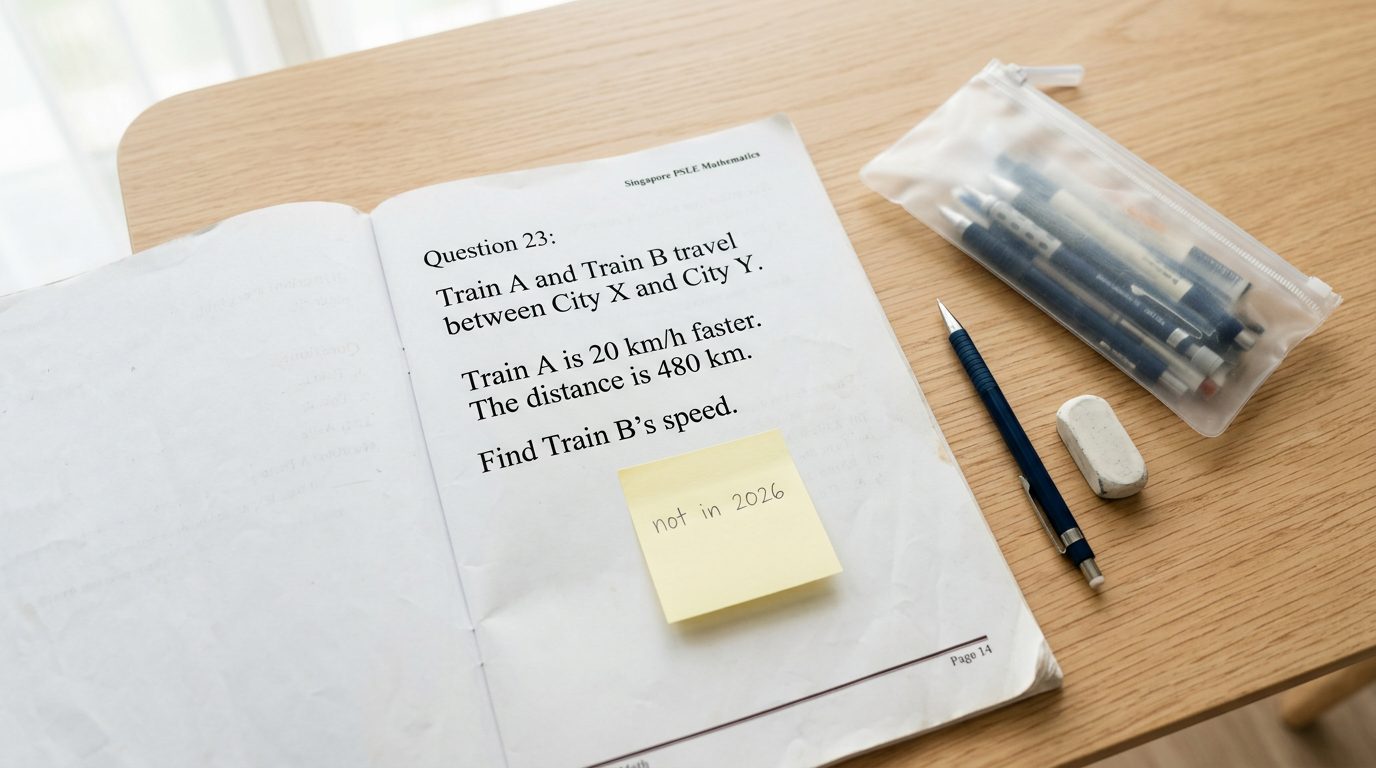
A father messaged me in a panic last week. His daughter had been working through a 2022 PSLE maths paper — the real thing, printed out — and she'd stalled completely on a question about two trains travelling towards each other. "She used to be okay at this. Now she freezes on speed. Should I book her more speed practice before October?"
I told him to put the pen down. Speed isn't on her paper anymore.
He had no idea. Most parents don't yet, and I understand why — the change is quiet, and the past-year papers everyone practises on still look exactly like the real thing. That's the trap hiding inside the PSLE 2026 syllabus changes: the papers your child is drilling were written for a syllabus their cohort isn't sitting. Most of each paper is still excellent practice. But a handful of questions test things that have been taken out, and the shape of the live exam has shifted underneath everyone's feet.
Here's the honest, subject-by-subject guide to what's different, so your child practises the right things and stops bleeding effort on the wrong ones.
Why older papers don't quite line up anymore
Two subjects were officially revised for 2026: Maths and Science. So any Maths or Science paper dated 2025 or earlier was set under the old syllabus. English is the one that trips parents up — its big shake-up (the heavier Oral) actually landed a year earlier, in 2025, so a 2025 English paper already matches the live format; only English papers from 2024 or earlier pre-date it. Mother Tongue, for PSLE purposes, hasn't changed. None of this makes the old papers useless — far from it. Done properly, past-year papers are still the best mirror of exam conditions your child has, and I've written separately on how to actually use past-year papers without just churning through them. But you do need to read them with two filters running.
The first filter is content that's been removed — topics that appear in an old paper but are no longer in the syllabus. When your child hits one, the right move is usually to skip it, not grind it. The second filter is format that's changed — the paper structure, mark weightings and question types have moved, so an old paper's shape is a slightly out-of-date map of the real one.
Maths: the topic to stop worrying about
The big one is Speed. It's been removed from the PSLE syllabus entirely and pushed up to secondary school. For years it was the topic that broke confident children in Paper 2 — two objects, two rates, one of them setting off late — and now it's simply gone. If your child meets a speed question in a 2023 or 2024 paper, that's your cue: skip it, or keep it as stretch practice for fun, but don't lose a weekend "fixing" it. I've explained the topic itself in the guide to speed, distance and time if you want to see exactly what's no longer required.
Two smaller removals travel with it: "turns" and the eight-point compass under the Angles topic are no longer tested. Older papers occasionally ask a child to work out a turn through north-east to south-west; you can wave those past.
Now the part parents get wrong in the other direction. A few topics didn't disappear — they just moved levels. Average and Ratio shifted into Primary 6, while Nets and Pie Charts moved earlier, into Primary 4. These are all still very much examinable. Don't let "the syllabus changed" become an excuse to skip them. They were re-timed, not removed.
The format has moved too. Paper 1 and Paper 2 are now worth 50 marks each — equal weighting — where Paper 1 used to carry less (it was 45, Paper 2 was 55). The marks have also shifted toward 2-mark, multi-step questions: in Paper 1, the short-answer questions are now all worth 2 marks, and only the opening multiple-choice section still carries 1-mark items. So a careless slip on a short-answer question now costs two marks, not one. The timings shuffled to match — Paper 1 grew by ten minutes (to 1 h 10 min) and Paper 2 shrank by ten (to 1 h 20 min), with the total still 2 h 30 min. Two small mercies for nervous markers: any unit required is now pre-printed on the answer line, so fewer marks vanish to a forgotten "cm" or "kg", and circle questions no longer demand answers left "in terms of π". An old paper won't show you any of this, so treat its front matter and mark scheme as a rough guide, not gospel.
Science: one whole chunk you can cross out
Science has a clean removal: the Cells topic is out. Your child no longer needs to memorise the nucleus, cytoplasm and cell membrane, or rattle off the differences between plant and animal cells. When an older paper opens a section with a labelled cell diagram, that's a section you can put a line through.
As with Maths, one topic merely moved rather than vanished: Photosynthesis shifted from Primary 5 into Primary 6. Still tested — just later in the journey — so keep it in the rotation.
On format, the weighting between the two booklets has settled at Booklet A (multiple choice) 60 marks and Booklet B (open-ended) 40 marks. The practical message is the one I find myself repeating most: MCQ accuracy now matters more than parents instinctively feel it does. Every Science MCQ is worth two marks now, so a child who shrugs off "just two multiple-choice wrong" isn't down two marks — they're down four. That's the exact misread I unpack in the PSLE 2026 marks breakdown.
There's a deeper shift hiding behind the numbers, and it's the part that actually changes how your child should practise. The new Science leans much harder on scientific inquiry — questions built around data tables, graphs, experimental set-ups and unfamiliar scenarios, where your child has to interpret results, spot the variable being tested and apply a concept rather than recite it. It's the same theme as dropping Cells: less rewarded for memorising, more rewarded for thinking like a scientist. So when an old paper offers a straight "state the three states of matter" recall question, treat it as a warm-up, not the main event — the live paper will hand your child a graph and ask what it means.
English: nothing removed, but the shape changed
English is different on two counts — no topics were cut, and the change came a year early. The revised English paper has been the live format since 2025, a year ahead of the Maths and Science revisions. So a 2025 English paper already matches what your child will sit; it's the 2024-and-earlier English papers that quietly under-represent where the marks now sit.
Paper 1 (Writing) is now out of 50 marks, down from 55. Paper 2 is out of 90, down from 95, and inside it the Visual Text Comprehension section shrank from 8 marks to 5 — and now gives your child two linked texts to read against each other rather than one poster to decode. The biggest shift is the Oral: it jumped from 30 marks to 40. Reading Aloud is now 15 and the Stimulus-Based Conversation is 25, the reading passage comes with a short preamble telling your child how to read it, and the conversation photo may have nothing to do with that passage's theme.
If your child has been practising oral from a 2022 paper, they've been rehearsing a component that's worth a quarter less than it now is. That's the danger of letting an old paper set your priorities — talking is heavier than it looks.
Mother Tongue: steady, for now
Mother Tongue is the reassuring one. The syllabus refresh is rolling out from the lower primary levels upward, so at PSLE level in 2026 the paper format is largely unchanged on paper. Older Chinese, Malay and Tamil papers remain a fair guide. The only caveat: some passage themes and vocabulary in much older papers can feel dated, so use them for skills practice and don't over-read the topics.
Common mistakes parents make with old papers
- Drilling a removed topic. The classic is booking extra speed practice in September. If it's out, it's out — that time belongs to fractions, ratio and problem sums.
- Panicking over a "low" score caused by removed questions. If your child skipped two speed questions and a cell-structure section, their raw mark looks worse than their real standing. Re-mark out of the questions that still count before you judge.
- Trusting an old paper's weighting. An old front cover that says Paper 1 is 45 marks, or English Oral is 30, is describing a paper your child isn't sitting. Check the current format.
- Confusing "moved" with "removed." Skipping Average, Ratio, Nets or Pie Charts because "the syllabus changed" throws away marks on topics that are very much still tested.
What to do this week
- Take the next past-year paper your child plans to attempt and pre-screen it for ten minutes: lightly cross out any Speed, turns/eight-point-compass, or Cells questions before they start.
- When you mark it, score it twice — once raw, once out of only the questions still in the syllabus. The second number is the honest one.
- If Maths or Science is the worry, shift a session onto a re-timed topic (Average, Ratio, Nets, Pie Charts, Photosynthesis) instead of a removed one.
- For English, give the Oral more airtime than the old papers imply — it's worth 40 now, and it's the easiest place to claw back marks with practice.
- When in doubt about a single topic, check the live subject format on SEAB's PSLE 2026 formats page — it's short, and it's the source of truth.
Older papers are still some of the best practice your child can get. They just need a teacher's eye reading over their shoulder — knowing which questions still count, which to wave past, and where the real marks now live.
Keep learning
Related PSLE guides
PSLE 2026 Marks: What Each Paper Is Really Worth
How the marks are split across every PSLE 2026 paper, which papers pull the most weight, and the spots where careless slips cost more than parents expect.
19 Jun 2026 · 10 min read
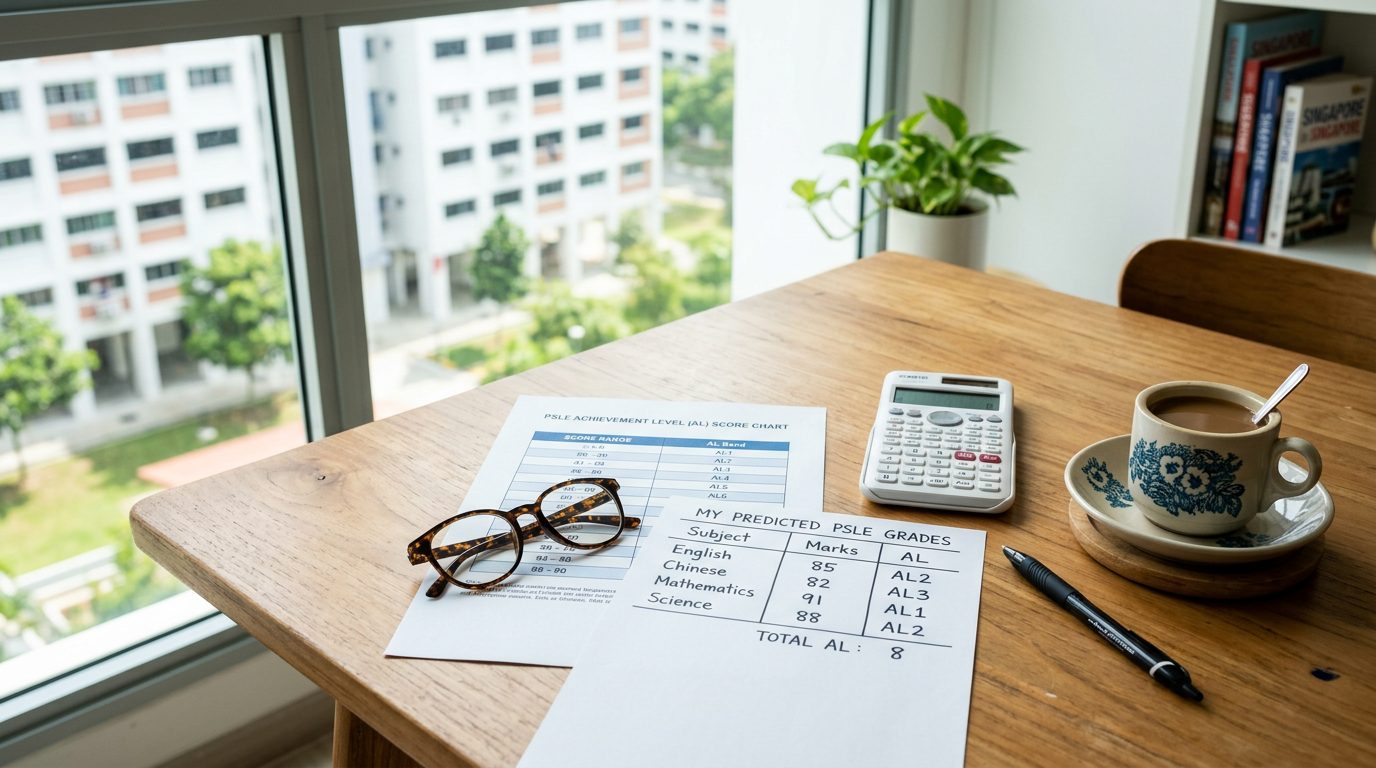
The PSLE AL Scoring System, Explained for Parents
What the AL bands actually mean, how the score of 4 to 32 is built, and the misreadings that quietly worry parents every results day.
9 Jan 2026 · 8 min read

PSLE Exam Week: What to Do the Night Before Each Paper
A teacher's night-before-and-morning-of routine for PSLE exam week — what to pack, light review not cramming, sleep, breakfast, arriving early, and staying calm paper to paper.
8 Sept 2026 · 10 min read
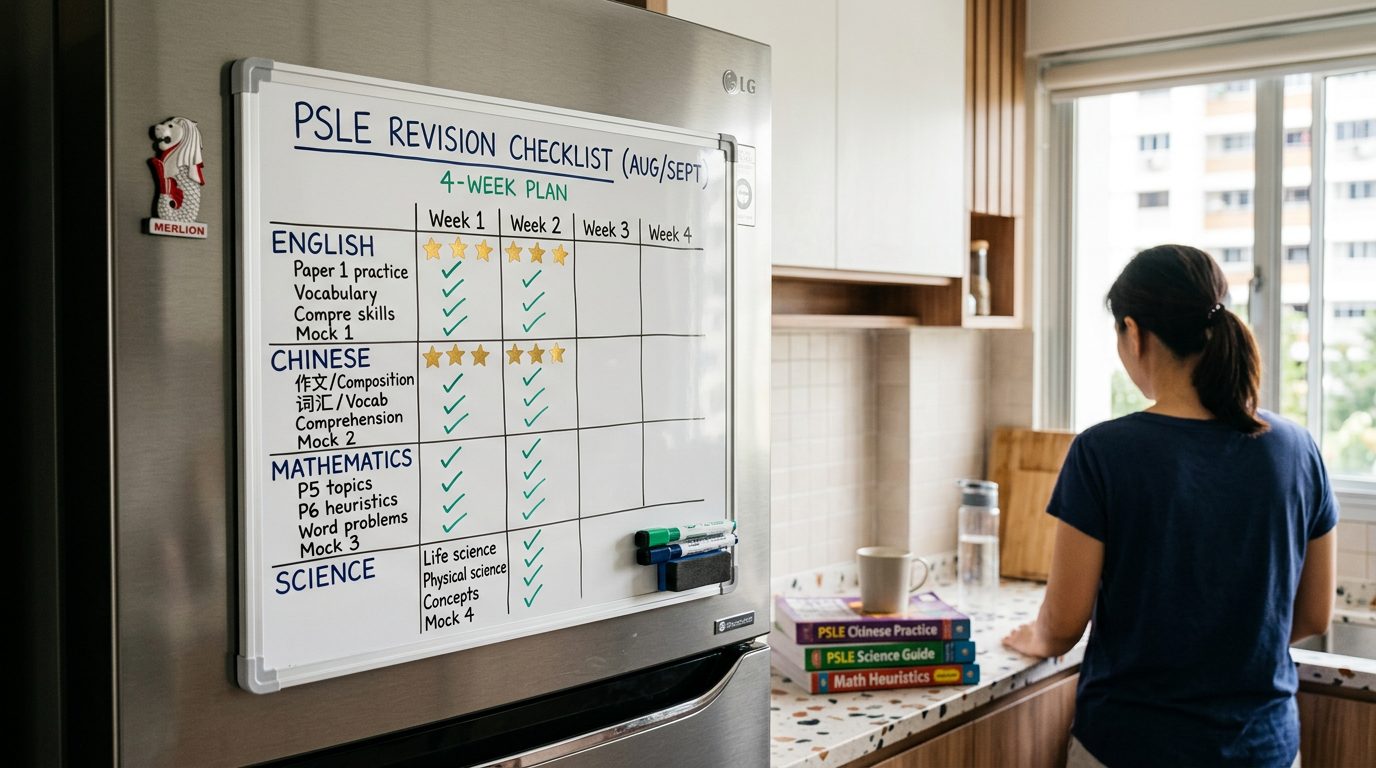
The Final 4 Weeks: a Subject-by-Subject PSLE Checklist
With orals done and the written papers weeks away, this is consolidation season, not new-content season. A subject-by-subject checklist for the last month — and the band-boundary targeting that actually moves a score.
1 Sept 2026 · 10 min read