PSLE Science · 9 min read
PSLE Science Experiment & Variables Questions, Decoded
A father once slid a marked Science paper across the table to me and pointed at one question. Setup A and setup B, two cups of water, a little table of readings underneath. His son had written a full, confident paragraph about why the water in cup A evaporated faster. The margin said one word: aim? Zero out of two. "He understood the whole thing," the dad said, exasperated. "How did he get nothing?"
He'd answered a different question. The marks weren't for why the water evaporated — they were for naming what the experiment changed, what it measured, and what it kept the same. That triad is the spine of every experiment question on the paper, and it's where I see careful, capable children quietly leak marks they should never lose. PSLE science experiment variables questions reward a way of reading an investigation, not just knowing the science behind it.
The three variables, in the words the marker uses
Strip away the jargon and an experiment is one person deliberately changing one thing to see what happens to another thing, while holding everything else still. Your child needs three labels, and the local phrasing matters because that's what the mark scheme is built on.
- The changed variable (the independent variable). The one thing the experimenter deliberately alters between setups. Type of material. Amount of sunlight. Surface area exposed to air. There should only ever be one.
- The measured variable (the dependent variable). The thing they observe or measure as a result — the height of a plant after two weeks, the time taken for sugar to dissolve, the volume of water left after an hour.
- The constant variables (the controlled variables — "kept the same"). Everything else, deliberately held still: same volume of water, same temperature, same size of container.
A teacher friend of mine drills it as a sentence the child says before writing anything: "They changed ___, they measured ___, and they kept ___ the same." If a child can fill those three blanks correctly, most of the question is already answered. If they can't, no amount of beautiful science prose will save them.
A worked example: which surface dries fastest
Here's the kind of investigation that turns up year after year. A pupil wants to find out whether the surface area of water affects how fast it evaporates. She pours the same amount of water — 200 ml — into three containers of different widths, leaves them in the same sunny spot, and measures how much water is left after three hours.
| Container | Surface area of water | Water left after 3 hours |
|---|---|---|
| A (narrow) | small | 180 ml |
| B (medium) | medium | 150 ml |
| C (wide) | large | 110 ml |
Now read it the way a marker does.
- Changed variable: the surface area of the water exposed to air (small, medium, large). That's the one thing deliberately different between A, B and C.
- Measured variable: the volume of water left after three hours (or, equally, how much evaporated).
- Constant variables: the starting volume of water (200 ml each), the temperature / amount of sunlight, the time left (3 hours), the type of liquid. All held the same on purpose.
And the conclusion the question is fishing for: the larger the surface area of the water, the faster the water evaporates. Notice the shape of that sentence — the more of X, the more of Y. That "the bigger… the faster…" pattern is exactly what a results table is built to support, and exactly what a strong child writes when asked to draw a conclusion.
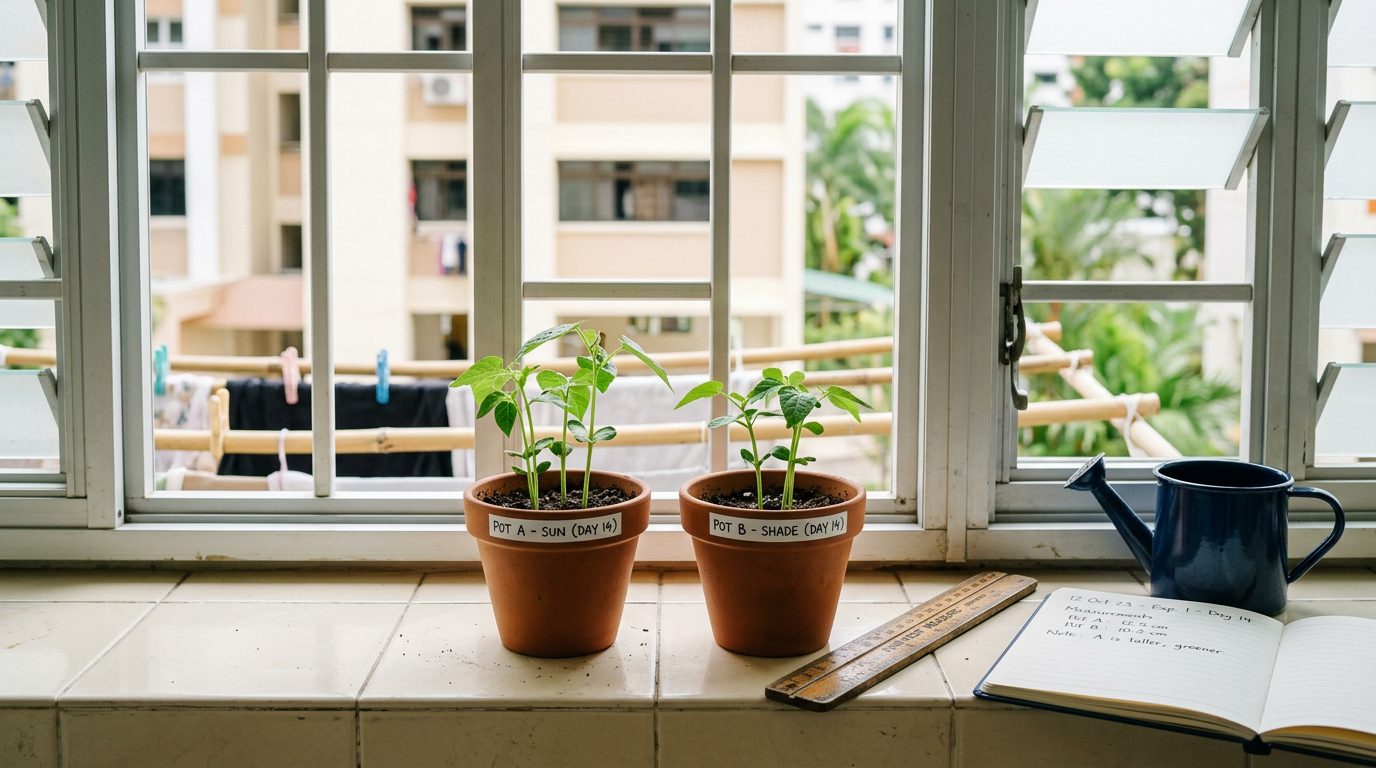
The same skeleton fits half the experiments on the paper. Springs: change the number of weights, measure the length of the spring, keep the spring the same. Dissolving: change the temperature of the water, measure the time for sugar to dissolve, keep the amount of sugar and water the same. Plant growth: change the amount of sunlight, measure the height after two weeks, keep the soil, water and pot size the same. Different topics, identical reading.
"Why must X be kept the same?" — the question that decides the fair test
This is the one parents tell me their children fumble most, and it has a precise answer the marker is waiting for. Why must the same volume of water be used in each container? The instinct is to write something true but empty — "so it is fair" or "so the experiment works".
That doesn't score. The mark scheme wants the reason it's fair, and it runs like this:
So that the volume of water is not another changed variable, so that any difference in the result is due only to the surface area (the changed variable) and not to something else.
That's the whole logic of a fair test in one sentence. If two things differ between the setups, you can no longer tell which one caused the result — and the aim of the experiment can't be answered. A fair test has exactly one changed variable; everything else is held constant precisely so the result points cleanly back to that one cause.
Finding the aim, and reading the table
Two smaller skills sit either side of the variables and are worth drilling on their own.
The aim is just the changed variable and the measured variable, joined: to find out how the surface area of water affects the rate of evaporation. A child who can name the two variables can write the aim mechanically — "to find out how [changed variable] affects [measured variable]." When the margin says aim?, this is the sentence that was missing.
Reading the table is about spotting the pattern, not reciting numbers. The strong answer doesn't say "A had 180, B had 150, C had 110." It says what the numbers mean together: as the surface area increased, the amount of water left decreased — so evaporation was faster. Look for the trend, then state it as a relationship. If the readings go up as the changed variable goes up, that's your conclusion in plain words.
For more on phrasing these answers so they land the exact word the scheme wants, I've written a companion piece on PSLE Science explain questions and the keyword method. And for the wider picture of how all the open-ended marks add up across Booklet B, there's a fuller guide to PSLE Science open-ended questions.
Common mistakes that quietly cost marks
Answering the science instead of the question. The boy at the start of this piece knew exactly why water evaporates. He just never named the changed, measured and constant variables — which is what the marks were for. Explain the science and identify the variables are two different questions.
Vague "to make it fair." "So it is a fair test" with no reason attached. The mark lives in why it's fair — that keeping it constant stops it from becoming a second changed variable.
Naming more than one changed variable. A child writes that the experiment changed "the surface area and the temperature." If two things change, it isn't a fair test and the result can't be pinned to either. There is one changed variable, full stop.
Confusing measured with constant. "The amount of water was the measured variable" when the amount of water was actually kept the same and the time to dry was measured. Read carefully: the measured variable is the one that comes out as a result, not one you set up at the start.
Quoting numbers instead of stating the trend. Listing the readings back ("180, 150, 110") isn't a conclusion. The conclusion is the relationship: the larger the surface area, the faster the evaporation.
Writing the conclusion without the link to the aim. A conclusion has to answer the aim. If the aim was about surface area and the child concludes something about temperature, they've drifted off the question.
What to do this week
Pull out your child's last Science paper or any assessment book with an experiment question. Cover the answer your child wrote, and before anything else, have them say the three-part sentence out loud: they changed ___, they measured ___, they kept ___ the same. You'll learn very fast whether the problem is the science or the reading — and nine times out of ten on these questions, it's the reading.
Then take three experiment setups and have your child do nothing but name the three variables and write the aim for each — no full answers yet, just the spine. Once that's automatic, add the fair-test reason: for every constant variable, finish the sentence "kept the same so it isn't a second change, so the result is due only to ___." Drill that for ten minutes a few times a week and the experiment questions stop being a place marks slip away and become some of the most reliable marks on the paper.
Keep learning
Related PSLE guides

2026 PSLE Science Predictions: What 10 Years of Past Papers Really Tell Us
We analysed ten years of PSLE Science papers to find the question families worth practising for 2026—and the patterns we deliberately left out.
1 Sept 2026 · 9 min read
PSLE Science: Answering 'Explain' Questions with the Keyword Method
An "explain" question wants a why, with a cause and an effect, landed on the one keyword the mark scheme is waiting for. Here's how to teach a child to deliver all three.
7 Jul 2026 · 9 min read
How to Answer PSLE Science Open-Ended Questions (and Why Marks Get Lost)
Most kids lose Science marks not because they don't know the answer, but because they don't write the one the marker is paid to award. Here's how to fix that.
22 Apr 2026 · 8 min read

PSLE Exam Week: What to Do the Night Before Each Paper
A teacher's night-before-and-morning-of routine for PSLE exam week — what to pack, light review not cramming, sleep, breakfast, arriving early, and staying calm paper to paper.
8 Sept 2026 · 10 min read