IllumiTutor video lesson thumbnail for Simultaneous Equations: An Algebra Extension

Simultaneous Equations: An Algebra Extension

How two linked equations can reveal two unknown prices when a bar model is not the clearest representation.

⏱ 13 min · 🎯 4 things to master

Two Prices, Two Equations: Find the Notebook and Pen | PSLE Maths

Watch on YouTube

Sometimes two unknown prices are tied to two different purchases. Guessing one price at a time is slow. Write both conditions as equations, make one unknown match, and subtract the two balanced statements. This page is an optional algebra extension for learners who are ready; ordinary PSLE problem sums can often use a model drawing instead.

Parents: let your child translate the two purchase statements before showing the elimination step, and remind them that this extension is enrichment rather than a required PSLE method.

By the end you will be able to name two unknowns, translate two linked conditions, scale every term equally, eliminate one unknown, and check the answer in the story.

When this extension helps

Use simultaneous equations when two unknown quantities obey two independent conditions and matching one term makes subtraction direct. The keeps the unknown price visible while you work. A bar model, ratio model or the units-and-parts page may be friendlier for other questions.

🤔 Predict first: Which problem has two independent conditions that can become two equations?

Name the unknowns and write both conditions

Here is the full question:

At a book fair, 2 notebooks and 3 pens cost $19. Four notebooks and 1 pen cost $23. What is the cost of one notebook and one pen?

Let n be the cost of one notebook and p be the cost of one pen, in dollars. Translate each purchase separately. Keep the two original equations visible; they are the conditions you must satisfy at the end.

Translate the story

2n+3p=192n + 3p = 19
4n+p=234n + p = 23
n=notebook price,p=pen pricen = \text{notebook price},\quad p = \text{pen price}
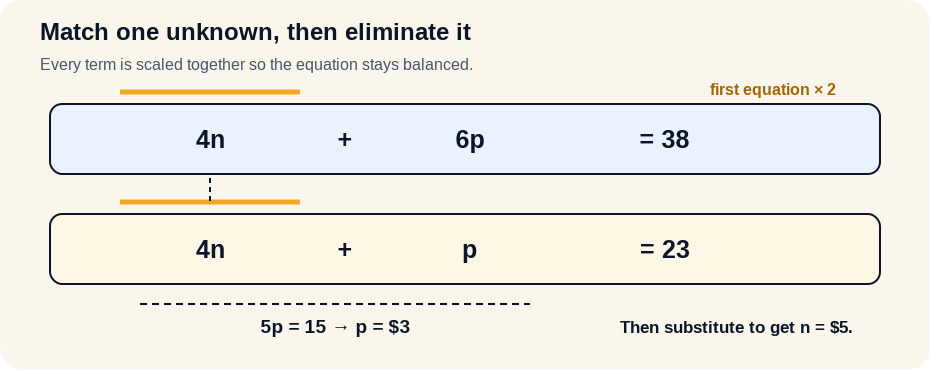
Two equation strips show 4n plus 6p equals 38 above 4n plus p equals 23, with the matching 4n terms marked for cancellation.
The first equation is doubled as a whole so the notebook terms match the second equation.

🤔 Predict first: What does p represent in this question?

Make one unknown match

The second equation has 4n. Double the first equation so its 2n becomes 4n. An equation stays balanced only when every term on both sides is multiplied by the same number.

Scale the complete equation

2×(2n+3p)=2×192 \times (2n + 3p) = 2 \times 19
4n+6p=384n + 6p = 38
4n+p=234n + p = 23

The two 4n groups now match. Subtract the second equation from the doubled first equation. The 4n terms disappear, leaving only pen terms and their difference in cost.

🤔 Predict first: When we double 2n + 3p = 19, which result is balanced?

Eliminate, then substitute

Subtract the untouched second equation from the doubled first. Four notebook terms cancel. Five pen terms cost $15, so one pen costs $3. Substitute that price into an original equation to find the notebook price.

Eliminate and solve

(4n+6p)−(4n+p)=38−23(4n + 6p) - (4n + p) = 38 - 23
5p=155p = 15
p=15÷5=3p = 15 \div 5 = 3
4n+3=234n + 3 = 23
4n=20,n=20÷4=54n = 20,\quad n = 20 \div 4 = 5

One notebook costs $5 and one pen costs $3. Use the interactive price slider to choose a pen price. It compares the notebook price implied by each original equation; the correct pen price is the one that makes both implications agree.

Choose the pen price

Predict first: What should agree at the correct pen price?

Check the original conditions

2×$5+3×$3=$192 \times \$5 + 3 \times \$3 = \$19
4×$5+$3=$234 \times \$5 + \$3 = \$23
Both conditions are satisfied\text{Both conditions are satisfied}

Catch the balance mistake

If you double only 2n and leave the other terms unchanged, you have changed the first purchase. The new line would not describe the same $19 purchase. It may still produce neat arithmetic, but it cannot be trusted.

🤔 Predict first: Which change breaks the first equation?

Algebra is optional enrichment

The Singapore primary syllabus emphasises arithmetic, fractions, ratio and model reasoning. A learner can solve many two-unknown questions with a well-drawn model. Use this page to practise a clean algebra representation when you want an extension, and never treat solving simultaneous equations as a required shortcut for every PSLE question.

Watch out — easily mixed up

Quick recap

Graduated practice

1. Erasers and rulers

Three erasers and 2 rulers cost $16. One eraser and 2 rulers cost $10. Find each price.

Show solution
Both purchases contain 2 rulers. Comparing their costs lets us find the price of the extra erasers first.

Step 1: Find the price of one eraser

Compare the two purchasesPurchase 12 rulers1 eraser1 eraser1 eraser$16$10Purchase 22 rulers1 eraser2 extra erasers cost ?The pieces show the items, not the sizes of their prices.
The first purchase has 2 more erasers, but the same number of rulers. So the difference in cost is the cost of those 2 erasers.
Cost of 2 erasers=$16−$10=$6Cost of 1 eraser=$6÷2=$3\begin{aligned} \text{Cost of 2 erasers} &= \$16-\$10\\ &=\$6\\[4pt] \text{Cost of 1 eraser} &= \$6\div2\\ &=\boxed{\$3} \end{aligned}
One eraser costs $3.

Step 2: Find the price of one ruler

Use the second purchase: 1 eraser and 2 rulers cost $10. Subtract the eraser’s price to find the cost of the rulers.
Cost of 2 rulers=$10−$3=$7Cost of 1 ruler=$7÷2=$3.50\begin{aligned} \text{Cost of 2 rulers} &= \$10-\$3\\ &=\$7\\[4pt] \text{Cost of 1 ruler} &= \$7\div2\\ &=\boxed{\$3.50} \end{aligned}
One ruler costs $3.50.
The prices found3 erasersPurchase 12 rulers: $7$3$3$3$16Purchase 22 rulers: $7$3$10The pieces show the items, not the sizes of their prices.

Step 3: Check both purchases

3×$3+2×$3.50=$9+$7=$161×$3+2×$3.50=$3+$7=$10\begin{aligned} 3\times\$3+2\times\$3.50&=\$9+\$7=\$16\\ 1\times\$3+2\times\$3.50&=\$3+\$7=\$10 \end{aligned}
Both costs match the question.
Answer
Each eraser costs $3 and each ruler costs $3.50.

2. Adult and child tickets

Two adult tickets and 3 child tickets cost $39. Four adult tickets and 1 child ticket cost $53. Find both prices.

Show solution
Make the number of adult tickets the same in both purchases. Then the difference in cost comes only from the extra child tickets.

Step 1: Show the two purchases

Each box below represents one ticket, not its price.
AdultAdultChildChildChildAdultAdultAdultAdultChildFirst purchase: total $39Second purchase: total $53Price of one adult ticket = ?Price of one child ticket = ?
Double the first purchase so that it also has 4 adult tickets.
2×$39=$782×2 adult tickets=4 adult tickets2×3 child tickets=6 child tickets\begin{aligned} 2\times \$39&=\$78\\ 2\times 2\text{ adult tickets}&=4\text{ adult tickets}\\ 2\times 3\text{ child tickets}&=6\text{ child tickets} \end{aligned}
So 4 adult tickets and 6 child tickets cost $78.

Step 2: Find the price of a child ticket

Compare the doubled purchase with the second purchase.
PurchaseAdult ticketsChild ticketsCost
Doubled first purchase46$78
Second purchase41$53
Difference05$25
Both purchases contain the same 4 adult tickets. Their costs cancel when we subtract. The extra cost pays for 5 extra child tickets.
Cost of 5 child tickets=$78−$53=$25Price of 1 child ticket=$25÷5=$5\begin{aligned} \text{Cost of 5 child tickets}&=\$78-\$53\\ &=\$25\\[4pt] \text{Price of 1 child ticket}&=\$25\div5\\ &=\boxed{\$5} \end{aligned}
One child ticket costs $5.

Step 3: Find the price of an adult ticket

Use the second purchase: 4 adult tickets and 1 child ticket cost $53. Subtract the cost of the child ticket first.
Cost of 4 adult tickets=$53−$5=$48Price of 1 adult ticket=$48÷4=$12\begin{aligned} \text{Cost of 4 adult tickets}&=\$53-\$5\\ &=\$48\\[4pt] \text{Price of 1 adult ticket}&=\$48\div4\\ &=\boxed{\$12} \end{aligned}
One adult ticket costs $12.

Step 4: Check both purchases

2×$12+3×$5=$24+$15=$394×$12+$5=$48+$5=$53\begin{aligned} 2\times\$12+3\times\$5&=\$24+\$15=\$39\\ 4\times\$12+\$5&=\$48+\$5=\$53 \end{aligned}
Both totals match the question.
Answer
Adult ticket: $12 each
Child ticket: $5 each

3. A non-money pair

Two notebooks and 5 stickers cost 19 units. Four notebooks and 1 sticker cost 17 units. Find the value of one notebook and one sticker.

Show solution
Double the first purchase so that both purchases contain 4 notebooks. Then cancel the matching notebooks to find the cost of the extra stickers.

Step 1: Match the number of notebooks

The given purchases are:
PurchaseNotebooksStickersCost (units)
First2519
Second4117
Double everything in the first purchase:
Notebooks=2×2=4Stickers=5×2=10Cost=19×2=38 units\begin{aligned} \text{Notebooks}&=2\times2=4\\ \text{Stickers}&=5\times2=10\\ \text{Cost}&=19\times2=38\text{ units} \end{aligned}
We now compare 4 notebooks and 10 stickers with 4 notebooks and 1 sticker.
Cancel the matching itemsStickereach = Notebookeach = StickerDoubled first38 units9 extra stickers: cost = ?Stickereach = NotebookSecond17 unitsThe blocks count items, not their prices. The outlined notebooks match and cancel.

Step 2: Find the value of one sticker

Both purchases have the same 4 notebooks, so their difference in cost comes only from the extra stickers.
Extra stickers=10−1=9Cost of 9 stickers=38−17=21 unitsCost of 1 sticker=21÷9=213 units\begin{aligned} \text{Extra stickers}&=10-1=9\\ \text{Cost of 9 stickers}&=38-17=21\text{ units}\\ \text{Cost of 1 sticker}&=21\div9\\ &=\boxed{2\frac{1}{3}\text{ units}} \end{aligned}
One sticker costs 2132\frac{1}{3} units.

Step 3: Find the value of one notebook

Use the second purchase: 4 notebooks and 1 sticker cost 17 units. Subtract the sticker’s cost, then divide by 4.
Cost of 4 notebooks=17−213=1423 unitsCost of 1 notebook=1423÷4=443÷4=113=323 units\begin{aligned} \text{Cost of 4 notebooks} &=17-2\frac{1}{3}\\ &=14\frac{2}{3}\text{ units}\\[4pt] \text{Cost of 1 notebook} &=14\frac{2}{3}\div4\\ &=\frac{44}{3}\div4\\ &=\frac{11}{3}\\ &=\boxed{3\frac{2}{3}\text{ units}} \end{aligned}
One notebook costs 3233\frac{2}{3} units.

Step 4: Check both purchases

2×323+5×213=223+353=19 units4×323+213=443+73=17 units\begin{aligned} 2\times3\frac{2}{3}+5\times2\frac{1}{3} &=\frac{22}{3}+\frac{35}{3} =19\text{ units}\\[4pt] 4\times3\frac{2}{3}+2\frac{1}{3} &=\frac{44}{3}+\frac{7}{3} =17\text{ units} \end{aligned}
Both costs match the question.
Answer
  • One notebook costs 3233\frac{2}{3} units.
  • One sticker costs 2132\frac{1}{3} units.

🎯 Mastery check

Answer all 7 — your progress is saved on this device.

  1. What should each variable represent?

  2. What is the correct translation of 2 notebooks and 3 pens costing $19?

  3. When doubling 2n + 3p = 19, what must happen?

  4. Subtracting 4n + p = 23 from 4n + 6p = 38 leaves…

  5. If 5p = 15, what is p?

  6. After p = 3, which original equation gives 4n = 20?

  7. Why is this page described as an optional algebra extension?