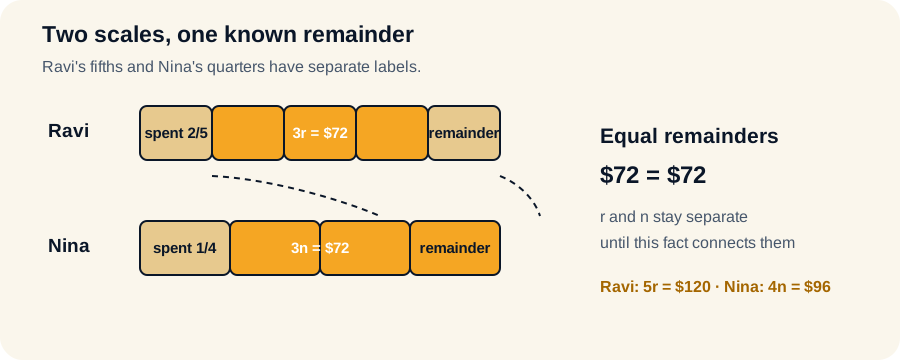
When two quantities are divided differently, each whole needs its own part scale. A stated equal remainder or known amount can connect the scales. That is the heart of units and parts: keep the labels separate until the story gives you a real equality.
Parents: ask your child to name the two independent wholes before drawing any bars. Then ask what the question says is equal.
By the end you will be able to give each whole a separate label, value each scale from a known part, compare the original wholes, and check the fractions in the story.
When this method helps
Use units and parts when two wholes are partitioned differently. If two unknown fractional portions are equal, making units equal may be more direct. Do not call two parts equal just because both are written as 1u: the labels can describe different scales.
Ravi spent 52 of his money. Nina spent 41 of hers. Each had $72 left. How much more money did Ravi have than Nina at first?
🤔 Predict first: Ravi and Nina each have $72 left. Which fact connects their two scales?
Give each whole its own label
Ravi spent 52, so 53 remained. Name 51 of Ravi's money r. Nina spent 41, so 43 remained. Name 41 of Nina's money n. The labels are deliberately different because fifths and quarters are different partitions.
Write the equal remainders
3r=$72
3n=$72
r=$72÷3=$24
n=$72÷3=$24
Ravi's fifths and Nina's quarters stay separate. The equal three-part remainders are the bridge.
🤔 Predict first: Ravi spent 52 of his money. How many fifths remained?
Find each original whole
Now value the whole bars. Ravi's money is five r parts. Nina's money is four n parts. Because both labels happen to be $24 here, the original totals can be compared.
Work back to the original totals
Ravi=5r=5×$24=$120
Nina=4n=4×$24=$96
Difference=$120−$96=$24
🔬
Units and parts: connect the equal remainders
🤔 Predict first: What connects the two independent scales?
Check the story
52×$120=$48
$120−$48=$72
41×$96=$24
$96−$24=$72
Original difference=$120−$96=$24
Why the scales stay separate
51 of Ravi's money and 41 of Nina's money are not automatically the same amount. In this question, 53 and 43 both equal $72, so r and n work out to the same value. That equality comes from the stated remainder, not from the letters.
🤔 Predict first: Which mistake should you catch first?
Watch out — easily mixed up
Quick recap
Graduated practice
Open each solution only after you have identified the known part or remainder for both wholes.
1. Compare paper lengths
Ada used 31 of her paper strip. Ben used 52 of his. Each had 60 cm left. Whose strip was longer at first, and by how much?
Show solution
Ada keeps two parts, while Ben keeps three. Use a for Ada's 31 part and b for Ben's 51 part.
Practice 1
2a=60 cm
a=60÷2=30 cm
Ada=3×30=90 cm
3b=60 cm
b=60÷3=20 cm
Ben=5×20=100 cm
Difference=100−90=10 cm
Ben's strip was 10 cm longer. Check that each used fraction leaves 60 cm.
2. Equal used amounts
Cara used 83 of a ribbon and Dev used 52 of another ribbon. Each used 30 cm. Find both original lengths.
Show solution
The known amount is the used portion, so value the two scales independently.
Practice 2
3c=30 cm
c=30÷3=10 cm
Cara=8×10=80 cm
2d=30 cm
d=30÷2=15 cm
Dev=5×15=75 cm
Cara's ribbon was 80 cm and Dev's was 75 cm. Check that both named used portions are 30 cm.
3. Unequal known remainders
Eli spent 41 of his money and had $90 left. Farah spent 52 of hers and had $72 left. Who had more at first?
Show solution
Eli keeps 43; Farah keeps 53. The two unit labels remain separate even though the final totals coincide.
Practice 3
3e=$90
e=$90÷3=$30
Eli=4×$30=$120
3f=$72
f=$72÷3=$24
Farah=5×$24=$120
Difference=$120−$120=$0
They had equal amounts at first: $120 each.
🎯 Mastery check
Answer all 7 — your progress is saved on this device.
When is units-and-parts reasoning useful?
Ravi spent 52 of his money. How many parts remained?
Which equations use Ravi and Nina's equal $72 remainders?