
Combined Rates: Water, Work and Speed
How simultaneous rates join into one rate, how total quantity links to time, and how to check a rate answer in its original story.
⏱ 8 min · 🎯 4 things to master
Combined rates: Two Taps. How Long? | PSLE Maths
Video · 3:45
Two taps can fill one tank faster together, but do you add the taps' times? That tempting shortcut gives the wrong story. The useful quantity is the amount each tap adds per minute.
Parents: let your child predict whether rates or times should be joined, then reveal the working and check it against the tank story together.
By the end you'll be able to decide when rates can be combined, find a simultaneous combined rate, connect quantity, rate and time, and check a rate answer.
When can rates join?
A tells you how much happens in one unit of time. Litres per minute, cards per minute and kilometres per hour are all rates. You can add two rates when they measure the same kind of thing in the same time unit and happen at the same time.
For example, two taps both add litres every minute to one tank. Their contributions happen together, so one combined rate describes the pair. Two consecutive journey stages are different: find each stage time before adding them.
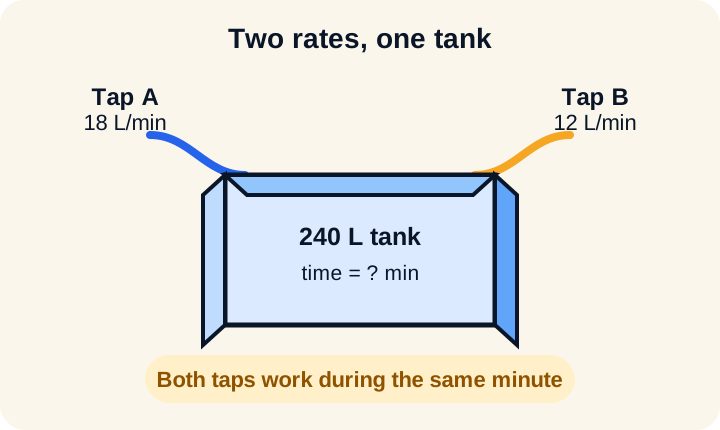
Combine two rates
Predict first: When two taps fill together, which quantity should we add?
Worked example: two taps, one tank
Here is the complete question:
Two taps fill an empty 240-litre tank at the same time. Tap A supplies 18 litres per minute and Tap B supplies 12 litres per minute. How long do they take to fill the tank?
First name what each rate measures. Both taps add litres during the same minute, so their rates are compatible.
Combine the rates
Every minute, the pair adds 30 litres. The tank needs 240 litres, so time is found by dividing the total quantity by the combined rate.
Find the filling time
The two taps fill the tank in 8 minutes. The unit is minutes because the question asks for time.
Check both contributions
An answer is stronger when it returns to the original conditions. In 8 minutes, Tap A supplies 18 litres each minute and Tap B supplies 12 litres each minute. Their amounts should add to the tank capacity.
Check the story
The check works, so the answer matches every given condition. Notice that 8 minutes belongs to both taps because they were working together.
🤔 Predict first: Two taps work together. Which working matches the story?
Rate, quantity and time are a team
The same relationship can be rearranged in three ways. tells you the amount for one unit. is the total amount. tells you how many units passed.
If you know the rate and time, multiply to find quantity. If you know quantity and one of the other two, divide. Always keep the units attached so you do not confuse litres with litres per minute.
The same relationship works for making, filling or travelling. Keep the quantity, rate and time in matching units, and rearrange the relationship to isolate the missing value.
Three useful forms
Graduated practice
Try each question before opening its solution. Say what the rate measures and whether the workers act together or one after another.
Practice 1 — start here
Two printers produce 25 and 15 cards per minute. How many cards do they print together in 6 minutes?
Show the solution
Both printers work at the same time, so first find their combined rate.
Working
They print 240 cards.
Practice 2 — change the missing quantity
A hose fills a 360-litre tank at 24 litres per minute. How long does filling take?
Show the solution
The total quantity and rate are known, so divide to find time.
Working
The hose takes 15 minutes.
Practice 3 — two speed legs
A cyclist travels 72 km at 24 km/h and then 54 km at 18 km/h. Find the total travel time.
Show the solution
The legs happen one after another, so find each time before adding them.
Working
The total travel time is 6 hours. The speeds were not averaged because the distances and legs were separate.
Watch out — easily mixed up
Quick recap
🎯 Mastery check
Answer all 7 — your progress is saved on this device.
Two taps supply 18 L/min and 12 L/min at the same time. What is their combined rate?
A 240-litre tank fills at a combined rate of 30 L/min. How long does it take?
Which pair can have its rates added directly?
A printer makes 25 cards per minute for 6 minutes. How many cards does it make?
A 360-litre tank fills at 24 L/min. Which operation finds the time?
A cyclist travels 72 km at 24 km/h and 54 km at 18 km/h in separate legs. What is the total time?
Two taps fill 240 L in 8 min. Tap A supplies 144 L. How much does Tap B supply?