Volume Conservation: Same Water, New Tank
A visual tank transfer makes conservation of volume concrete: the water amount stays fixed while the base area and depth change.
⏱ 7 min · 🎯 4 things to master
Volume conservation: Same Water. Same Depth? | PSLE Maths
Video · 4:45
When water moves from one tank to another, the tank changes but the water does not vanish. The amount stays the same. Draw the transfer, calculate the first volume, then place that exact volume in the second tank.
Parents: ask your child whether the water volume, tank depth or water shape is guaranteed to stay the same before revealing the transfer.
By the end you'll be able to calculate volume from base area and depth, conserve volume during a transfer, and check a new depth with units.
Track the same water
The of a tank is the volume of the water inside it. For a tank with a uniform base, use volume = base area × depth. A transfer changes the container, but the amount of water stays constant as long as nothing spills.
Pour without losing volume
Predict first: When water is poured into a wider tank, what stays the same if nothing spills?
Worked example: Tank A to Tank B
Here is the complete question:
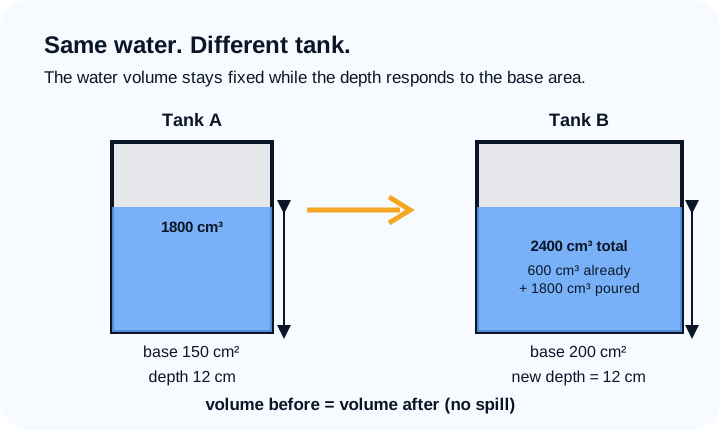
Tank A and Tank B are rectangular tanks with vertical sides. Tank A has base area 150 cm² and water depth 12 cm. All its water is poured into Tank B, which already contains 600 cm³ of water and has base area 200 cm². Tank B has enough capacity and no water spills. Find the new water depth in Tank B.
First find the volume in Tank A. Then add that volume to Tank B's initial 600 cm³. Finally divide by Tank B's base area to find its depth.
Find the water in Tank A
Transfer the water
Find Tank B depth
The new depth in Tank B is 12 cm. The equal depth is a result of the chosen numbers, not a rule for every transfer. The volumes match because the water was transferred without spilling.
Why the depth can change
If the receiving tank has a wider base, the same water spreads over more area and becomes shallower. If the receiving base is narrower, the same water becomes deeper. Conservation tells you what stays fixed; the base area tells you how the depth changes.
🤔 Predict first: The same water enters a receiving tank with a larger base area. What usually happens to the depth?
Use the conservation equation
Check the transfer
Multiply the receiving base area by the new depth. It should equal the water transferred from Tank A plus the water already in Tank B.
Check Tank B
The two volumes agree. This check catches a missed initial amount, a wrong divisor or a unit mismatch.
Graduated practice
Try each question before opening its solution. Label every volume in cubic units and every depth in linear units.
Practice 1 — start here
A tank has base area 80 cm² and water depth 15 cm. The water is poured into a tank with base area 120 cm². Find the new depth.
Show the solution
Find the original volume, then divide by the new base area.
Working
The new depth is 10 cm.
Practice 2 — include water already there
Tank A contains 900 cm³ of water. Tank B already contains 300 cm³ and has base area 150 cm². After all Tank A's water is added, find Tank B's depth.
Show the solution
Add the volumes before dividing by the receiving base area.
Working
The final depth is 8 cm.
All outside faces are painted before the unit cuts.
Practice 3 — a solid changes shape
A solid cube is painted on the outside and cut into unit cubes. The original cube has edge length 3 units. How many small cubes have paint on exactly two faces?
Show the solution
Exactly two painted faces occur on the edge cubes, excluding the corners. Each of the 12 edges has 3 − 2 such cubes.
Working
There are 12 unit cubes with paint on exactly two faces.
Watch out — easily mixed up
Quick recap
🎯 Mastery check
Answer all 7 — your progress is saved on this device.
A tank has base area 150 square cm and depth 12 cm. What is its volume?
What stays the same when all water is poured into another tank without spilling?
A 1200 cubic cm volume enters a tank with base area 120 square cm. What is the depth?
Tank B has 300 cubic cm already and receives 900 cubic cm. How much water is in it?
The same volume enters a wider tank. What happens to the depth?
Which check confirms a final depth of 12 cm in a tank with base area 200 square cm?
A cube of edge 3 units is cut into unit cubes. How many have paint on exactly two faces?
Cuboid dimensions: length 3, breadth 3, height 3 units. All outside faces are painted, then cut into unit cubes. All outside faces are painted before the unit cuts.