
Pattern Formulas: Square Numbers and Cycles
Turn a picture pattern into n²+n, then use the same careful indexing and remainder thinking for cycles and bead figures.
⏱ 7 min · 🎯 4 things to master
Find Figure 25 Without Counting Every Tile | Pattern Formulas
Video · 3:41
Counting every tile in a large figure is slow and easy to lose. Look for the part that repeats: a square of side n and one extra strip of n tiles. Once the pattern is written as a formula, Figure 25 is one substitution.
Parents: ask your child to describe the first three figures in parts, then check the formula against Figure 1 before trying a large figure.
By the end you'll be able to split a visual pattern into square and strip parts, build a formula, test it, and use remainders for repeating cycles.
See the square and the strip
In the main pattern, Figure n has an n by n blue square and a strip of n amber tiles. The part grows faster, while the strip adds one row of n.
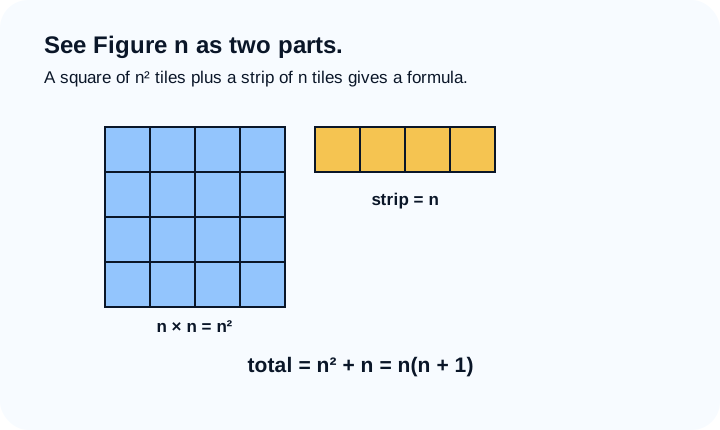
Build Figure n
Predict first: What are the two parts of Figure n?
Worked example: Figure 25
Here is the complete question:
Figure n is made from an n by n square and a strip of n tiles. Find the number of tiles in Figure 25.
The square contributes n × n tiles, which is n². The strip contributes n more tiles. Add the two parts, then substitute 25.
Build the pattern formula
Substitute Figure 25
Figure 25 has 650 tiles. The factored form and the expanded form give the same count; use the form that is clearest for the numbers.
Test before trusting the formula
Use a small figure to check what the picture means. Figure 3 has a 3 by 3 square and a strip of 3, so its total should be 12. If a formula gives a different result, return to the picture and recount the two parts.
Check Figure 3
Repeating cycles use remainders
The source pattern also includes a repeating red-red-blue-green cycle. A cycle of four starts again after every four positions. Divide the position by 4 and use the remainder: 1 or 2 means red, 3 means blue and 0 means green.
Find the colour at position 73
Position 73 is red. A remainder of 0 means the last colour in the cycle, green, rather than the first colour.
🤔 Predict first: In this four-colour cycle, what does remainder 0 mean?
Another pattern check: bead Figure 40
The bead extension changes the rule: Figure 1 has 7 beads and each new figure adds 4 beads. This is a consecutive pattern, so count the intervals from Figure 1 to Figure 40 before adding the increase.
Find bead Figure 40
Figure 40 has 163 beads. Do not reuse the square-plus-strip formula when the rule has changed to “add 4 each time”.
Graduated practice
Try each question before opening its solution. Draw or describe the repeating parts, then test with a small figure.
Practice 1 — start here
Figure n has an n by n square and a strip of n tiles. Find Figure 12.
Show the solution
Use the square-plus-strip formula.
Working
Figure 12 has 156 tiles.
Practice 2 — a cycle position
The colours repeat red, red, blue, green. What colour is position 26?
Show the solution
Find the remainder after dividing by the cycle length 4.
Working
Position 26 is red.
Practice 3 — count intervals
Figure 1 in a bead pattern has 7 beads. Each new figure has 4 more beads than the previous figure. How many beads are in Figure 40?
Show the solution
Count the intervals from Figure 1 to Figure 40. There are 39 increases, not 40.
Working
Figure 40 has 163 beads.
Watch out — easily mixed up
Quick recap
🎯 Mastery check
Answer all 7 — your progress is saved on this device.
A figure has an n × n square and a strip of n tiles. Which formula gives its total?
How many tiles are in Figure 25 for the square-plus-strip pattern?
Why should Figure 3 be checked?
In a red-red-blue-green cycle, what colour is position 73?
In the red-red-blue-green cycle, what does remainder 0 mean?
What is Figure 12 for the n²+n pattern?
Figure 1 has 7 beads and each new figure adds 4. What is Figure 40?