Overlapping Areas: Count the Shared Region Once
When two mats overlap, add both areas and remove the shared patch once so every part of the floor is counted exactly once.
⏱ 6 min · 🎯 4 things to master
Count the Overlap Once! | Covered Area Maths
Video · 4:03
Two mats can cover one floor patch together, but the shared patch belongs to both mats. If you add the two mat areas without correcting it, that patch is counted twice. Add first, then subtract the shared region once.
Parents: ask your child to shade the shared patch and decide how many times it appears in the first addition before showing the correction.
By the end you'll be able to split a covered region into rectangles, remove a double-counted overlap, and check that each floor patch is counted once.
See the shared region
The is the region shared by two shapes. If the full area of shape A and the full area of shape B are added, the overlap appears in both totals. The covered area is therefore:
Let A and B be the two whole areas, including their shared patch.
The overlap relationship
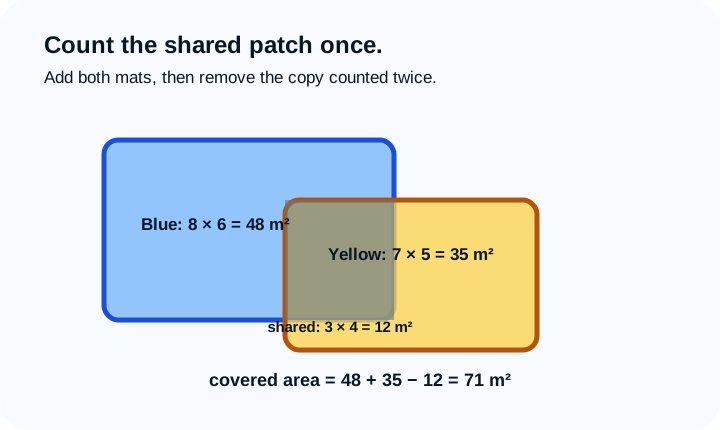
Count the shared patch once
Predict first: If two mats overlap, how many copies of the shared patch belong in the covered floor total?
Worked example: two mats on one floor
Here is the complete question:
A blue mat is 8 m by 6 m. A yellow mat is 7 m by 5 m. They overlap in a rectangle 3 m by 4 m. Find the total floor area covered by at least one mat.
Find both full mat areas, then find the shared patch. The phrase “at least one” means the overlap should appear once in the final answer.
Find the three areas
Remove the double count
The mats cover 71 m² of floor. The subtraction removes one copy of the shared 12 m² patch, leaving one copy in the total.
Check by using non-overlapping parts
Another route is to split the floor into blue-only, shared and yellow-only regions. These pieces do not overlap, so adding them should give the same answer.
Check each floor patch once
The check works because every covered patch appears exactly once in the second method.
🤔 Predict first: If the overlap is 12 m², what should happen when blue and yellow full areas are added?
Graduated practice
Try each question before opening its solution. Sketch the shapes and shade the shared region first.
Practice 1 — start here
Two posters cover 30 cm² and 24 cm². Their overlap is 6 cm². Find the area covered by at least one poster.
Show the solution
Subtract the shared region once because it was included in both full areas.
Working
The covered area is 48 cm².
Practice 2 — identify the double count
Two rectangular garden beds have a combined summed area of 96 m². Their shared strip is 14 m². Find the union area and the area counted twice in the simple sum.
Show the solution
The simple sum counts the shared strip twice. Remove one copy for the union, while the amount counted twice is the shared strip itself.
Working
The union area is 82 m², and 14 m² was counted twice in the simple sum.
Practice 3 — no overlap
Two floor mats have areas 18 m² and 25 m² and do not touch. Find the total area covered.
Show the solution
There is no shared region, so the overlap is zero.
Working
The total covered area is 43 m².
Watch out — easily mixed up
Quick recap
🎯 Mastery check
Answer all 7 — your progress is saved on this device.
Two mats have areas 48 m² and 35 m² and overlap by 12 m². What area do they cover together?
Why is the overlap subtracted?
Rectangle A is 30 m², B is 24 m² and the overlap is 6 m². What is the covered area?
Areas are 54 m² and 42 m², and the covered total is 82 m². What is the overlap?
Two mats do not touch and have areas 18 m² and 25 m². What correction is needed?
Which check counts every covered patch exactly once?
If the overlap grows while both full mat areas stay fixed, what happens to the covered area?