
One Repeated Cell: Find the Complement Area
One tile contains a square with a circular cut-out. Find the uncovered part once, then scale it across all the repeated tiles.
⏱ 6 min · 🎯 4 things to master
Solve One Tile, Then All 24 | Uncovered Area Maths
Video · 4:21
When 24 identical slabs repeat, solving all 24 drawings separately invites mistakes. Solve one slab first: square area minus circular cut-out. Then multiply the uncovered complement by 24.
Parents: ask your child to label the circle's radius before calculating, then predict why the one-cell answer can be scaled exactly.
By the end you'll be able to find a complement area, turn diameter into radius, and scale one repeated cell across a whole pattern.
Solve one cell
The is the part of a cell that remains uncovered by the circular cut-out. For one square cell, subtract the two areas. Then multiply the uncovered area of one cell by the number of identical cells:
The one-cell relationship
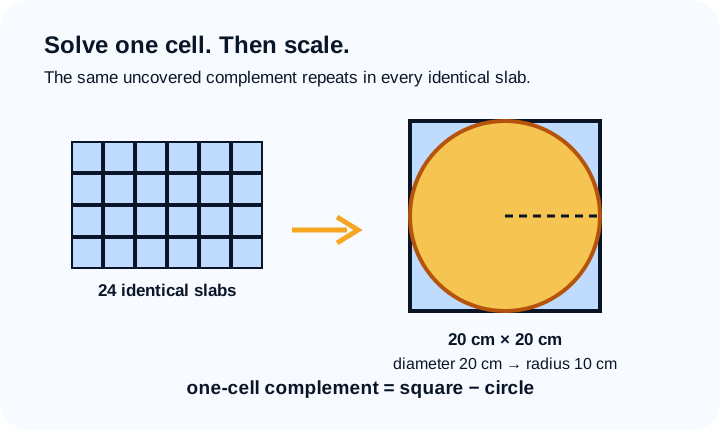
Solve one cell, then scale
Predict first: A circle has diameter 20 cm. What is its radius?
Worked example: 24 identical slabs
Here is the complete question:
A walkway is paved with 24 identical square slabs. Each slab is 20 cm by 20 cm and contains a circular metal disc of diameter 20 cm. Using pi = 3.14, find the total slab area not covered by the discs.
Find the area of one square and one circle. Subtract to leave the uncovered part of one slab, then multiply by 24.
Find one slab's complement
Scale across 24 slabs
The total uncovered area is 2064 cm². The cells are identical, so the same 86 cm² complement repeats 24 times.
Check with totals
Calculate the total square area and subtract the total circular cut-out area. It should agree with the one-cell method.
Check all 24 pieces
The two routes match. The repeated-cell method is shorter because it uses the identical structure.
🤔 Predict first: A circular cut-out has diameter 20 cm. Which length belongs in the radius step?
Graduated practice
Try each question before opening its solution. Solve one cell completely before scaling.
Practice 1 — start here
There are 10 identical square tiles. Each tile is 14 cm by 14 cm and has a circular cut-out of radius 7 cm. Use pi = . Find the total uncovered area.
Show the solution
Find the complement of one tile, then multiply by 10.
Working
The total uncovered area is 420 cm².
Practice 2 — scale a changed cell
There are 18 identical rectangular cells, each 12 cm by 10 cm. A 4 cm by 3 cm rectangle is painted in each. Find the unpainted area.
Show the solution
Find the unpainted part of one cell first.
Working
The total unpainted area is 1944 cm².
Practice 3 — work backwards
Each of 12 identical square cells has area 225 cm². A circular cut-out has area 154 cm². Find the total uncovered area.
Show the solution
The complement of one cell is the cell area minus the cut-out area.
Working
The total uncovered area is 852 cm².
Watch out — easily mixed up
Quick recap
🎯 Mastery check
Answer all 7 — your progress is saved on this device.
A 20 cm square contains a circle of diameter 20 cm. What is the circle radius?
Using pi = 3.14, what is the area of a circle with radius 10 cm?
A 20 cm square has a 314 square cm circular cut-out. What is its uncovered area?
If one repeated cell leaves 86 square cm and there are 24 cells, what is the total?
Ten tiles are 14 cm squares with a radius 7 cm cut-out. Using pi = , what is the total uncovered area?
Which calculation finds one 12 cm by 10 cm slab after a 4 cm by 3 cm rectangle is removed?
Why is it efficient to solve one repeated cell first?