When three people are linked by different clues, drawing three unrelated bars makes the question feel larger than it is. Put the bars on one baseline. A shared base quantity becomes repeated equal units, while a fixed “more” or “less” piece stays visibly separate.
Parents: ask your child to choose whose amount should be the base and predict how many equal units the total will contain before revealing the stack.
By the end you will be able to choose a base quantity, stack three related bars, keep fixed pieces separate, and solve the common unit from a total.
Choose a base quantity
Model stacking fits when several quantities can be described using one amount as a base. If one person has “12 more” than another, draw the shared base and a separate 12 piece. If a third person has “twice as many”, copy the base bar twice.
It does not fit when the relationships use unrelated wholes or when no common base can be identified. A comparison model can be enough for two quantities; stacking is useful when a third linked quantity joins the picture.
🤔 Predict first: Amir, Bella and Chen have 100 stamps. Bella has 12 more than Amir and Chen has twice Amir. Whose amount is the useful base?
Stack the related bars
Here is the full question:
Amir, Bella and Chen have 100 stamps altogether. Bella has 12 more stamps than Amir. Chen has twice as many stamps as Amir. How many stamps does each child have?
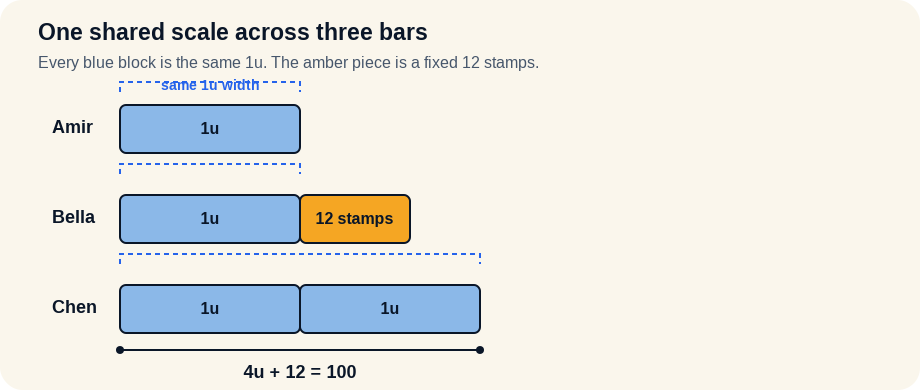
Let Amir's collection be 1 unit. Bella has the same 1 unit plus a fixed 12-stamp piece. Chen has two copies of Amir's unit. Align all three left edges so every 1u block has the same width.
Stack each bar on the same left edge. The amber 12-stamp piece is fixed and is not another unit.
Translate the stack
Amir=1u
Bella=1u+12 stamps
Chen=2u
🤔 Predict first: How many true 1u blocks are in all three bars?
Remove the fixed piece before dividing
The three amounts total 4u plus the fixed 12 stamps. The total is 100, so first remove the fixed piece. Only the remaining 88 stamps are carried by four equal units.
Find one unit
4u+12=100
4u=100−12=88
1u=88÷4=22 stamps
Amir=1×22=22 stamps
Bella=22+12=34 stamps
Chen=2×22=44 stamps
🔬
Model stack: find the shared unit
🤔 Predict first: What should be removed before dividing the total?
The answers are Amir 22, Bella 34 and Chen 44. The model gives one base value, then each bar is read from its own relationship.
Check every clue
22+34+44=100 stamps
34−22=12 stamps
44=2×22 stamps
Fixed pieces are not units
A rectangle labelled 12 stamps has a known value. It is not automatically the same length as 1u. If you counted it as another unit, you would write 5u = 100 and get the wrong answer. The drawing must show the difference between a repeated base piece and a fixed add-on.
🤔 Predict first: Bella's bar is 1u plus 12 stamps. Why is the 12 piece separate?
Watch out — easily mixed up
Quick recap
Graduated practice
1. Three card collections
Ana, Bo and Cara have 87 cards altogether. Bo has 7 more cards than Ana. Cara has three times as many cards as Ana. Find each amount.
Show solution
Use Ana’s amount as 1 unit. Remove Bo’s extra 7 cards from the total, then divide the remaining cards into equal units.
Step 1: Draw the relationship
Ana has 1 unit, Bo has 1 unit and 7 extra cards, and Cara has 3 units.
The extra 7-card piece is not drawn to scale.
From the model, the total consists of 5 equal units and 7 extra cards:
1+1+3=5 units
Step 2: Find the value of 1 unit
Subtract the extra 7 cards first. The remaining cards make up exactly 5 units.
5 units1 unit=87−7=80 cards=80÷5=16 cards
So Ana has 16 cards.
Step 3: Find Bo’s and Cara’s amounts
Bo has 7 more cards than Ana:
Bo’s cards=16+7=23 cards
Cara has three times Ana’s amount:
Cara’s cards=3×16=48 cards
Check the total:
16+23+48=87 cards✓
Answer
Ana has 16 cards, Bo has 23 cards, and Cara has 48 cards.
2. A shorter first bar
Dev has 5 fewer stickers than Eva. Farah has twice as many stickers as Eva. Together they have 135 stickers. Find each amount.
Show solution
Use Eva’s amount as 1 unit. Add back Dev’s missing 5 stickers to make 4 complete units.
Step 1: Represent the amounts in units
Eva has 1 unit, so Farah has 2 units. Dev has 1 unit minus 5 stickers.
The 5-sticker gap is not drawn to scale.
From the model:
4 units−5 stickers=135 stickers
Step 2: Add back the missing stickers
If we give Dev 5 more stickers, he will have 1 complete unit, just like Eva. The new total is therefore 4 complete units.