
Cut and Paste: Rearrange Shapes to Find Area
A cut-and-paste move turns a slanted parallelogram into a rectangle, making its base and perpendicular height easy to use.
⏱ 7 min · 🎯 4 things to master
Move One Triangle, Find the Area | Parallelogram Maths
Video · 3:49
A parallelogram can look harder than a rectangle because its sides lean. Cut one triangular piece, slide it to the other side, and the slant disappears. The area has not changed; the useful base and perpendicular height are now easy to see.
Parents: ask your child which piece can move without changing its size, then let them predict the rectangle's dimensions before opening the working.
By the end you'll be able to choose a base and perpendicular height, explain a cut-and-paste rearrangement, and find the area of a parallelogram accurately.
Find the two useful lengths
For a parallelogram, the base is the side chosen along the bottom. The perpendicular height is the shortest distance from the base line to the opposite parallel line. A sloping side can be longer, but it is not the height unless it meets the chosen base at a right angle.
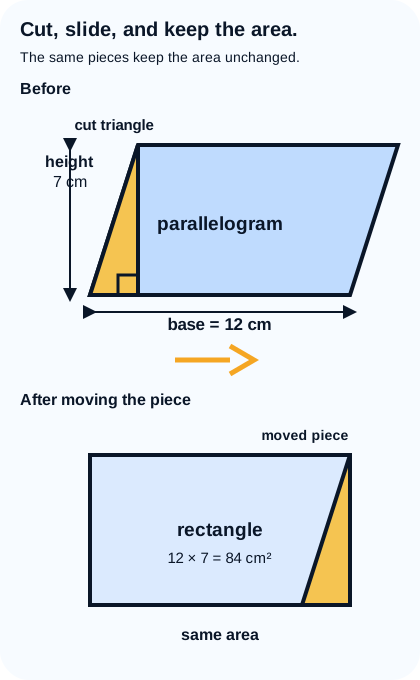
Move one piece — does the area change?
Predict first: When an equal piece is moved without stretching, what happens to the area?
Worked example: the slanted parallelogram
Here is the complete question:
A parallelogram has base 12 cm and perpendicular height 7 cm. Find its area.
Cut the small triangle at the left. Slide it to the right. The two pieces make a rectangle with length 12 cm and width 7 cm. Cutting and moving a piece does not change the amount of space covered.
Find the rearranged rectangle area
The parallelogram has area 84 cm². The rectangle is only a helpful picture; the original shape and the rearranged shape have the same area.
Why the sloping side is a trap
The parallelogram's sloping side is not the distance between the parallel lines. The perpendicular height crosses the base at 90°. If the sloping side is used by mistake, the answer describes a different rectangle and is too large for this question.
Use the same idea when a diagram is not drawn to scale. Read the labelled base and the perpendicular distance, then imagine the triangle sliding across.
🤔 Predict first: Which pair of measurements finds the area of this parallelogram?
Check that every piece is kept
Trace the cut triangle and the remaining piece in both pictures. The same two pieces fit together without a gap or overlap, so the rearranged rectangle has exactly the original area.
Check the main example
Every piece is kept exactly once. Keep the unit squared because a length was multiplied by a length.
Graduated practice
Try each question before opening its solution. Name the base, mark the perpendicular height, and describe what the moved piece becomes.
Practice 1 — start here
A parallelogram has base 15 m and perpendicular height 4 m. Find its area.
Show the solution
Treat the parallelogram as a rectangle after moving the cut triangle.
Working
The area is 60 m².
Practice 2 — two matching pieces
Two congruent trapeziums can be fitted together to make a parallelogram. The parallel sides of one trapezium are 8 cm and 14 cm, and its height is 5 cm. Find the area of one trapezium.
Show the solution
Two copies make a parallelogram whose base is 8 + 14 cm and whose perpendicular height is 5 cm. Divide the total area by 2.
Working
One trapezium has area 55 cm².
Practice 3 — explain the move
A parallelogram has base 9 cm and perpendicular height 6 cm. A student says its area is 9 × 9 because the sloping side is 9 cm. Correct the student and find the area.
Show the solution
The sloping side is not the perpendicular height. Slide the cut triangle to make a rectangle with base 9 cm and width 6 cm.
Working
The correct area is 54 cm².
Watch out — easily mixed up
Quick recap
🎯 Mastery check
Answer all 7 — your progress is saved on this device.
A parallelogram has base 12 cm and perpendicular height 7 cm. What is its area?
What does the cut triangular piece do?
Which measurement is the height for a chosen horizontal base?
A parallelogram has base 15 m and height 4 m. What is its area?
Two matching trapeziums together have area 110 square cm. What is the area of one?
A student uses 9 cm × 9 cm when the base is 9 cm and perpendicular height is 6 cm. What should change?
Why do the original parallelogram and the rearranged rectangle have equal area?