Common Base and Height: Same Area
How a shared base and perpendicular height make different-looking triangles equal in area, with a worked example and an interactive experiment.
⏱ 9 min · 🎯 4 things to master
Common base and height: Different Shapes. Same Area? | PSLE Maths
Video · 3:49
Two triangles can look completely different and still cover exactly the same amount of space. The trap is trusting the sloping sides or the way a triangle looks. The useful clues are the chosen base and the perpendicular height.
Parents: ask your child to predict what will stay equal while the apex moves, then let them reveal the explanation together.
By the end you'll be able to choose a common base, find the perpendicular height between parallel lines, recognise equal-area triangles, and explain what changes when the height changes.
The height that matters
The is the side you choose to measure along. The is the shortest straight distance from that base line to the opposite corner. It is not automatically a sloping side.
For any triangle, use of the product of the base and perpendicular height.
Here b is the base and h is its perpendicular height.
Triangle area relationship
If two triangles share a base and their top points lie on the same line parallel to that base, their perpendicular heights match. Their areas match too, even when one triangle leans left and the other leans right.
🤔 Predict first: A triangle has base 14 cm and perpendicular height 6 cm. What is its area?
Worked example: ABP and ABQ
Here is a full PSLE-style question:
Points P and Q lie on a line parallel to AB. AB is 14 cm and the perpendicular distance between the parallel lines is 6 cm. Find the areas of triangles ABP and ABQ.
First, choose AB as the common base. For both triangles, the base is 14 cm.
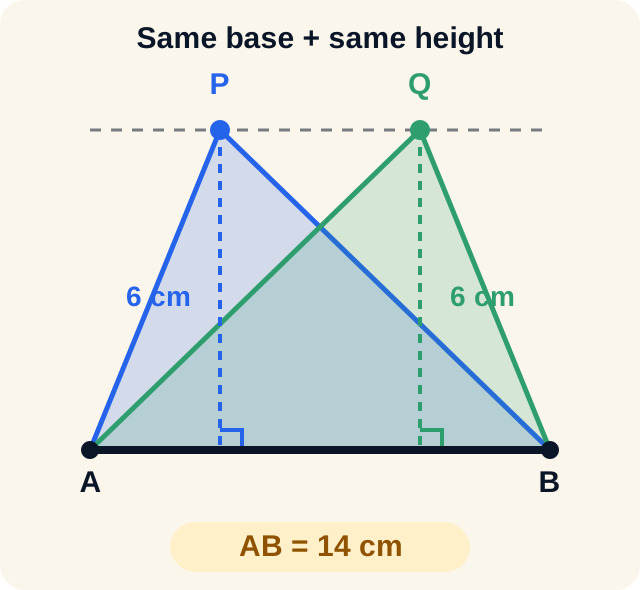
Next, read the distance between the parallel lines. The dashed perpendicular is 6 cm, so the perpendicular height of both triangles is 6 cm. The distances AP and BQ are sloping sides, so they are not the heights for this chosen base.
Find both triangle areas
The triangles are different shapes, but the base and perpendicular height used in the calculation are the same. Therefore, their areas are equal.
Same base, same height — same area?
Predict first: If Q slides sideways along the same parallel line, what happens to its area?
Why moving sideways changes nothing
Imagine pushing Q along the upper line, like moving a magnet across a whiteboard. Q moves horizontally, but its distance from AB stays 6 cm. The base AB stays 14 cm too, so the same calculation still applies.
That is why looking at the sloping sides can fool you. One side can become longer while the triangle's area stays unchanged. The area follows the perpendicular height, not the sloping side.
If Q moves to a different parallel line, the rule changes. The base is still 14 cm, but a new height gives a new area.
A changed height gives a changed area
🤔 Predict first: Q keeps the same base AB but moves to a parallel line 8 cm above it. What happens to its area?
Check the equal-area reason
The diagram gives two independent clues: one common base and one common perpendicular distance. State both before concluding that the areas match.
Check the main example
Both triangles have 42 cm². The check uses the measurements that define the rule, rather than the triangles' sloping sides.
Graduated practice
Try each question before opening its solution. Draw the common base first, then mark the perpendicular height.
Practice 1 — start here
Triangles XYZ and XYW share base XY = 9 cm. Z and W lie on a line parallel to XY, 8 cm away. Find the area of each triangle.
Show the solution
Both triangles use base 9 cm and perpendicular height 8 cm.
Working
Each triangle has area 36 cm².
Practice 2 — explain the clue
Triangle LMN has base LM = 12 cm and height 5 cm. Point R is moved sideways along the line parallel to LM at the same height. Find the area of triangle LMR after the move.
Show the solution
The base is still 12 cm and the perpendicular height is still 5 cm.
Working
The area remains 30 cm².
Practice 3 — work backwards
Triangle ABC has area 54 cm² and base AB = 12 cm. Point D lies on a line parallel to AB through C. Find the area of triangle ABD.
Show the solution
ABC and ABD have the same base AB and the same perpendicular height because C and D lie on a line parallel to AB.
Working
Triangle ABD also has area 54 cm².
Watch out — easily mixed up
Quick recap
🎯 Mastery check
Answer all 8 — your progress is saved on this device.
A triangle has base 14 cm and perpendicular height 6 cm. What is its area?
Triangles XYZ and XYW share base XY = 9 cm and both have height 8 cm. What is the area of each?
Q slides sideways along a line parallel to base AB. What happens to the triangle area?
Triangle ABP has base 14 cm and height 6 cm. Q is on the same parallel line as P and uses base AB. What is the area of ABQ?
Base AB is 14 cm and Q is 8 cm above AB at a right angle. What is the area of triangle ABQ?
Which measurement is the height when AB is the chosen base?
Triangle ABC has area 54 square cm. D lies on a line parallel to AB through C, so triangle ABD has the same base and height. What is its area?
A class is choosing between two triangular banners with the same base. Which pair is guaranteed to have equal area?