The most dangerous part of a fraction question can be the tiny phrase after of. One fraction may describe all the seedlings, while the next describes only the remainder. A connected branching tree keeps each fraction attached to its parent group.
Parents: ask your child to point to the parent box for each fraction and predict the fraction of the original total before revealing the path calculation.
By the end you will be able to label each parent whole, trace a two-edge fraction path, multiply the fractions, and use a known subgroup to recover the original total.
Start with one named parent
A is the group an outgoing fraction describes. Branching is useful when a group is split and one child is split again. It is a representation choice: it shows relationships clearly, whether you read forward or work backwards.
🤔 Predict first: In '31 of all seedlings are herbs', what is the parent?
Split the garden tree
Here is the full question:
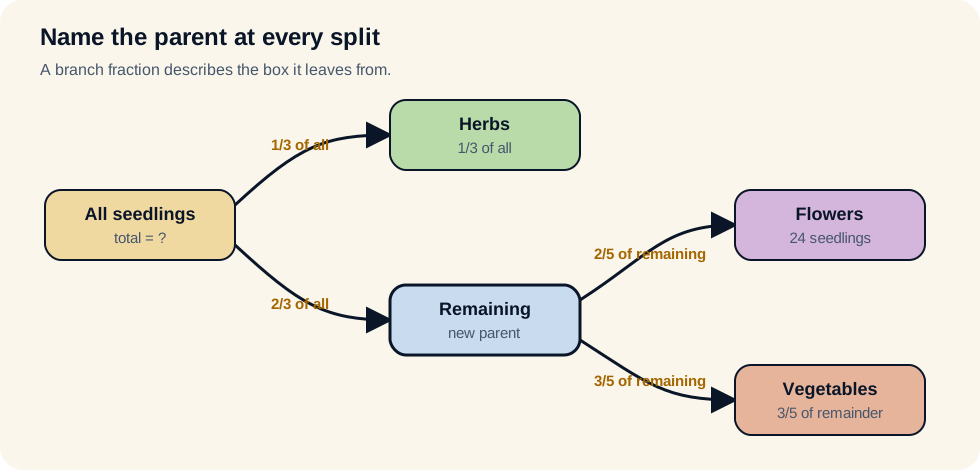
An Eco Club has some seedlings. 31 are herbs. 52 of the remaining seedlings are flowers, and the rest are vegetables. There are 24 flower seedlings. How many seedlings are there altogether?
Begin with one root: All seedlings. 31 branches to herbs, so the complementary 32 branches to the Remaining seedlings group. The second split starts at Remaining, not at the root. 52 of Remaining are flowers; 53 of Remaining are vegetables.
The second pair of branches leaves Remaining. Its fractions 52 and 53 describe that parent, not All seedlings.
Label every branch
Herbs=31 of all seedlings
Remaining=1−31=32 of all seedlings
Flowers=52 of remaining
Vegetables=53 of remaining
🤔 Predict first: Which group is the parent of the flower branch?
Multiply along the flower path
To reach Flowers from All seedlings, follow two edges. First take 32 to reach Remaining. Then take 52 of that smaller parent to reach Flowers. A part of a part is found by multiplying along the connected path.
Follow the path
Flowers=52×32 of all seedlings
52×32=154
Flowers=154 of all seedlings
Why is the result 154? Imagine the original whole split into 15 equal shares. The 32 remainder occupies 10 shares. Dividing those 10 shares into five groups gives 2 shares per group. Flowers take two groups, or 4 of the 15 original shares.
🤔 Predict first: 31 of the whole is herbs. Flowers are 52 of the 32 remainder. What fraction of the original whole is flowers?
Link the path to the known count
The question gives 24 flower seedlings. Flowers are 4 of 15 equal original shares. Use that known subgroup to find one share, then multiply by all 15 shares.
Recover the original total
4 shares=24 seedlings
1 share=24÷4=6 seedlings
15 shares=15×6=90 seedlings
🔬
Branching path: change the original total
🤔 Predict first: 31 of the 43 remainder is what fraction of the original?
The activity uses the same path idea with stickers: 41 is used on Monday, so 43 remains; 31 of that remainder is 41 of the original. The number changes when the original total changes, but the path fraction stays fixed.
Check the garden story
31×90=30 herbs
Remaining=90−30=60 seedlings
52×60=24 flowers
Vegetables=60−24=36 seedlings
30+24+36=90 seedlings
The intermediate Remaining group is a subtotal, not an extra terminal category. Add herbs, flowers and vegetables once.
Branching and bars have different jobs
The branching tree shows who came from whom. A bar model can show equal lengths to scale. For a nested fraction, use the tree first when the parent relationship is easy to lose; convert to equal shares when you need a numerical answer. The tree's line length does not represent amount.
🤔 Predict first: What does a short tree branch tell you?
Watch out — easily mixed up
Quick recap
Graduated practice
1. Stickers used on two days
I used 41 of my stickers on Monday. On Tuesday, I used 31 of the remaining stickers. What fraction of my original stickers did I use on Tuesday?
Show solution
After Monday, 43 of the original stickers remain. Tuesday takes 31 of that parent.
Practice 1
Remainder after Monday=1−41=43
Tuesday=31×43=41 of the original
Tuesday used 41 of the original stickers. The final remainder is 21, and 41 + 41 + 21 = 1.
2. Money left after two branches
Nadia spent 41 of her money on lunch. She then spent 32 of the remaining money on a book. She had $18 left. How much money did she have at first?
Show solution
After lunch, 43 remains. Spending 32 leaves 31 of that remainder, which is 41 of the original.
Practice 2
Money left=31×43=41 of original
41 of original=$18
Original money=18×4=$72
Check: lunch is $18, leaving $54; the book costs 32 × $54 = $36, leaving $18.
3. Science books and adventure books
52 of the books on a shelf are science books. The rest are fiction. 32 of the fiction books are adventure stories. There are 24 adventure books. How many books are on the shelf?
Show solution
Fiction is 53 of all books. Adventure is 32 of fiction, so the path to adventure is 32 times 53.
Practice 3
Fiction=1−52=53
Adventure=32×53=52 of all
2 shares=24 books
1 share=24÷2=12 books
Whole shelf=5×12=60 books
Check: 24 science books and 36 fiction books; 32 of 36 is 24 adventure books.
🎯 Mastery check
Answer all 7 — your progress is saved on this device.
In '31 of all seedlings are herbs', which is the parent?
52 of which group are flowers in the garden problem?
52 of the 32 remainder is what fraction of all seedlings?
Four original shares are 24 flower seedlings. What is one share?
If one share is 6 seedlings and the whole has 15 shares, what is the total?
Why is 31 plus 52 not the correct flower-and-herb total?
In the garden check, why is Remaining not added to herbs, flowers and vegetables?