
The ATEDO Method
How one careful assumption turns two types of items into a fixed total, a small difference and a solvable opposite count.
⏱ 11 min · 🎯 5 things to master
ATEDO Method: How Many Cars? | PSLE Maths Made Clear
Video · 4:45
Have you ever seen a question with bicycles and cars, or adults and children, and felt stuck because there are two unknown numbers? You do not need to guess both numbers at once. ATEDO lets you pretend first, then repair the pretend total one item at a time.
Parents: ask your child to predict the opposite count, then let them adjust one replacement before reading the explanation together.
By the end you will be able to recognise an ATEDO problem, keep the item count fixed, find the big and small gaps, and explain why the final division gives the opposite type.
Main question
A car park has 30 vehicles. Every vehicle is either a bicycle with 2 wheels or a car with 4 wheels. There are 86 wheels altogether. How many bicycles and cars are there?
A — Assume: keep every position
ATEDO fits when you know the total number of items, each item is one of two types, and each type contributes a fixed amount. A car park with 30 vehicles fits: every position is either a bicycle or a car, and each has a known number of wheels.
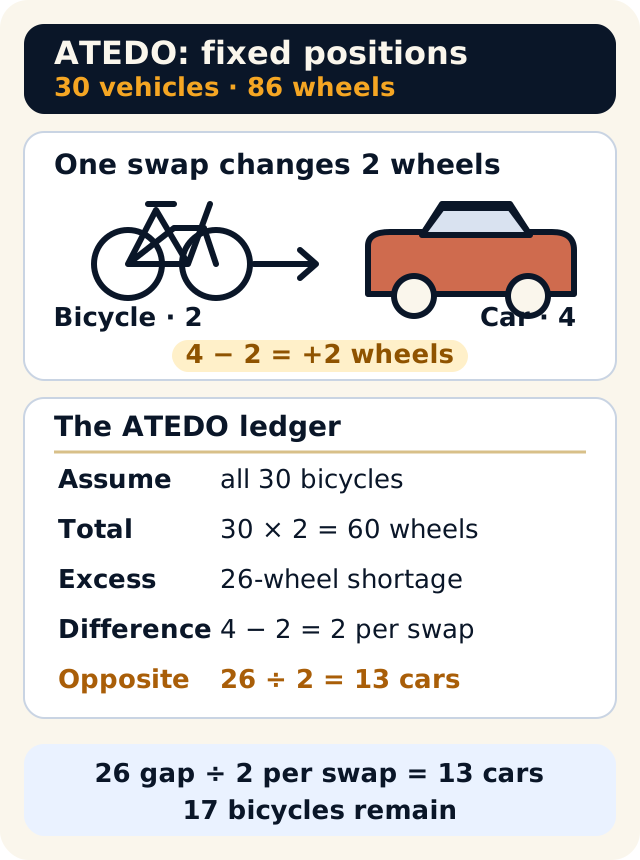
The first move is . Choose one type and imagine that every position has that type. The number of positions must stay fixed. You are changing labels in your imagination, not adding vehicles.
🤔 Predict first: A car park has 30 vehicles. If you assume every vehicle is a bicycle, what must stay fixed?
T — Total: count the pretend world
Now calculate the under the assumption. A bicycle has 2 wheels, so 30 assumed bicycles would have:
Working
This is a hypothetical total. It is useful even though the real total is different, because it gives us a clean starting line.
E — Excess: measure the big gap
The question says there are 86 wheels altogether. Our pretend total of 60 is short. Subtract the two totals:
Working
ATEDO calls this positive gap the . The word does not mean the assumption must be too high. Here it is a shortage of 26; if your assumption had produced too many wheels, it would be an excess of 26. Use the positive size of the gap and name its direction.
🤔 Predict first: Our assumed total is 60 wheels and the actual total is 86 wheels. What is the big gap?
D — Difference: test one swap
Do not divide by the number of wheels on a car. One position already had 2 bicycle wheels in the assumption. Replace one assumed bicycle with one car and compare:
Working
That is the per swap, the small gap. The vehicle count stays 30, but the wheel total rises by 2 each time. This is the heart of ATEDO: every replacement repairs the same small amount.
Replace one assumed vehicle at a time
Predict first: How many cars are needed to move from 60 wheels to 86 wheels?
Working
The grid still has 30 positions. Thirteen bicycles have changed into cars; no thirty-first vehicle appeared.
O — Opposite: divide the big gap by the small gap
Now the final letter is ready. The 26-wheel shortage needs 2-wheel repairs:
Working
The count is 13. We assumed bicycles, so 13 of those assumed bicycles are actually cars. The remaining vehicles are:
Working
There are 17 bicycles and 13 cars. Check both facts.
Working
When ATEDO fits — and when to pause
ATEDO is a good choice when there are a known number of items, exactly two types, and a fixed contribution for each type. If the question gives pairs or groups, first convert the group contribution to one-person or one-item contribution. In a fruit question, two children sharing 2 apples means each child represents 1 apple.
The two contributions must be different. If both types contribute 3 each, replacing one with the other changes nothing, so no division can identify the types. Also check that the gap is divisible by the difference; a leftover part of a swap means the given numbers do not describe a whole-number solution.
🤔 Predict first: Which question is ready for ATEDO?
A mistake worth catching
In the car-park example, dividing the big gap by four is not the right working. The four-wheel car does not add four new wheels to a position: that position already contributed two wheels as a bicycle. The replacement adds only the difference shown in the working panel.
Another common slip is to call 26 the number of cars. It is the wheel gap. Each car replacement repairs two wheels, so the quotient gives the replacement count.
Graduated practice
Practice 1 — identify the opposite
Seven seats are made from 3-legged stools and 4-legged chairs. There are 25 legs altogether. How many chairs are there?
Show solution
Working
Practice 2 — the assumption gives too much
A shop sold 28 tickets. Adult tickets cost $12 and child tickets cost $7. The shop collected $256. How many adult tickets were sold?
Show solution
Working
Practice 3 — convert a group rate first
Eighteen people share fruit. Each adult receives 3 apples, while every 2 children share 2 apples. Altogether, 38 apples are given out. How many children are there?
Show solution
Working
Watch out — easily mixed up
Quick recap
🎯 Mastery check
Answer all 8 — your progress is saved on this device.
In ATEDO, what must stay fixed when you make the assumption?
Thirty assumed bicycles have 2 wheels each. What is the assumed Total?
The assumed total is 60 and the actual total is 86. What is the positive Excess gap?
Why is the Difference in the bicycle and car problem 4 − 2 instead of 4?
What does 26 ÷ 2 = 13 count in the main example?
Seven seats have 3-legged stools and 4-legged chairs, with 25 legs. How many chairs are there?
A shop sold 28 adult or child tickets. Adult tickets cost $12, child tickets $7, and revenue is $256. Which assumption makes the first total larger?
Two children share 2 apples. In an ATEDO model for 18 people, what contribution should one child represent?