Exterior Angles: Find the Angle Outside a Triangle
How a side extension turns two remote interior angles into an exterior angle, with a careful triangle and straight-line check.
⏱ 8 min · 🎯 4 things to master
Exterior angles: What Is The Outside Angle? | PSLE Maths
Video · 4:24
An angle outside a triangle can look like a new puzzle, but it is built from two familiar 180-degree facts. The trap is adding the outside angle to all three inside angles. First trace the triangle, then trace the straight line.
Parents: ask your child to point to the two remote interior angles before revealing the shortcut, then check the result with both 180-degree relationships.
By the end you'll be able to identify an exterior angle, use a triangle sum and a straight-line sum, and explain why the exterior angle equals the two remote interior angles together.
Spot the exterior angle
An is made when one side of a triangle continues in a straight line. The two inside angles that do not touch that outside angle are the .
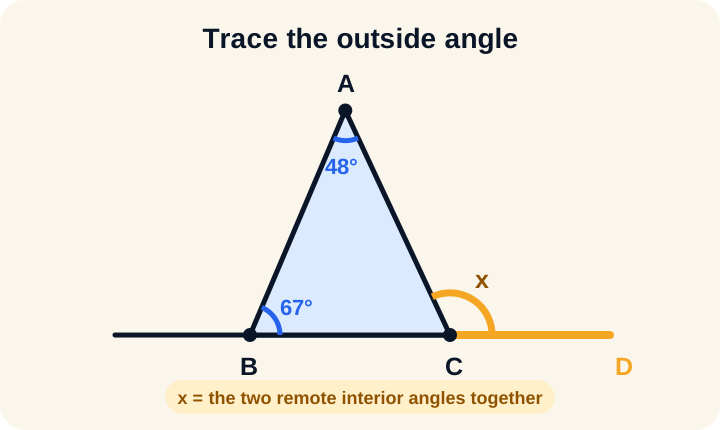
In the main question, side BC continues through C to D. The outside angle ACD sits at C between CA and CD. The inside angle at C and the outside angle share one arm, while BC and CD make a straight line.
Turn the straight line
Predict first: Angles c and x sit on a straight line. What must their total be?
Use the triangle sum first
Here is the complete question:
In triangle ABC, angle A is 48° and angle B is 67°. Side BC is extended through C to D. Find exterior angle ACD.
Call the inside angle at C (c). The three angles inside triangle ABC add to a straight angle, so subtract the two known angles from 180 degrees.
Find the inside angle c
This step uses the triangle, so it includes the inside angle at C. Keep the outside angle (x) separate until the straight-line step.
Use the straight line at C
Angles (c) and (x) sit next to each other on line BCD. Their total is 180 degrees. Use the inside angle already found, then subtract it from the straight angle.
Find the exterior angle x
Exterior angle ACD is 115°. There is also a quicker way to read the same result: the two subtractions cancel, leaving the sum of the two remote interior angles.
See the shortcut
Check both 180-degree facts
Do not check by adding the outside angle to the triangle's three inside angles. Instead, check the inside triangle and the straight line separately.
Check the original diagram
Both checks work. The angle asked for is (x), and its unit is degrees.
🤔 Predict first: Which two angles are remote interior angles for exterior angle ACD?
Graduated practice
Try each question before opening its solution. Draw the side extension, mark the requested angle, and identify the two remote interior angles.
Practice 1 — use the shortcut
A triangle has remote interior angles 39° and 76°. Find the exterior angle at the third vertex.
Show the solution
The exterior angle is the sum of the two remote interior angles.
Working
The exterior angle is 115°, with a 65° inside angle next to it as the check.
Practice 2 — a stated star property
The five tip angles of a simple five-point star are 28°, 31°, 35°, 40° and (x)°. If their sum is 180°, find (x).
Show the solution
This uses the stated five-tip property, which is different from the triangle exterior rule.
Working
The missing star tip is 46°.
Practice 3 — work backwards
An exterior angle is 132°. One of its remote interior angles is 58°. Find the other remote interior angle.
Show the solution
The two remote interior angles must add to the exterior angle.
Working
The other remote interior angle is 74°.
Watch out — easily mixed up
Quick recap
🎯 Mastery check
Answer all 7 — your progress is saved on this device.
A triangle has remote interior angles 48° and 67°. What is its exterior angle?
Which angle sum finds the inside angle at C before the exterior angle?
If the inside angle next to an exterior angle is 65°, what is the exterior angle on the straight line?
A triangle has remote interior angles 39° and 76°. What is the adjacent third interior angle?
Which pair is guaranteed to add to an exterior angle of a triangle?
An exterior angle is 132° and one remote interior angle is 58°. What is the other remote interior angle?
A student adds an exterior angle to all three inside angles and sets the total to 180°. What is the problem?