
PSLE English · 11 min read
PSLE Oral: Stimulus-Based Conversation Tips That Work
A father asked me once why his daughter, who chats happily for an hour at dinner, "froze up" in her oral practice and barely scraped a pass. I sat her down with a photo of children at a hawker centre and asked what she saw. "There are some people eating. The girl is holding a tray." Then she stopped and looked at me, waiting for the next question. That was the whole problem in one sentence. She wasn't shy. She was answering the wrong exam.
The PSLE oral isn't a describe-the-picture test, and it hasn't been for a while. The part that carries the most marks rewards something his daughter could already do at the dinner table — have an opinion and back it up. She just didn't know that's what was being asked. So let's look at what the PSLE oral stimulus-based conversation actually marks, where the easy marks sit, and how a capable child stops freezing and starts scoring.
What the PSLE oral really looks like now
The oral is taken as Paper 4 of PSLE English, and from 2025 it's worth 40 marks — 20% of the whole English grade, up from 30 marks and 15% before. That's a real jump. A fifth of the subject is decided in a ten-minute conversation, and most families spend almost no time on it because there's no script to mark and no worksheet to file. (Mother Tongue has its own oral, marked separately on similar principles — but this is the English paper, and that's what we'll stay on.)
It splits into two parts:
| Part | Marks | What it is |
|---|---|---|
| Reading Aloud | 15 | Read a short passage aloud, after a brief "given situation" that sets the purpose, audience and tone |
| Stimulus-Based Conversation | 25 | A real photograph, then three questions you talk through with the examiner |
Notice where the marks live. The conversation is worth more than the reading, and it's the part children prepare for least. That imbalance is where a parent can make the most difference in the least time.
Reading Aloud: it's a performance, not a recital
Reading Aloud is fifteen marks, and it's the more recoverable of the two because it's a closed task — the words are right there on the page. The child isn't being marked on whether they can read. They're being marked on how they read.
Three things decide it:
Pronunciation and articulation. Clear, accurate sounds. The endings matter — the -ed on "walked", the -s on "books", the th in "thought". Children drop these without noticing, and a dropped ending is an audible slip every single time. (We break down the exact sounds that trip Singaporean children up — the th and the swallowed -d/-t/-k endings — in our Reading Aloud pronunciation guide.)
Pacing and pausing. Reading is not racing. A strong reader slows at a full stop, lifts slightly at a question mark, and lets a comma breathe. The nervous child reads everything at one flat speed, like a train that won't stop at the stations, and the meaning blurs.
Expression matched to the situation. Since the new format, the passage comes with a short preamble telling the child the purpose, audience and tone — reading a notice to younger pupils, say, versus telling an exciting moment in a story. The reading has to sound like that. A thrilling rescue read in a monotone is a child who hasn't understood the assignment.
The cheapest marks here are lost to nerves and speed. A child who takes one breath, reads three words slower than feels natural, and actually voices the punctuation will out-score a faster, flatter reader who's technically "accurate". Slow is not the enemy. Flat is.
Stimulus-Based Conversation: describing the photo is the trap
Here's the part that decides the paper. The child is shown a real photograph — since 2025 it's a genuine photo, not a poster with words on it — and then has a conversation built on three questions. The questions stand on their own now, with no sub-prompts to lean on. They run roughly like this:
- The picture. What do you see, and what do you think is happening or how someone feels?
- Your experience. A related moment from your own life.
- Your opinion. A view on the wider topic, with your reasons.
The single biggest mistake — the one the father's daughter was making — is treating all three like question one. Describing what's in the frame. "There are people. They are eating. It looks like a hawker centre." All true, all visible, all worth very little, because the examiner can see the photo too. You don't earn marks for reading out what's in front of both of you.
What the twenty-five marks actually reward is three things working together: personal response and engagement — genuine reactions, a willingness to share; development of ideas — opinions backed by reasons and examples, answers that grow instead of stopping; and language use — varied vocabulary, accurate grammar, clear sentences when spoken. The thread running through all three is the same: don't just describe — respond, reason, and keep going.
Weak versus strong, on the same question
Picture a photo of a family at a dinner table, everyone looking at their phones. The examiner asks: "Do you think families should put their phones away during meals? Why?"
Here's a weak answer:
Yes. Because it is good to talk. Phones are not good at the table.
It's not wrong. It's just thin. There's an opinion, barely, and then it dies. No reason developed, no example, nothing personal. That's a mid-band answer at best, and it's where most children stop.
Now the same child, taught to keep going:
Yes, I think they should. When my family eats together, my mother has a rule — no phones at the table — and at first I hated it. But now it's the only time we actually talk about our day. My brother once told a funny story about his football match that we'd never have heard if everyone was scrolling. So I think the phone rule looks strict, but it actually brings a family closer.
Same child, same opinion. The difference is everything the marker is listening for: a clear stand, a real reason, a personal example with a concrete detail, and a sentence that ties it back to the question. That's a top-band response, and it needs no fancy vocabulary at all. It just develops.
The four-beat habit that fixes thin answers
The reason strong speakers sound effortless is that they're following a shape without thinking about it. You can teach the shape directly. I drill it as four beats:
- Stand — say what you think, clearly. "Yes, I think they should."
- Because — give your reason. "Because mealtimes are when a family connects."
- For example — a specific moment. "In my family, my mother…"
- So — link it back. "So I think the rule looks strict but it helps."
Four short moves and a flat "yes" becomes a developed answer. The child who internalises stand, because, for example, so never freezes, because they always know what the next beat is. That's not a talent. It's a habit, and two weeks of dinner-table practice builds it.
Fluency, pronunciation and engagement — the quiet markers
Underneath the content, the examiner is forming an impression of how the child carries the conversation, and three things shape it.
Fluency is flow, not speed. A child who speaks in short, complete thoughts with natural pauses sounds far more fluent than one who rushes and trips. The cure for a wall of "um, like, um" is having something prepared to say, not speaking faster.
Pronunciation carries straight over from Reading Aloud — the same clear sounds and word endings. Mumbling costs marks even when the idea is good.
Engagement is the most underrated one. The child who makes eye contact, leans in a little, and actually talks to the examiner reads as confident and interested. Examiners are human; a warm, engaged speaker earns the benefit of the doubt, while a mumbling, eyes-down one has to fight for every mark. Treating it as a chat with an interested adult, not an interrogation, changes the whole register.
Common mistakes that quietly cost marks
Describing the photo instead of responding to it. The number-one error. The picture is a springboard, not the answer. After one sentence about what's there, the child should be onto what they think about it.
Stopping after the first sentence. A "yes" or a "no" with one weak reason and then silence. The marks are in the development — the reason, the example, the link back. Answers that stop early stay mid-band no matter how correct they are.
Reading aloud at one flat speed. No pauses at punctuation, no expression matched to the preamble. The words are all there; the performance isn't, and that's most of the fifteen marks.
Dropping word endings. "Walk" for "walked", "book" for "books". Small, constant, and audible to the marker in both parts of the paper.
Memorising a speech. A child who recites a rehearsed paragraph that doesn't quite fit the question sounds stiff and, worse, off-topic. The examiner can tell. Prepare habits and examples, not scripts.
Treating it as low-stakes. It's a fifth of the English grade. A child a band below where they should be in English is often losing it here, in the part nobody practised.
What to do this week
You don't need a worksheet for this — you need a photo and ten minutes at dinner. Pull up any everyday photograph on your phone: a crowded MRT, children at a playground, a family cooking. Ask your child one opinion question about it — "Should children have more time to play? Why?" — and then say nothing until they've hit all four beats: stand, because, for example, so. The first few times they'll stop after "because". Wait. Let the silence do the teaching. Within a week, "for example" starts arriving on its own. (For a ready bank of themes and the exact question types examiners now ask, see our guide to practising oral at home.)
For Reading Aloud, have them read one short passage a night — a few lines from any storybook is plenty — and beforehand, decide together how it should sound. Then make them do it twice: once flat, once with the pacing and expression. Hearing the difference in their own voice teaches more than any instruction. (The same instinct for showing rather than telling pays off on paper too — see how PSLE English composition is really marked, and how the open-ended comprehension answers reward giving the full, developed response rather than the half one.)
If you'd like your child's spoken answers heard back the way an examiner would hear them — pointing at the exact spot the answer stopped developing, the dropped ending, the reason that never arrived — that's the kind of honest, specific feedback IllumiTutor is built to give. Ten minutes of real conversation a day, with someone pointing out where the marks leak, does more than a term of silent worksheets ever will.
Keep learning
Related PSLE guides

PSLE Oral Practice at Home: The Themes and Questions Examiners Keep Asking
The themes and question types the stimulus-based conversation keeps circling back to — and a 10-minute home routine that turns a quiet child into one who gives a reason and an example.
27 Jun 2026 · 10 min read
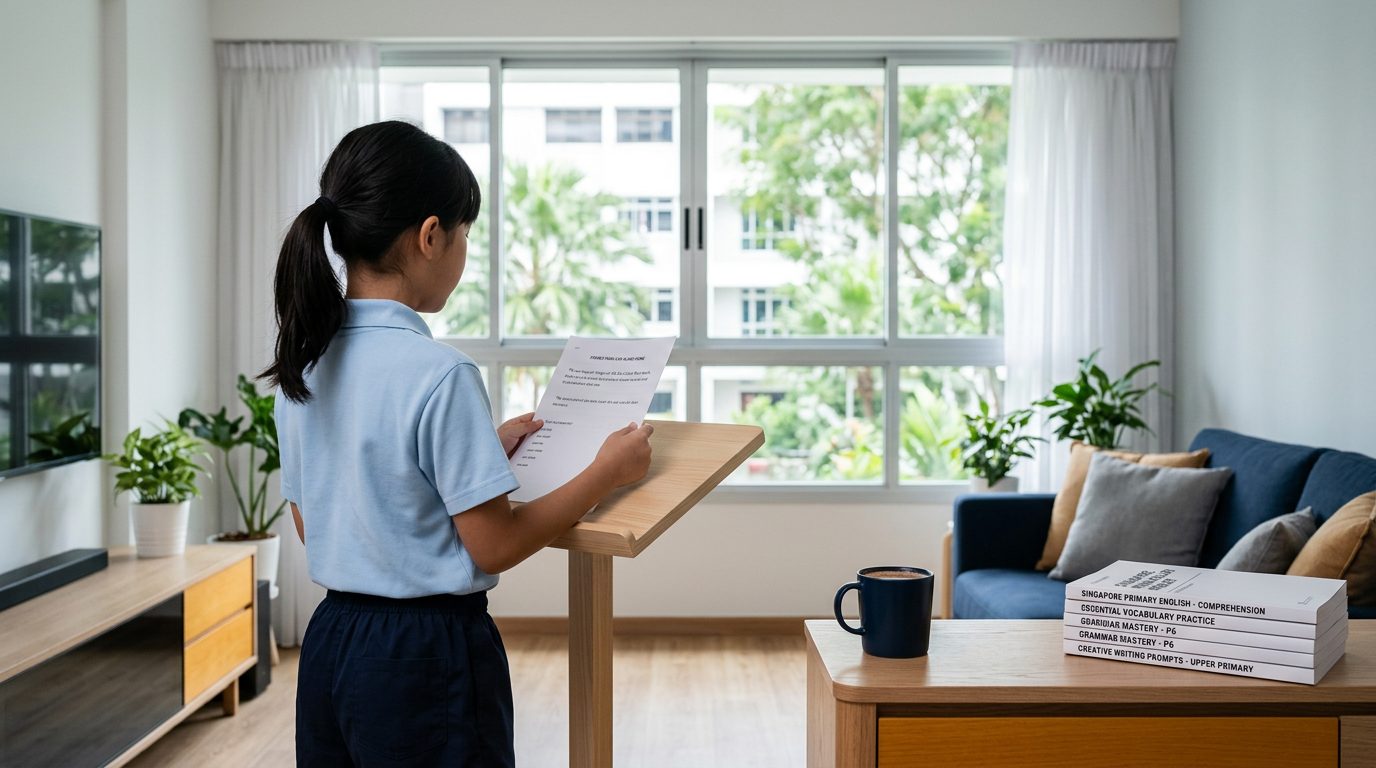
PSLE Oral Reading Aloud: How to Win the Pronunciation and Expression Marks
Reading Aloud is now worth 15 marks on its own, and most families never practise it. Here is exactly what the examiner is listening for — and how a careful reader picks up the easy marks.
27 Jun 2026 · 10 min read
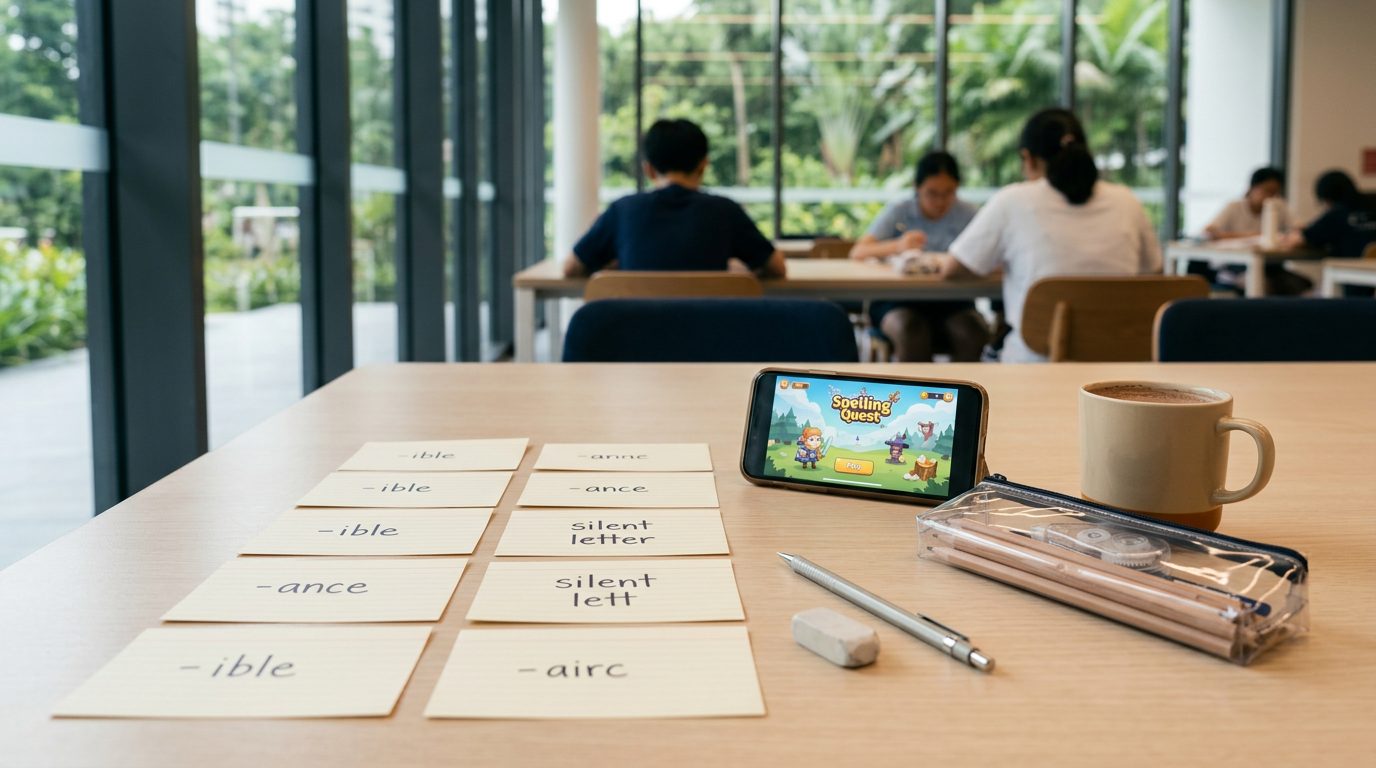
The Word Patterns That Decide PSLE English: From Editing Traps to Vocab Cloze
Why memorising random vocabulary lists fails upper-primary students, the word families that actually cost marks in Paper 2, and how to practice them actively.
7 Sept 2026 · 10 min read

PSLE Vocabulary Cloze: Why All Four Options Look Right
The vocabulary options are near-neighbours separated by usage, not meaning. Why memorising definitions is the wrong drill, and what to do instead.
20 Aug 2026 · 14 min read