PSLE English · 10 min read
PSLE Oral Practice at Home: The Themes and Questions Examiners Keep Asking
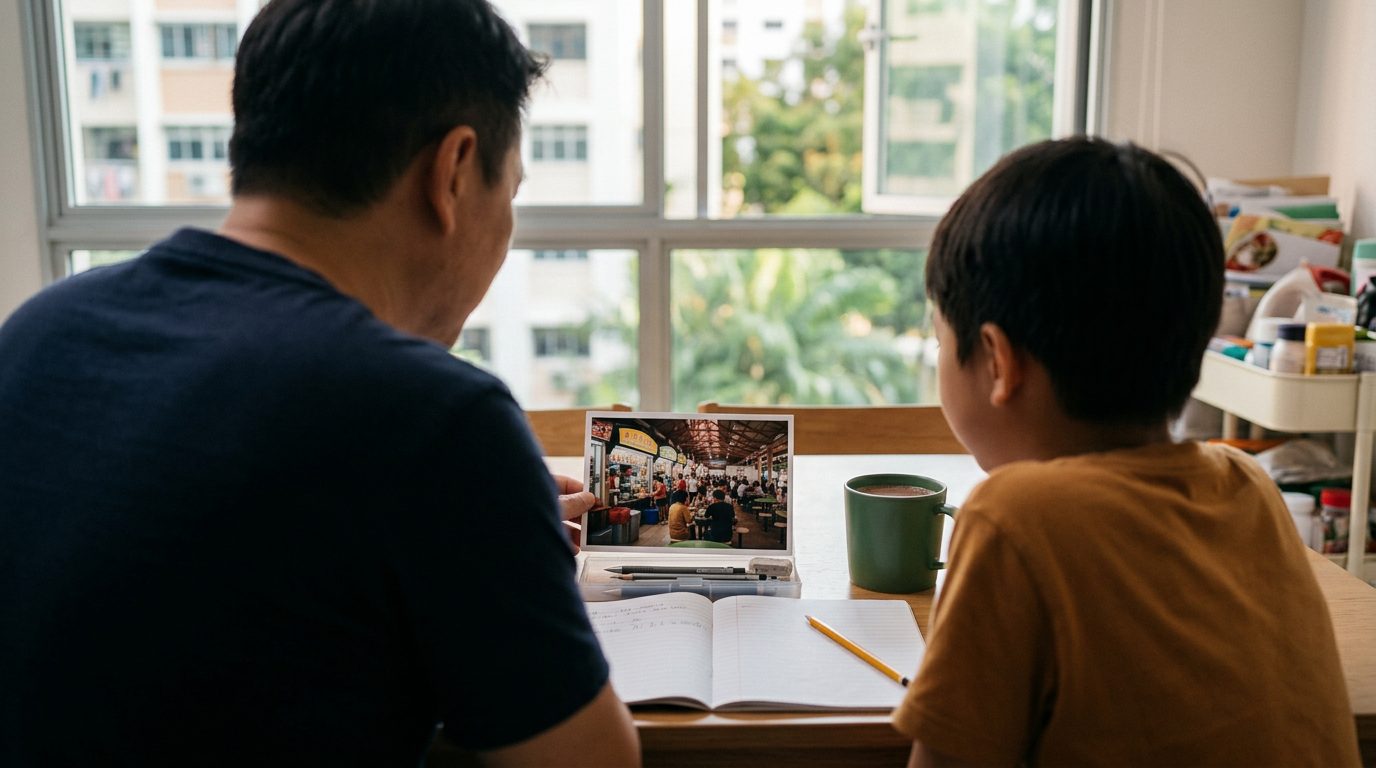
"He just describes the picture and stops." A mother said that to me about her son's oral, and she'd diagnosed it perfectly without knowing it. I asked him a practice question off a photo of a family washing the car together. "The father is holding a hose. The boy has a sponge. They are washing the car." Correct, fluent, and worth almost nothing. He'd answered the question a younger child would have been asked five years ago — "What can you see?" — and that question is mostly gone.
The stimulus-based conversation has quietly changed shape. It used to lean on description. Now it leans on opinion, reflection, and the ability to connect one photograph to something bigger — your own life, your own town, what might happen next. The child who only narrates the picture isn't wrong. He's just leaving the marks that matter sitting on the table. The good news for parents is that the PSLE oral practice questions the examiners keep reaching for fall into a small, predictable set of themes. You can prepare them at the dinner table, and you don't need a single assessment book to do it.
What's actually being tested now
The oral is Paper 4 of PSLE English, about ten minutes long, and from 2025 it carries 40 marks — 20% of the whole English grade, up from 30 marks and 15%. The stimulus-based conversation alone is now 25 marks (it used to be 20) — our stimulus-based conversation guide explains how it is marked — so a quarter of your child's English subject is decided across three spoken questions. (The other 15 marks are Reading Aloud, a separate skill with its own pronunciation and expression marks.)
Two changes matter for how you practise. The stimulus is now a real photograph, not a poster with helpful words printed on it — so there's no caption to lean on. And the three questions no longer hang together as one scaffolded topic; the sub-prompts are gone, so each question stands alone. In practice the three tend to move outward like ripples:
- Q1 — the photo. Something about what's shown: not just what is happening, but why people might be doing it, how they might feel, what could happen next.
- Q2 — your experience. "Have you ever…", "Tell me about a time when…" Now the photo is just a doorway into the child's own life.
- Q3 — your opinion. The broadest one: "Do you think…", "Would you recommend…", "Some people say… what do you think?" Pure reflection.
A child who treats all three as "describe the picture" answers Q1 thinly and has nothing for Q2 and Q3. That's where most of the lost marks live.
The themes worth preparing
The photographs change every year, but the worlds they come from barely do. Prepare these themes and very little will surprise your child on the day.
It helps to actually rehearse a few rather than admire the list. Here are three, with the kinds of questions each tends to throw up. The wording is mine, but the shape is true to what gets asked.
Healthy living and eating. (Photo: children eating at a hawker centre, or a packed school canteen.)
- Why do you think these children chose this food?
- Do you think this is a healthy meal? Why?
- Have you ever tried to eat more healthily? What did you do?
- What might happen if someone ate like this every day?
Family bonding and helping at home. (Photo: a family cooking together, or a child hanging laundry on the bamboo pole.)
- Why do you think this family is doing this together?
- What chores do you help with at home, and how do you feel about them?
- Do you think children your age should help with housework? Why or why not?
- How might this be different in a family where both parents work long hours?
Civic-mindedness on the MRT. (Photo: a crowded train, someone offering a seat.)
- What do you think this person is doing, and why?
- Have you ever given up your seat for someone? What happened?
- Would you recommend that everyone do this? Why?
- What might happen on the train if nobody bothered to be considerate?
Notice the family of questions threading through all three: Why do you think…? Have you ever…? Do you think…? What might happen…? Would you recommend…? Once your child can hear which of those is being asked, half the battle is over.
The newer question types to rehearse
If your child has only ever practised "How does the girl feel?", these will catch them out. Drill them by name:
- "Do you think this is a good place to ___?" — judgement, not description.
- "Have you ever done something similar to what's in the photo?" — straight into personal experience.
- "What do you think might happen next?" — prediction; reward the because.
- "Why do you think the people chose to do this?" — motive, reading intentions.
- "Would you recommend this to others — why or why not?" — a verdict with a reason.
- "How might this be different in another setting, or with different people?" — connecting and comparing.
One more thing worth telling your child: the photos have gone very local. Hawker centres, MRT cabins, wet markets, void decks, the neighbourhood playground. That's a gift, not a threat — these are places your child actually knows. A child who can talk about helping Ah Ma carry bags at the wet market has a real answer ready; the child who has only memorised model phrases about "spending quality time" sounds like a recording.
A structure your child can actually hold
Forget anything elaborate. The whole thing fits in three steps your child can keep in their head under pressure:
Point → Reason → Experience. State what you think, say why, then back it with one short story from your own life. "I remember a time when…" is the most valuable phrase in the entire oral, because it's the one thing no other candidate can copy.
Here's one worked answer — my own — to "Do you think children should help with housework? Why?"
"Yes, I think children should help with housework. Firstly, it teaches us to be responsible, because if everyone in the family only relies on the parents, the parents become very tired. I remember a time when my mother was unwell and I had to wash the dishes and hang the laundry myself for a few days. It was tiring, and it made me realise how much she usually does without complaining. On the other hand, I think the chores should match our age — a Primary 1 child might only tidy their toys. In conclusion, helping at home is a small thing, but it makes the whole family's day easier."
That's a strong answer not because the vocabulary is fancy — it isn't — but because it has a clear opinion, a real reason, a genuine memory, and it flows. The signposting words carry the listener: Firstly, Furthermore, On the other hand, In conclusion. Teach your child four or five and they'll never sound like they're listing.
And when the photo is genuinely unclear and the child is guessing what's going on, teach the possibility words: perhaps, maybe, might, could, it looks as though. "Perhaps they are celebrating a birthday, because there seems to be a cake on the table" is a confident, examiner-pleasing answer. "I don't know what they are doing" throws marks away for no reason.
What lifts a good answer to a top one
A solid answer gives a point, a reason and an example. An AL1 answer does all that — and then adds one more mature idea the average candidate doesn't reach for. After three sensible reasons, your child stretches once:
- Role-modelling. "When I give up my seat, younger children watching might learn to do the same."
- Shared responsibility. "Keeping the playground clean isn't only the cleaner's job — it belongs to everyone who uses it."
- Flip the question. Consider the consequence if people didn't: "If nobody queued, the hawker centre would be chaos and the elderly would always lose out."
That single deeper sentence is what separates a fluent child from an impressive one. The trick is to add it naturally, as a genuine thought, not as a memorised flourish bolted to the end. Examiners can hear the difference between a child thinking and a child reciting — and they reward the first.
Common mistakes
- One-word and one-line answers. "Yes." "It's healthy." The examiner is waiting for a because that never comes. Every answer should run two to four full sentences.
- Describing the photo when an opinion was asked. The most common and most expensive error. Listen to the question word — do you think, have you ever, would you — and answer that, not "what I see".
- The memorised, robotic tone. A child reciting a model answer about "bonding and cherishing moments" sounds hollow, and it shows in the eyes. Examiners want a real opinion in the child's own plain words.
- Rambling with no shape. Plenty of words, no point. Without Firstly… because… I remember…, fluent children still drift and lose the listener.
- No personal experience. Skipping "I remember a time when…" leaves every answer general and forgettable. The story is the part only your child can give.
What to do this week
Ten minutes a day, no worksheet required.
- Find one photo. A family album shot, a news photograph, a picture off your own phone — a hawker centre, a void deck, a child's CCA. Anything from the theme list above.
- Ask two questions, not one. One opinion question ("Do you think this is a good place to ___?") and one experience question ("Have you ever…?"). Make them stand alone, the way the real paper now does.
- Insist on full sentences with a connector. If the answer comes back in three words, smile and say, "Tell me why — start with because." Hold the bar gently but hold it.
- Push for one deeper idea. Once they've given a reason, ask, "Now give me one more — something a younger child might not think of." That's the AL1 muscle, and it grows with use.
Do that five evenings a week and the change by the exam is not subtle. The freezing stops, because the child has had the conversation before — not this exact photo, but this exact kind of question. While you're building the spoken muscle, the same point-reason-example habit pays off on paper too; it's the backbone of composition and situational writing that scores.
Keep learning
Related PSLE guides
PSLE Oral: Stimulus-Based Conversation Tips That Work
The oral is now 20% of the English grade, and the child who only describes the photograph leaves the easiest marks on the table. Here is what the examiners actually reward.
27 Jun 2026 · 11 min read
PSLE Oral Reading Aloud: How to Win the Pronunciation and Expression Marks
Reading Aloud is now worth 15 marks on its own, and most families never practise it. Here is exactly what the examiner is listening for — and how a careful reader picks up the easy marks.
27 Jun 2026 · 10 min read
The Word Patterns That Decide PSLE English: From Editing Traps to Vocab Cloze
Why memorising random vocabulary lists fails upper-primary students, the word families that actually cost marks in Paper 2, and how to practice them actively.
7 Sept 2026 · 10 min read
PSLE Vocabulary Cloze: Why All Four Options Look Right
The vocabulary options are near-neighbours separated by usage, not meaning. Why memorising definitions is the wrong drill, and what to do instead.
20 Aug 2026 · 14 min read