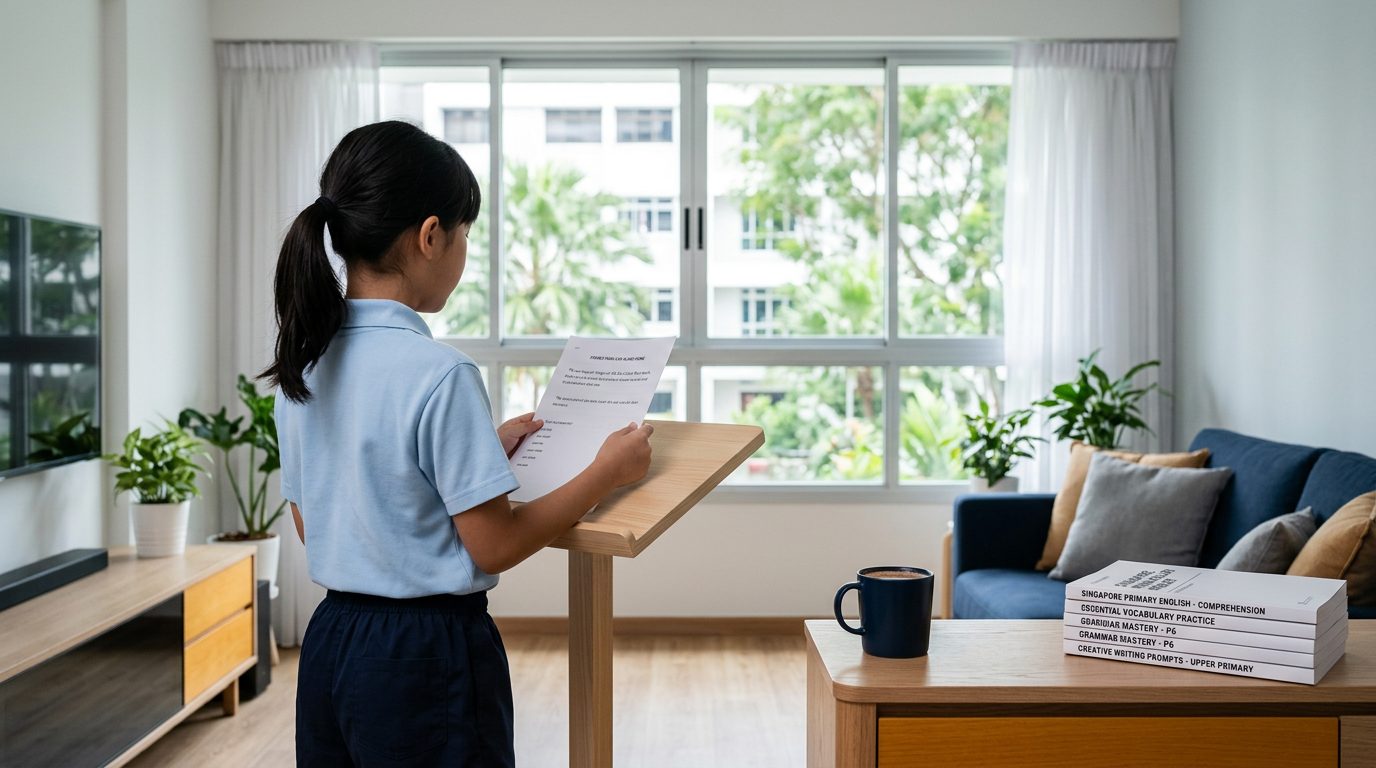
PSLE English · 10 min read
PSLE Oral Reading Aloud: How to Win the Pronunciation and Expression Marks
A mother told me her son "reads beautifully at home" but came out of his oral practice looking deflated. So I handed him a passage cold and asked him to read it to me. He read it like he was racing someone — flat, fast, every full stop ignored, the word thought coming out as fought, the -ed sliding off the end of gasped so it became gasp. He wasn't a weak reader. He was a fast reader who had never been told what the examiner is actually listening for. Two short coaching sessions later he sounded like a different child, and nothing about his English had changed — only his awareness had.
That gap is the whole story of PSLE oral reading aloud. It is the most coachable 15 marks in the entire English paper, and it is the part families practise least, because there is no worksheet to mark and no script to file. So let me walk you through what the examiner is really scoring, where capable children quietly leak marks, and a two-minute routine that does most of the heavy lifting.
Why Reading Aloud is worth taking seriously now
From the 2025 examination, the PSLE English oral (Paper 4) is worth 40 marks — 20% of the overall English grade, up from 30 marks and 15% before. Those 40 marks split into two parts: Reading Aloud (15 marks) and the Stimulus-Based Conversation (25 marks). So a full 15 marks of your child's English grade now ride on roughly a minute of reading a short passage out loud.
One change matters more than the headline numbers. Reading Aloud and the conversation are no longer on the same theme — the passage and the discussion photograph can be about completely unrelated things. There is also a short preamble before the passage that tells the reader the situation: who is speaking, to whom, and why. That preamble isn't decoration. It tells you the tone the examiner wants to hear, and a child who reads it and adjusts their voice is already reaching for the expression marks. (For the other 25 marks — the conversation — see our piece on the PSLE oral stimulus-based conversation.)
What Reading Aloud is actually marked on
When I assess a read, I'm listening for four things at once. Children who know these four exist will outscore children who are simply "reading nicely."
Pronunciation and articulation. Are the individual sounds accurate and clear? This is where the most marks slip away, because the errors are small and habitual — a swallowed ending, a softened th — and the child has said the word that way their whole life.
Pace and rhythm. Reading should sound like natural speech, not a sprint and not a funeral. Nervous children speed up; the words blur and the full stops vanish. The fix is almost always to slow down by about a third.
Expression and volume. Does the voice change to match the meaning? A question should lift at the end. An exclamation should carry feeling. A line of fear or excitement should not sound like a shopping list. This is exactly where the preamble earns its keep — if it tells you a worried mother is speaking, your voice should sound worried.
Phrasing and fluency. Smooth, logical pausing — a small breath at the comma, a fuller stop at the full stop — and minimal hesitation. The single biggest fluency upgrade is to replace every "um" and "er" with a clean, silent pause. A pause sounds composed. An "um" sounds lost, and the examiner hears the difference.
The sounds that quietly cost marks
Singaporean speech is clear and confident, but it carries a few habits that the Reading Aloud rubric notices. None of these mean a child speaks "wrongly" day to day — they're simply the sounds an examiner is trained to listen for.
The "th" sound — front, middle and end
English has two th sounds, and both get substituted. The soft one in thought, think and bath often turns into an f (fought, fink, baf). The voiced one in brother, they and with often turns into a d (broder, dey, wid). It happens at the front of a word (thought), in the middle (brother), and at the end (bath, teeth) — and the end is where it's hardest to catch.
The cure is mechanical: the tongue tip lightly touches the back of the top teeth and a little air escapes. Have your child hold th for a second — thhhought, thhhree — until the tongue knows where to go. Then they don't have to think about it under pressure.
Dropped ending consonants
This is the one I flag most. The final -d, -t and -k get clipped off:
- act read as ac
- asked read as ask (or even ah)
- helped read as help
- lapsed read as lap
- back read as bah
The -ed ending is the worst offender because it carries the past tense — gasped, rushed, grabbed. Drop it and the sentence quietly changes its grammar. Tell your child to land the last sound of every word, especially before a pause. It feels exaggerated to them and sounds completely normal to the listener.
Words that are simply mispronounced
A handful of words trip up even strong readers because the spelling lies about the sound. A few safe ones to drill:
- their / there / they're — identical in sound, so the read is fine, but children sometimes "correct" themselves mid-word and stumble. Don't — just read on.
- epitome — four syllables, ih-PIT-uh-mee, not "ep-i-tome."
- subtle — the b is silent: SUTT-le.
- mischievous — three syllables, MIS-chiv-us, not "mis-CHEE-vee-ous."
- Wednesday, comfortable, vegetable — all lose a syllable in real speech; read them the way they're actually said, not letter by letter.
You won't be able to predict the exact passage, so don't try to memorise a word list. The point is the habit of noticing a tricky word in the prep time and deciding how to say it before you reach it out loud.
A two-minute prep routine that works
Children get a short period to look at the passage before they read. Most waste it staring at the page in a mild panic. Here's the routine I teach — it fits in two minutes and turns the prep time into points.
First pass — read for the gist. Skim the preamble and the whole passage once. What's the situation, and what is this passage for? A speech, an announcement, a story, a worried message — the genre tells you the tone. You can't read a passage well if you don't know what it's about, so understanding comes first.
Second pass — mark it up in your head. Now go through more slowly and do four things:
- Spot the difficult words and silently mouth them — the th words, the long words, the ones with silent letters. Decide how to say each one now, not live.
- Mark the pauses. Every comma is a small breath; every full stop is a fuller stop; a dash usually means a pause for effect. Picture a little slash at each one.
- Decide your pace — deliberately a touch slower than feels natural, because nerves will speed you up.
- Find the expression cues — every question mark means your voice lifts at the end; every exclamation mark means feeling; speech in quotation marks should sound like a person talking.
Common mistakes
A few patterns show up again and again, and every one of them is a habit, not a talent gap.
Racing. The single most common fault. The child finishes a beat too fast, the words run together, and the punctuation disappears. Slowing down by a third instantly improves pace, phrasing and clarity all at once.
Reading in a monotone. A technically perfect read with no expression caps out below the top band. The examiner is listening for a voice that responds to the words. A question read as a flat statement is a missed cue sitting right there on the page.
Filler sounds. "Um," "er," and the little throat-clear before a hard word. Each one chips at the fluency mark. The replacement is silence — a pause is invisible on the score sheet; a filler is not.
Self-correcting out loud. A child stumbles on a word, stops, says "sorry," and re-reads it. The stumble alone is minor; the visible panic around it costs more. Teach them to read straight through a small slip and keep the rhythm.
Trailing off at full stops. The voice fades and the last word of the sentence gets swallowed — often the very ending consonant the rubric is listening for. Finish each sentence as clearly as you started it.
Ignoring the preamble. Treating it as a label to skip rather than the instruction for tone. It's the easiest expression mark on the page, and it's free.
What to do this week
You don't need a tutor or a special book for this — you need five honest minutes a day and a phone.
- Read aloud for five minutes a day. Any real passage works: a page of a storybook, a news article, the back of a cereal box. The muscle you're building is reading out loud well, and it only grows with reps.
- Record and play it back. This is the one that changes everything. Children can't hear their own dropped endings until they hear the recording. The first playback is always a small shock — and the second read is always better.
- Mark up one passage with a highlighter. One colour for th words, one for words with ending consonants to land, and a slash at every pause point. Then read it. Seeing the marks trains the eye to spot them cold on exam day.
- Read the preamble first, every time. Make it a fixed habit so it's automatic under pressure: who's speaking, to whom, why — then read in that voice.
Reading Aloud rewards the same thing good writing does — control, not flash. A child who lands their endings, honours the punctuation and matches the tone to the passage will out-read a child with a bigger vocabulary every time. (The same control wins marks on paper too — see what separates a top-band composition from a mid one.) These 15 marks are sitting right there, and a week of five-minute reads is usually all it takes to claim most of them. Reading Aloud is only half the oral, though — the 25-mark conversation rewards a different skill, which we cover in our bank of oral practice questions by theme.
Keep learning
Related PSLE guides

PSLE Oral Practice at Home: The Themes and Questions Examiners Keep Asking
The themes and question types the stimulus-based conversation keeps circling back to — and a 10-minute home routine that turns a quiet child into one who gives a reason and an example.
27 Jun 2026 · 10 min read

PSLE Oral: Stimulus-Based Conversation Tips That Work
The oral is now 20% of the English grade, and the child who only describes the photograph leaves the easiest marks on the table. Here is what the examiners actually reward.
27 Jun 2026 · 11 min read
The Word Patterns That Decide PSLE English: From Editing Traps to Vocab Cloze
Why memorising random vocabulary lists fails upper-primary students, the word families that actually cost marks in Paper 2, and how to practice them actively.
7 Sept 2026 · 10 min read

PSLE Vocabulary Cloze: Why All Four Options Look Right
The vocabulary options are near-neighbours separated by usage, not meaning. Why memorising definitions is the wrong drill, and what to do instead.
20 Aug 2026 · 14 min read