What is a Community?
The difference between three keywords students often mix up — habitat, population and community — and how they fit together.
⏱ 8 min · 🎯 4 things to master
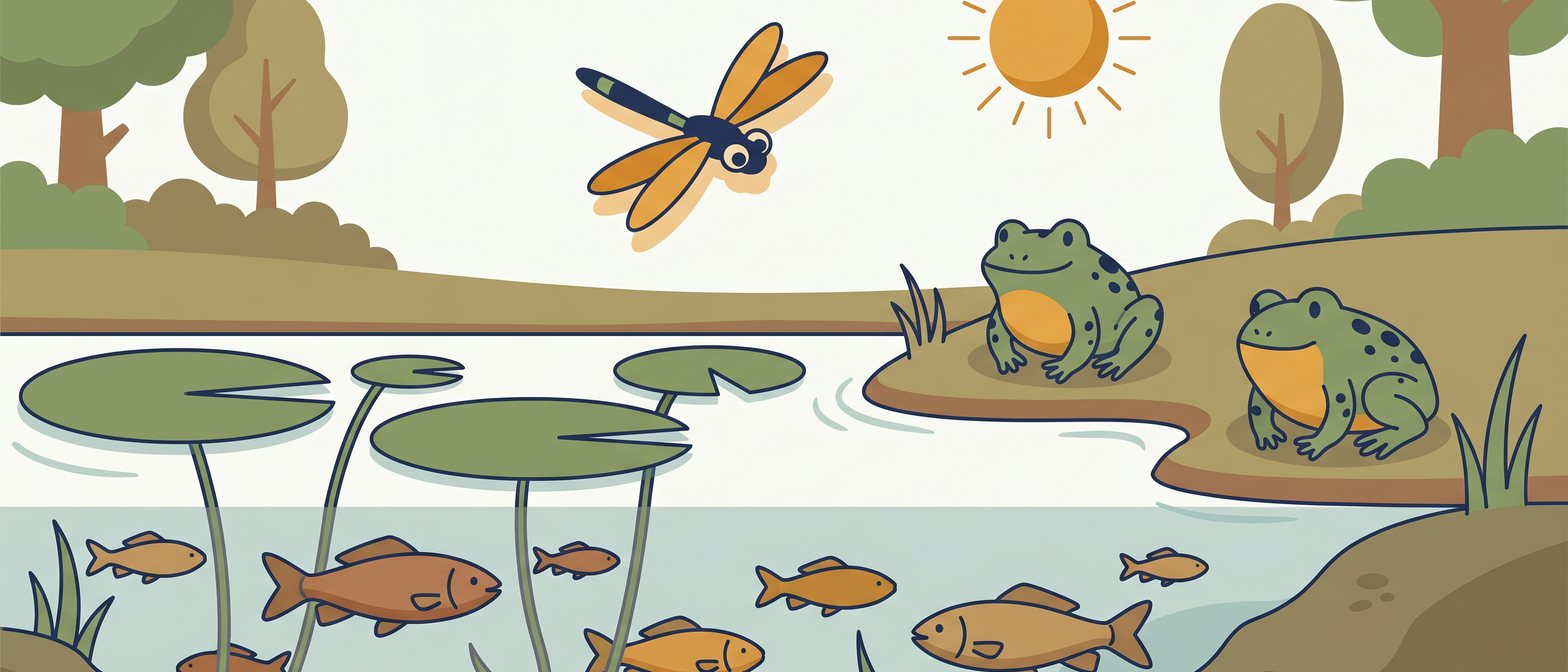
You have probably walked past a pond in the Botanic Gardens and watched fish dart through the water, heard frogs croaking at the edge, and spotted a dragonfly hovering above a lily pad. But here is something most students never think about — that pond is not just a nice scene. It is a system, with exact scientific names for every part. And if you learn those names now, you will pick up marks that other students leave behind.
Parents: each blue dotted word is a tappable definition, and the pond builder below lets your child add organisms and watch the labels change. Let them predict the answer before they tap — saying the keyword out loud is how it sticks.
By the end you will know the difference between a habitat, a population, and a community, and you will be able to use each word correctly in a PSLE question. The three concepts build on each other, so read them in order.
Habitat — the place where an organism lives
Every living thing needs a place to live that gives it what it needs: food, water, shelter, and the right conditions. That place is its .
A pond is a habitat. A forest is a habitat. The drain outside your HDB block is even a habitat — for mosquito larvae. A goldfish lives in a pond habitat. A monkey lives in a forest habitat. An earthworm lives in a soil habitat. The habitat matches the organism's needs: fish need water, earthworms need damp soil, eagles need open sky above a tall tree.
🤔 Predict first: A snail lives under a damp leaf on the forest floor. What do we call the damp leaf under the forest floor for the snail?
Population — all organisms of the SAME kind in a place
Now imagine ten goldfish swimming in the same pond. Those ten goldfish are all the same kind of organism, and they all live in the same place. Together they make up a .
One goldfish alone is not a population — a population means the whole group of the same kind. All the frogs in the pond form the frog population. All the lily pads in the pond form the lily pad population. Notice that a population is always just ONE kind of organism — not a mix. The keyword is population.
🤔 Predict first: There are 12 frogs living together in a pond. What do we call these 12 frogs?
Community — all the different populations together
Here is where it gets interesting. The frog population, the fish population, the lily pad population, and the dragonfly population all share the same pond habitat. When ALL these DIFFERENT populations live together in the same habitat, we call that a .
A community is always a mix. It contains every different population in the same place. One population alone is never a community — you need at least two different kinds of organisms living together. The keyword is community.
Now build the pond yourself and watch the labels change in real time.
Build a pond — habitat, population, community
Predict first: All the fish of one kind in a pond are called a…
How the three ideas fit together
Think of them as three layers, like nesting boxes.
The habitat is the outermost box — the pond itself. Inside it, each population is one group of the same kind of organism (all the fish, all the frogs, all the lily pads). All those populations living together inside the same habitat form the community.
You can only have a community if you have a habitat (a place) and at least two populations (different kinds of organisms). They need each other to exist.
Watch out — these are easily mixed up
Quick recap
🎯 Mastery check
Answer all 8 — your progress is saved on this device.
A garden has grass, butterflies, ants, and earthworms all living together. What do we call all these different populations living together in the garden?
All the sparrows living in a park are best described as…
What do we call the mangrove swamp where mudskippers, crabs, and mangrove trees all live?
A pond has 20 guppies and 15 water hyacinths living in it. Which of the following is correct?
You want to describe all the monitor lizards living in the Sungei Buloh wetland reserve. Which word fits best?
A student says the forest is a population. Why is this wrong?
Which of the following is an example of a community?
A coral reef has clownfish, sea anemones, parrotfish, and coral all living together. If the parrotfish all die, what happens to the community?