Water and Its States
How water changes between ice, liquid and vapour at fixed temperatures — melting at 0°C, boiling at 100°C — and how to read a heating or cooling graph.
⏱ 10 min · 🎯 4 things to master
You have probably seen ice, water, and steam in your kitchen every day — but here is the question that catches students out in the PSLE: at exactly what temperature does each change happen? The answer is not "it depends on the weather" or "when it gets hot enough." For pure water, these temperatures never change. They are fixed, they have names, and your marker awards marks only when you write those names and numbers correctly.
Parents: the virtual thermometer below lets your child drag the temperature and watch the state of water change — let them predict each boundary before they move the slider, then compare. The blue dotted words are tappable definitions, and the Teacher's tip boxes name the exact phrases the marker awards.
By the end of this note you will be able to name the three states of water, state the two fixed temperatures (and their names), and describe what a heating or cooling graph looks like. Let's start with what water actually looks like in each state.
The Three States of Water
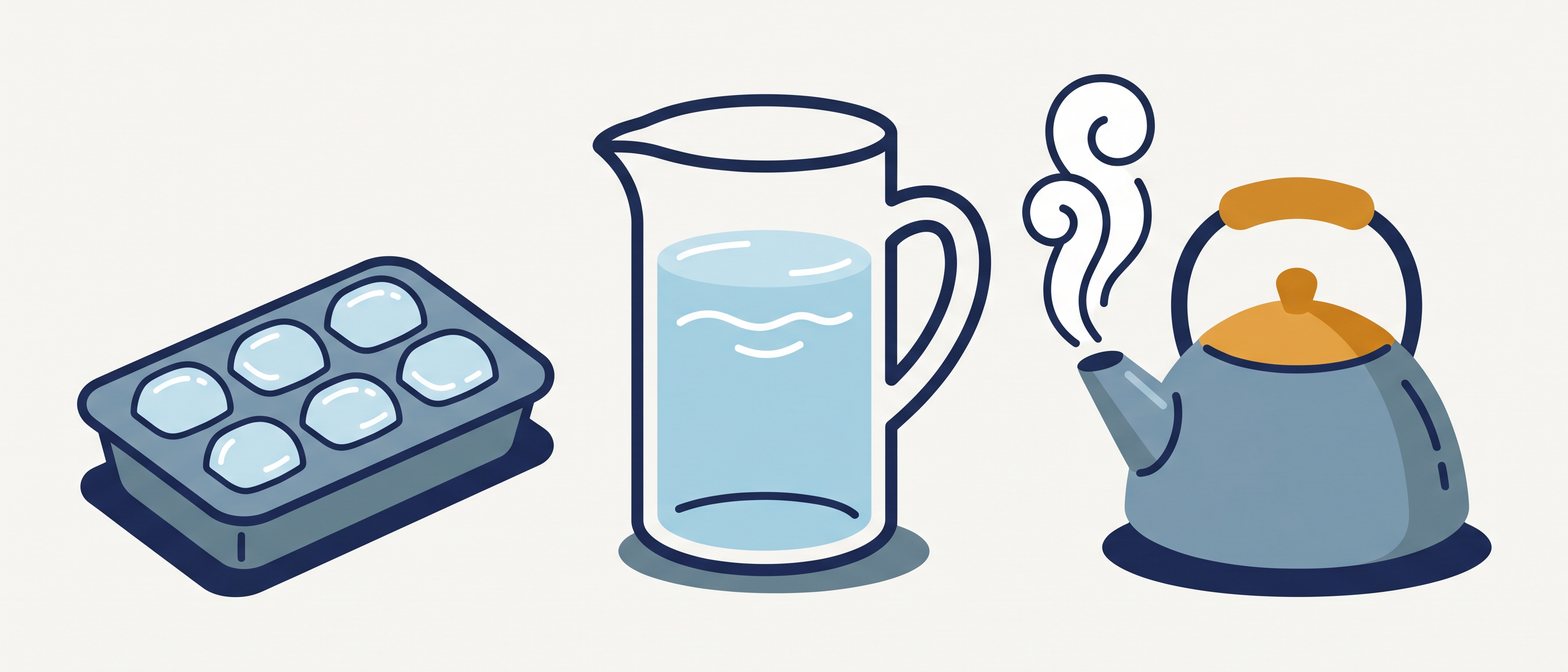
The same substance — water — can exist in three forms depending on its temperature. In the freezer it is solid. In your water bottle it is liquid. Coming out of a boiling kettle it turns into gas. The scientific name for the gas form is .
When something is a , its particles are packed tightly and locked in place. When it is a , its particles flow past each other. When it is a , its particles move freely and spread out in every direction.
The three forms of water have everyday names too: ice (solid), water (liquid), and water vapour (gas).
🤔 Predict first: Which state of water has particles that are locked in a fixed position?
Melting and Freezing — Both at 0°C
Put an ice cube on the kitchen counter on a warm Singapore morning. It starts to melt into water almost immediately. What is special about the temperature when this happens? It is exactly 0°C — not 1°C, not -1°C. This is called the of water.
Now put that water in the freezer. When the temperature drops back down to 0°C, the water turns back into ice. This reverse change is called , and it happens at the same temperature: 0°C. The melting point and the freezing point of water are both 0°C.
Boiling and Condensation — Both at 100°C
Watch a pot of water heating on the stove. Bubbles begin rising all through the water and you see white clouds of steam above it. This is , and it happens at exactly 100°C. This temperature is called the of water.
When water vapour touches a cold surface — like a cold glass or a mirror in the bathroom after a shower — it changes back from gas into liquid. You see little water droplets appear. This reverse change is called . The water droplets you see on the outside of a cold drink can on a humid Singapore day? That is condensation from the air.
Virtual Experiment: The Heating Thermometer
Drag the slider to change the temperature of water from -20°C all the way up to 120°C. Watch the state change and look out for what happens at 0°C and 100°C.
Heating and Cooling Water
Predict first: At what temperature does ice melt?
Reading a Heating or Cooling Graph
The PSLE often shows a temperature-time graph — a line graph where the horizontal axis is time and the vertical axis is temperature. When you heat ice in a container, the graph has a very specific shape.
Here is what the heating graph for water looks like and what each part means:
Stage 1 — Heating the ice (below 0°C): The temperature rises steadily. The line slopes upward.
Stage 2 — Melting (at 0°C): The temperature stops rising and stays flat at 0°C even though you keep adding heat. All the energy is being used to melt the ice, not to raise the temperature. This flat section is called a .
Stage 3 — Heating the water (0°C to 100°C): Once all the ice has melted, the temperature rises again. The line slopes upward.
Stage 4 — Boiling (at 100°C): The temperature stops rising again and stays flat at 100°C. All the energy is being used to turn the liquid water into water vapour.
Stage 5 — Steam (above 100°C): Once all the water has boiled away, the temperature of the steam can rise further.
For a cooling graph (starting with hot water vapour), the shape is the reverse: two flat sections appear — one at 100°C (condensation) and one at 0°C (freezing).
🤔 Predict first: On a heating graph, why does the temperature stop rising at 0°C even though you are still adding heat?
Watch out — these are easily mixed up
Quick recap
🎯 Mastery check
Answer all 8 — your progress is saved on this device.
At what temperature does ice melt into water?
What is the scientific name for the change when water turns into water vapour at 100°C?
Water vapour from the air turns into tiny droplets on a cold glass. What change of state is this?
On a temperature-time heating graph, there is a flat section at 0°C. What is happening during this flat section?
A student places a bowl of water on the counter. After a few hours, the level of water has dropped. Which process caused this?
What are the correct temperatures for the melting point and boiling point of water?
Ice cream left out on the counter starts to melt. The temperature at which the ice cream starts to melt is most similar to which change for water?
Which statement correctly describes what happens at the boiling point of water?