The Water Cycle
How water moves between the Earth and the sky through evaporation, condensation and precipitation, in a cycle that never stops.
⏱ 9 min · 🎯 4 things to master
Have you ever watched a puddle on the void deck disappear after the rain stops? Where does all that water go? It does not vanish — it travels up into the sky as invisible vapour, joins the clouds, and eventually falls back to Earth as the next rainstorm. This non-stop journey of water is called the water cycle, and it has been running without a break for billions of years.
Parents: the interactive sim below lets your child step through each stage of the water cycle and name it — let them click through first, then read the explanation together. The blue dotted words are tappable definitions, and the "Teacher's tip" boxes call out the precise keyword the PSLE marker rewards.
By the end you will be able to describe the four stages of the water cycle using the exact words your marker is looking for. Those four stages are: evaporation, condensation, precipitation, and collection. Let's step through the cycle.
Evaporation
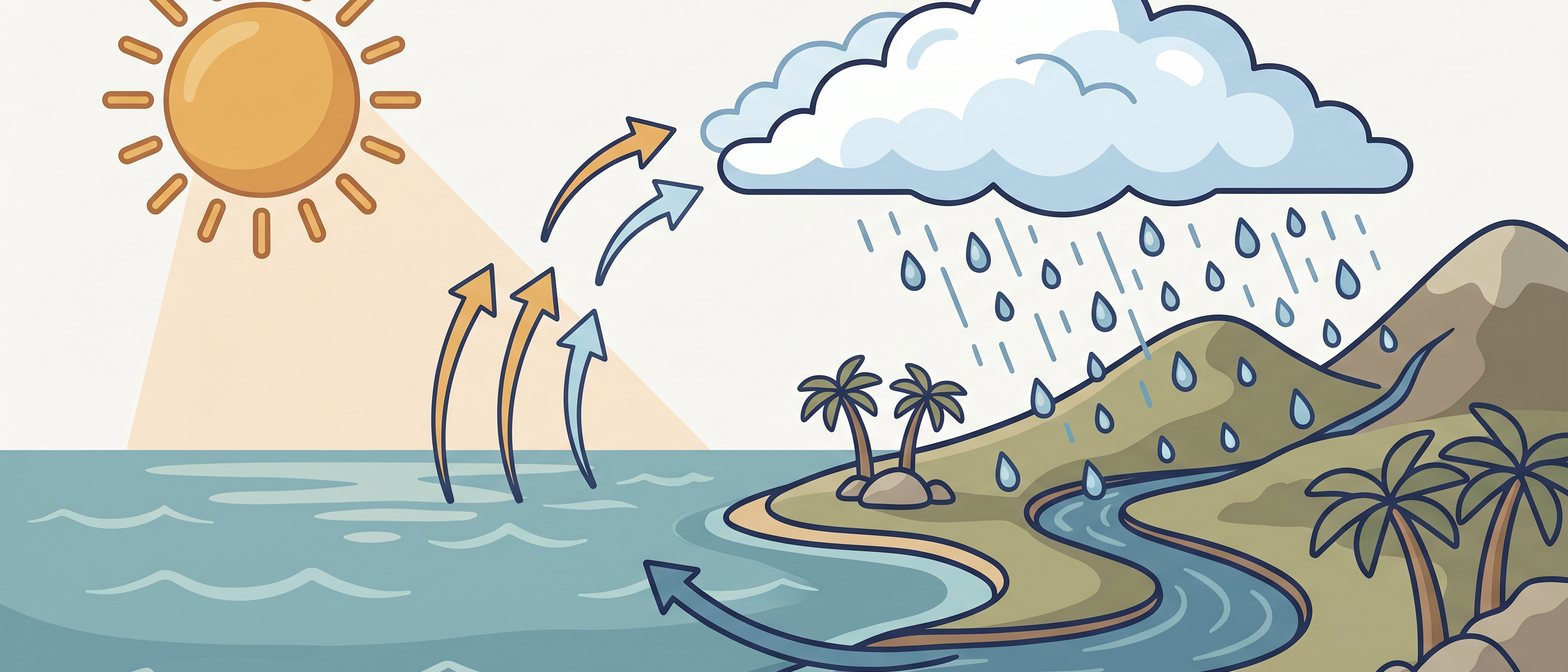
On a hot afternoon in Singapore, the sun beats down on the sea, on reservoirs, on rivers, and on every wet surface it can find. The heat gives water molecules enough energy to break free from the liquid surface and drift upward as an invisible gas called .
This change from liquid water to water vapour is called . You see it every day: your wet umbrella dries out after the rain, your swimming costume dries on the line, and puddles shrink in the afternoon sun. In every case, liquid water is absorbing heat and turning into water vapour that rises into the air.
🤔 Predict first: A wet cloth is left in the sun. The cloth feels dry an hour later. Where did the water go?
Condensation
Water vapour is lighter than air, so it rises. As it climbs higher, the temperature drops. Cool air cannot hold as much water vapour as warm air. So when the vapour meets cool air high in the sky, it loses energy and turns back into tiny liquid water droplets. These droplets collect around tiny dust particles to form the white puffs we call clouds.
This change from water vapour back into liquid water droplets is called . You see the same thing on a cold can of drink on a hot day — tiny droplets appear on the outside of the can as the warm, moist air around it cools suddenly and its vapour condenses. On a bigger scale, that same process forms every cloud in the sky.
🤔 Predict first: Cold water is poured into a glass on a humid Singapore afternoon. Tiny water droplets appear on the outside of the glass. What is happening?
Precipitation
Clouds look weightless, but they are made of millions of tiny water droplets. As more vapour condenses, the droplets join together and grow heavier. Eventually they become too heavy to float in the air and they fall from the cloud. When water falls from the sky in any form, that is called .
In Singapore it almost always falls as rain. In colder countries at higher altitudes, it can fall as hail or snow — but no matter the form, the PSLE word for "water falling from clouds" is precipitation.
🤔 Predict first: Dark clouds have formed over Bukit Timah Hill and it starts to pour with rain. What is the correct PSLE term for the rain falling from the clouds?
Collection and the Cycle Repeating
When rain hits the ground, it flows downhill into . This gathering of water on the surface is called . Singapore's four main reservoirs — including the Bedok and Pandan reservoirs — collect rain for our drinking supply. The water stays there until the sun heats it again, and the whole cycle starts over from evaporation.
Now drive the cycle yourself — step through all four stages and name each one.
Drive the water cycle
Predict first: What makes water rise into the sky as water vapour?
Watch out — these are easily mixed up
Many students mix up the four terms because they all sound technical. Lock in the difference now.
Quick recap
🎯 Mastery check
Answer all 8 — your progress is saved on this device.
The sun heats the surface of a reservoir and the water level slowly drops on a dry day. What process is happening?
High in the sky, water vapour cools and forms tiny water droplets that make up a cloud. What is this process called?
Dark clouds gather and rain falls heavily on Orchard Road. Which stage of the water cycle is this?
After the rain, water flows off the roads and into the Kallang River, which drains into the sea. What is this stage called?
Cold water drips are seen on the outside of a chilled metal cup on a humid afternoon. What is the correct name for this process, and why does it happen?
Which part of the water cycle requires energy from the sun to work?
A student says: "Clouds form when water vapour falls from the sky." What is wrong with this statement?
Singapore gets about 2,400 mm of rainfall a year. Which stage of the water cycle provides all of that rain?