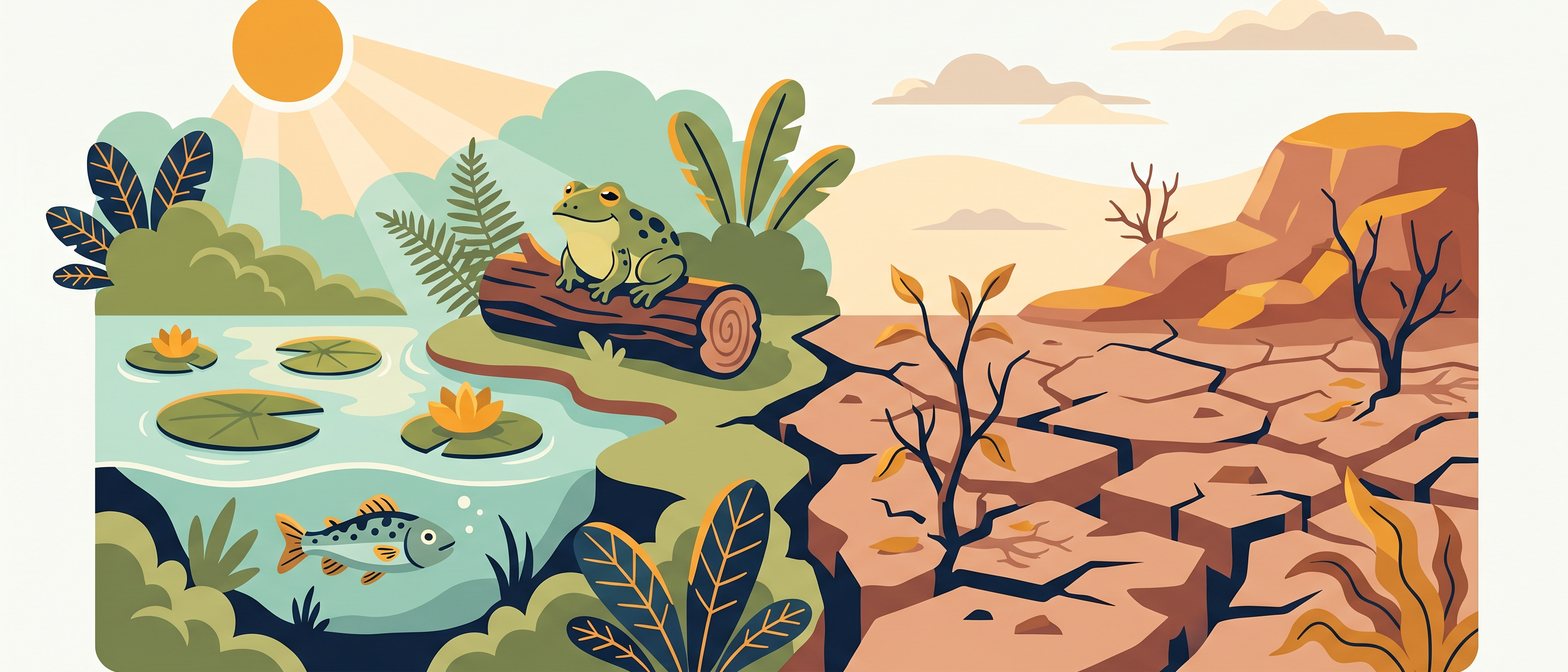
The Environment
How living (biotic) and non-living (abiotic) factors like light, water and temperature shape a habitat and the organisms that can live there.
⏱ 11 min · 🎯 4 things to master
The pond outside your school is not just water and mud. Look more carefully and you will find pond plants, small fish, insects hovering over the surface, and maybe even a frog or two. Now look even further — the sunlight shining in, the temperature of the water, the soil at the bottom, the air above. All of these together make up the environment. Take any single piece away and the whole picture changes. That is what this note is about.
Parents: each section has a prediction step — let your child guess first before tapping to reveal the answer. The blue dotted words open a quick definition, and the Teacher Tip boxes flag the exact keywords the PSLE marker rewards. Ten minutes together here is worth more than reading a textbook summary alone.
By the end you will be able to describe what an environment is, name the three core physical factors, explain how food and other organisms also affect survival, and predict what happens when one factor changes. The four ideas we will master: biotic and abiotic, physical factors, interdependence, and factor changes.
Biotic and Abiotic: Two Parts of Every Environment
Your school garden has caterpillars munching on leaves, birds hopping across the grass, bacteria in the soil doing their invisible work. These are all living things — scientists call them the parts.
But the garden also has sunlight, rain, warm afternoon air, and the soil those plants grow in. These have never been alive. Scientists call them the parts. Every single environment — a park, a pond, a void-deck pot plant, a Singapore nature reserve — is made up of both parts together.
🤔 Predict first: A pond contains water, mud, sunlight, fish, pond plants and frogs. How many of these are non-living (abiotic)?
Three Core Physical Factors — and Other Examples
For the P6 environment outcome, focus first on three physical factors: light, temperature and water. The availability of food and the types of other organisms present also affect whether an organism survives. Air and soil are useful extra examples of non-living parts of an environment.
- — plants capture light energy to make food. Too little light and they cannot photosynthesise. Too much direct heat from light can also scorch leaves.
- — most organisms live within a narrow band. A tropical fish kept in cold water will slow down and eventually die.
- — every living thing needs water for its life processes. A pond plant in a dried-up pond wilts and dies.
- — an additional abiotic example; land animals and most plants need oxygen from air to .
- — another abiotic example; plants anchor their roots in soil and absorb water and minerals from it.
Living Things Depend on Non-Living Factors — and on Each Other
Here is the key idea that PSLE questions love to test: living things do not just exist inside an environment, they depend on it. Take water away and the pond plant dies. Take the pond plant away and the herbivorous fish that eats it has no food. Take that fish away and the heron that eats the fish goes hungry. Everything is connected. Survival is also affected by the availability of food and by which other organisms are present, including producers, consumers and decomposers.
This is called . The living things depend on the non-living factors, and they depend on each other through food chains and other relationships.
Try the habitat experiment below. Set the non-living factors yourself and see whether the organism thrives, struggles or dies.
Tune the Habitat
Predict first: What happens to a pond plant if all the water dries up?
Changes in Factors Affect Which Organisms Can Live There
Now think about what happens when a non-living factor changes. Heavy rainfall floods the void deck. A heatwave warms the pond. A tree is cut down and the forest floor suddenly gets a lot more sunlight. Each change creates winners and losers.
Organisms that can cope with the new conditions survive. Organisms that cannot cope have to move away or they die. Over time the community of living things in that habitat shifts. This is why protecting non-living factors — keeping a river clean, keeping a forest shaded — is the same as protecting the organisms that live there.
What happens when a factor changes?
Predict first: If a pond dries up completely, which organism is most directly affected first?
🤔 Predict first: A large tree is cut down in a forest. Which non-living factor changes most immediately for the plants on the forest floor?
Watch out — easily mixed up
Quick recap
🎯 Mastery check
Answer all 8 — your progress is saved on this device.
A pond contains water, sunlight, soil, pond plants, fish and frogs. Which of these are the abiotic (non-living) parts?
Name two non-living factors that affect whether a plant can grow in a habitat.
A pond dried up during a long dry season. What happened to the pond plants?
A factory releases warm water into a river, raising the river temperature. How does this affect the fish in the river?
A student says fire is a living (biotic) thing because it moves, grows and needs air. Is the student correct?
You want to grow a cactus and a pond fern in the same pot. Why is this a bad idea?
Trees in a forest are cut down. Predict what happens to the ferns on the forest floor that normally grow in shade.
Which of these is the best example of an organism depending on a non-living factor?