Reproduction in Plants
The parts of a flower, how pollination and fertilisation turn a flower into a fruit, and the ways seeds are dispersed to new places.
⏱ 12 min · 🎯 4 things to master
Most people think a flower is just something pretty to look at. But for a plant, a flower is a working machine — its only job is to make seeds so the next generation of plants can grow. Everything inside that flower, from the dusty yellow powder to the sticky bumps, is part of a precise reproduction system. Once you understand the parts and what each one does, the PSLE questions on this topic become straightforward.
Parents: the interactive experiment in the Pollination section lets your child carry the pollen step by step — let them predict first before tapping through. The tappable blue words are definitions, and the Teacher's tip boxes highlight useful science keywords.
By the end you'll be able to name every part of a flower, explain what pollination and fertilisation mean, and describe the four ways seeds are dispersed. The four ideas we'll master are: parts of a flower, pollination, fertilisation, and seed dispersal.
Parts of a Flower
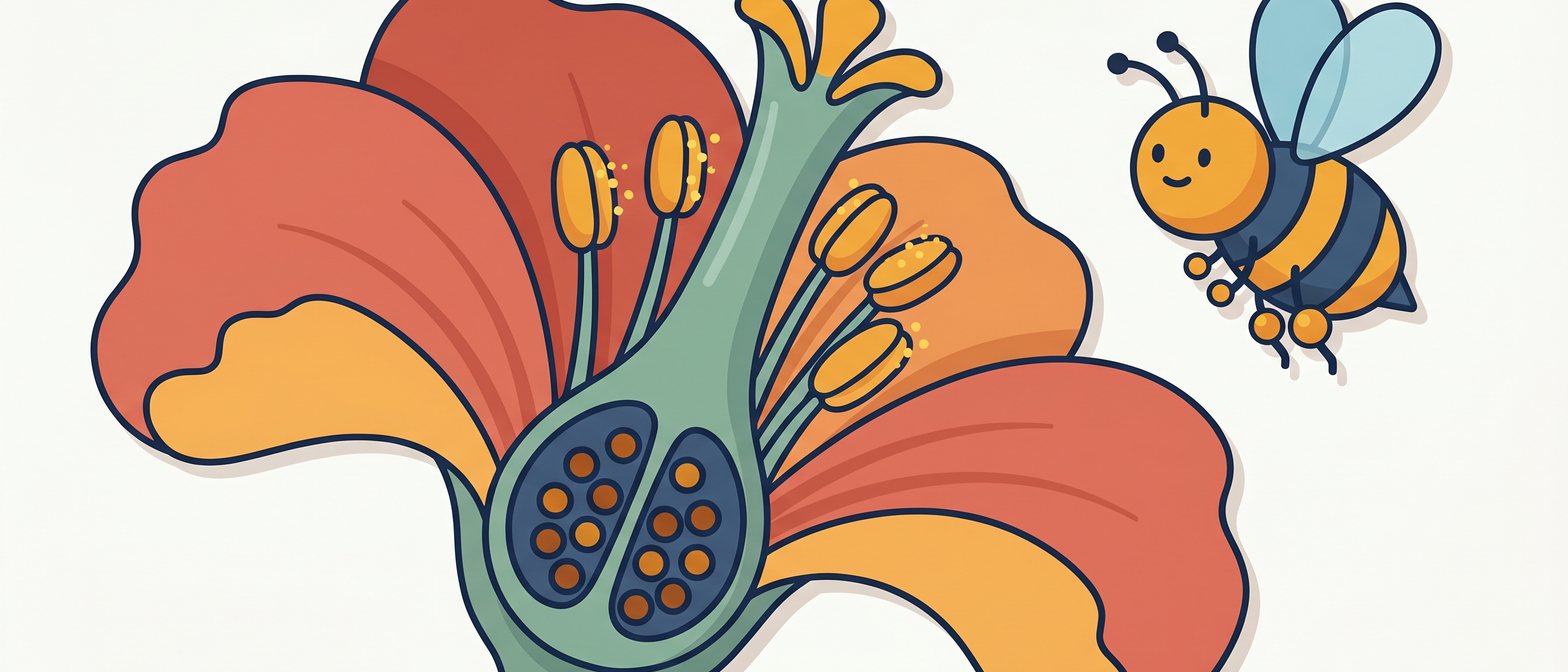
If you pull apart a hibiscus flower (the national flower of Malaysia, common in Singapore parks), you find two sets of parts: the parts that make pollen and the parts that receive pollen.
The is the male part. It has two pieces. The is the small, often yellow sac at the top where pollen grains are made. The is the thin stalk that holds the anther up in the air, where pollen can be picked up easily.
The is the female part, right in the centre of the flower. It has three pieces stacked on top of each other. The is the sticky surface at the very top — pollen grains land here. The is the slender tube below it. At the bottom is the , which holds one or more .
🤔 Predict first: Which part of the stamen actually makes the pollen?
Pollination
The pollen sitting on the anther is no good to anyone while it stays there. For a plant to reproduce, the pollen must travel to a stigma. That journey is called .
Pollen cannot walk. It needs a carrier. The most common carriers in Singapore are insects (especially bees, which collect pollen for food) and wind (some plants like grasses release huge clouds of pollen that float on the breeze). Birds and other animals also carry pollen between flowers.
When a bee lands on a flower to collect nectar, pollen from the anther rubs onto its body. When the bee visits the next flower, some of that pollen brushes off onto the stigma. Pollination is complete the moment a pollen grain lands on the stigma.
Try the experiment below. You carry the pollen yourself — predict what must happen first, then step through each stage. The pollen-tube step shown later is optional enrichment; the P5 core is pollination, fertilisation and the changes to the ovary and ovules.
Pollination and Fertilisation — step by step
Predict first: What must happen BEFORE a flower can make seeds?
Fertilisation (with optional enrichment)
Pollination gets the pollen onto the stigma — but seeds are not formed yet. The next step is .
For optional enrichment, you can picture a tiny pollen tube growing down through the style into the ovary. The P5 core idea is simpler: inside an ovule, the male cell from the pollen joins with the female cell. This joining is fertilisation.
Once fertilisation is complete, the ovule develops into a . At the same time, the ovary wall grows and swells to become the . The fruit you eat — a mango, a papaya, a watermelon — is the ovary of the flower that made the seeds inside.
🤔 Predict first: After fertilisation, what does the ovary become?
Seed Dispersal
A fruit full of seeds is useful only if the seeds can get to a new place to grow. If all the seeds fell directly under the parent plant, they would have to compete with it for water, light, and space. So plants have four main ways to scatter their seeds far away — each matched to the seed's structure.
Wind dispersal — seeds or fruits that travel on the wind are very light and often have wing-like or feathery parts. The of the angsana tree spins like a helicopter blade, slowing its fall so the breeze can carry it further. Dandelion seeds have a tiny parachute of fine hairs.
Water dispersal — some fruits or seeds float. The is a classic Singapore example. Its fibrous husk traps air so the fruit can float across the sea, carrying the seed inside.
Animal dispersal — two sub-types. First, animals eat fleshy fruits and later discard the seeds elsewhere — mango, papaya and guava seeds can spread this way. Some seeds may also pass through an animal undamaged. Second, some seeds have hooks or burrs that catch on fur or clothing. Have you ever picked little spiky seeds off your school socks after a walk in the park? Those hooks are deliberate.
Splitting (explosive dispersal) — some seed pods dry out and then suddenly split open, flinging seeds outward. The of the rubber tree's seed pod can throw seeds several metres.
How is this seed dispersed?
Predict first: Which method does a coconut use?
Watch out — these are easily mixed up
Quick recap
🎯 Mastery check
Answer all 8 — your progress is saved on this device.
A student says the anther receives pollen. Is this correct?
A bee lands on a flower and pollen from the anther sticks to its body. The bee then flies to another flower and the pollen rubs off onto the stigma. What process has just occurred?
After pollination, the male cell joins the female cell inside an ovule. What is this process called?
After fertilisation, what does the ovary of a flower develop into?
A student finds a seed with a flat, wing-shaped structure attached to it. Which dispersal method does this seed most likely use?
A coconut can float across the sea for many weeks before it washes up on shore. Which seed dispersal method does this describe?
Which of the following correctly describes the order of events in plant reproduction?
A seed has tiny hooks on its surface. You find several of these seeds stuck to your school socks after a walk in the park. Which dispersal method does this seed use, and why is it effective?