Reproduction in Humans
How a new human life begins at fertilisation, develops in the womb over nine months, and continues the human life cycle.
⏱ 10 min · 🎯 4 things to master
Every single person you have ever met started as one tiny cell. That includes you, your parents, your friends, and every person who has ever lived. The moment that first cell formed — the moment a sperm cell joined an egg cell — is called fertilisation, and it is the start of the human story. In this note you will step through the full journey: from that very first cell, all the way to birth, and then to the adult who can one day start the cycle again.
Parents: let your child tap through the development timeline below before reading the explanations — predict first, then reveal. The blue dotted words are tappable definitions, and the "Teacher's tip" boxes highlight useful science keywords. 15 minutes of active clicking beats 30 minutes of passive reading.
By the end you'll be able to explain four key ideas: how works, what happens in the womb over about 9 months, the broad stages of development before birth, and how the human keeps repeating. The stage details are optional enrichment; the core ideas are fertilisation, development in the womb, and the repeating life cycle. Let's go.
Fertilisation
You already know that living things reproduce — they make more of their own kind. In humans, reproduction begins when two special cells come together. The testes produce , and the ovaries produce . A sperm cell joins an egg cell. The joining of these two cells is called .
When fertilisation happens, a brand-new cell is formed. This cell is called a . The zygote contains information from both parents and will develop into a new human being.
Predict before you see the answer.
🤔 Predict first: A sperm cell joins an egg cell. What is the cell that is formed called?
Development in the Womb
After fertilisation, the zygote does not stay as a single cell for long. It begins to divide — first into 2 cells, then 4, then 8, and so on. These cells travel to the mother's (also called the uterus), where they attach and grow. The womb provides warmth, protection, and food for the developing baby.
Over about 9 months, the zygote develops through several stages. At first, the developing baby's main organs begin to form. Later, arms and legs become clear. By the end, the baby is fully formed and ready to be born. The whole time, the baby is safely inside the mother's womb.
Step through the 9-month journey below. Predict what is formed first, then advance through the broad stages. The stage-by-stage detail is optional visual enrichment; the key idea is development inside the womb over about 9 months.
Development in the womb — 9-month timeline
Predict first: What is formed when a sperm cell joins an egg cell?
Optional enrichment — broad stages of development before birth
The broad sequence below helps you picture how a zygote develops from fertilisation to birth. Detailed foetal development is beyond the required P5 depth, so use this as enrichment rather than as a list of required exam stages:
| Stage | What it is |
|---|---|
| Fertilisation | Sperm cell joins egg cell |
| Zygote | The first cell that is formed |
| Developing baby (early) | Main organs begin to form (months 1–2) |
| Developing baby (growing) | Arms, legs, fingers, toes are clear; baby can move (months 3–6) |
| Baby ready to be born | Fully formed, lungs developed (months 7–9) |
| Birth | Baby is born after about 9 months |
The key idea: the zygote develops inside the womb. It is not fully formed at the start — it grows and changes over many months.
🤔 Predict first: How long does it take for a baby to fully develop inside the mother's womb?
The Human Life Cycle
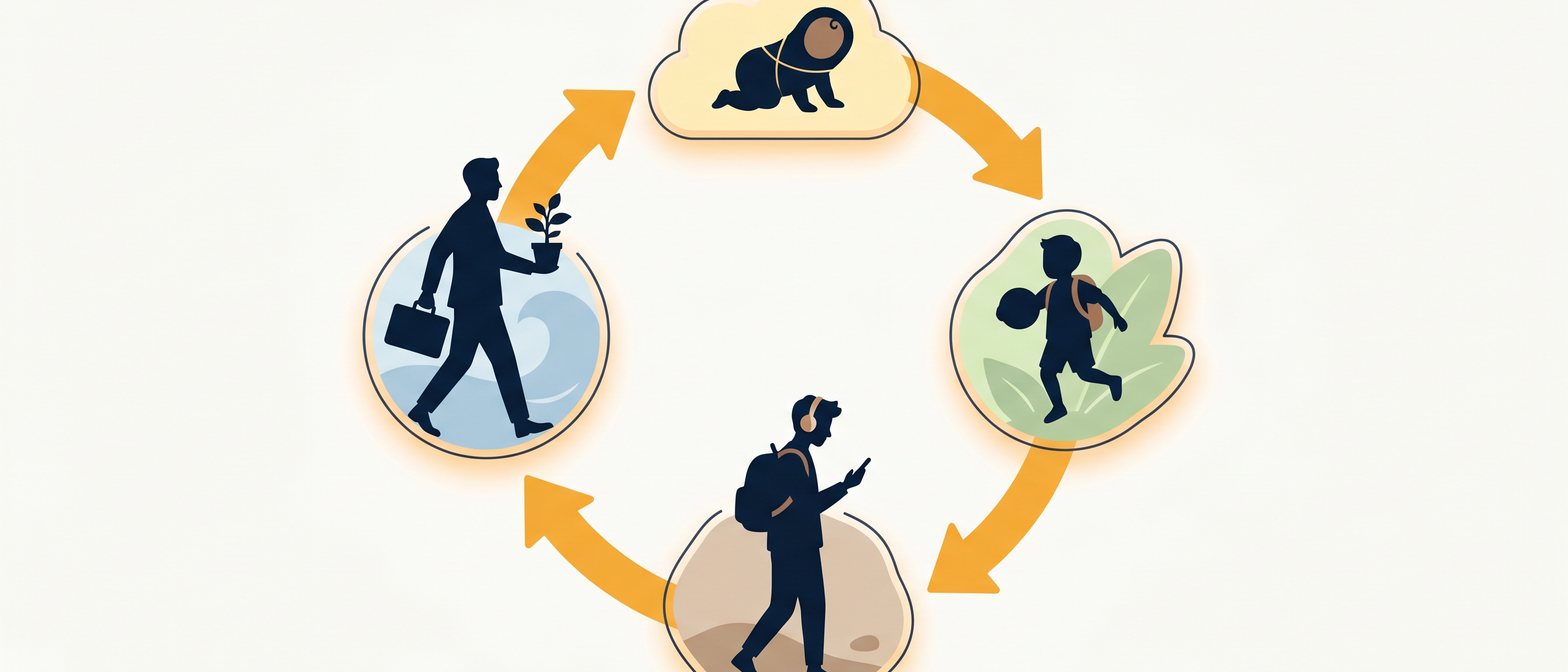
A life cycle shows how a living thing reproduces and its young grow to become adults, who then reproduce again. The human life cycle follows this path:
Baby → Child → Teenager → Adult → (a mature human reproduces) → Baby → …
The cycle continues as long as the species continues. Here is the key idea: as humans mature, they can reproduce, allowing the cycle to begin again from the start. This is why it is called a "cycle": it goes round and round.
Which stage comes next in the human life cycle?
Predict first: What stage comes AFTER the baby in the human life cycle?
Watch out — easily mixed up
Quick recap
🎯 Mastery check
Answer all 8 — your progress is saved on this device.
What is the name of the process in which a sperm cell joins an egg cell?
What is the cell formed when a sperm cell joins an egg cell?
Where does the zygote develop into a baby?
Approximately how long does it take for a baby to develop fully inside the womb?
Which stage represents a mature human who can reproduce in this simple life-cycle model?
Aisha says the baby develops in the mother's stomach. Is she correct? Explain.
Which of the following correctly describes a life cycle?
Which statement best describes development after fertilisation?