Properties of Materials
The five properties that decide what a material is used for — whether it floats, absorbs water, bends, holds weight, or lets light through.
⏱ 9 min · 🎯 5 things to master
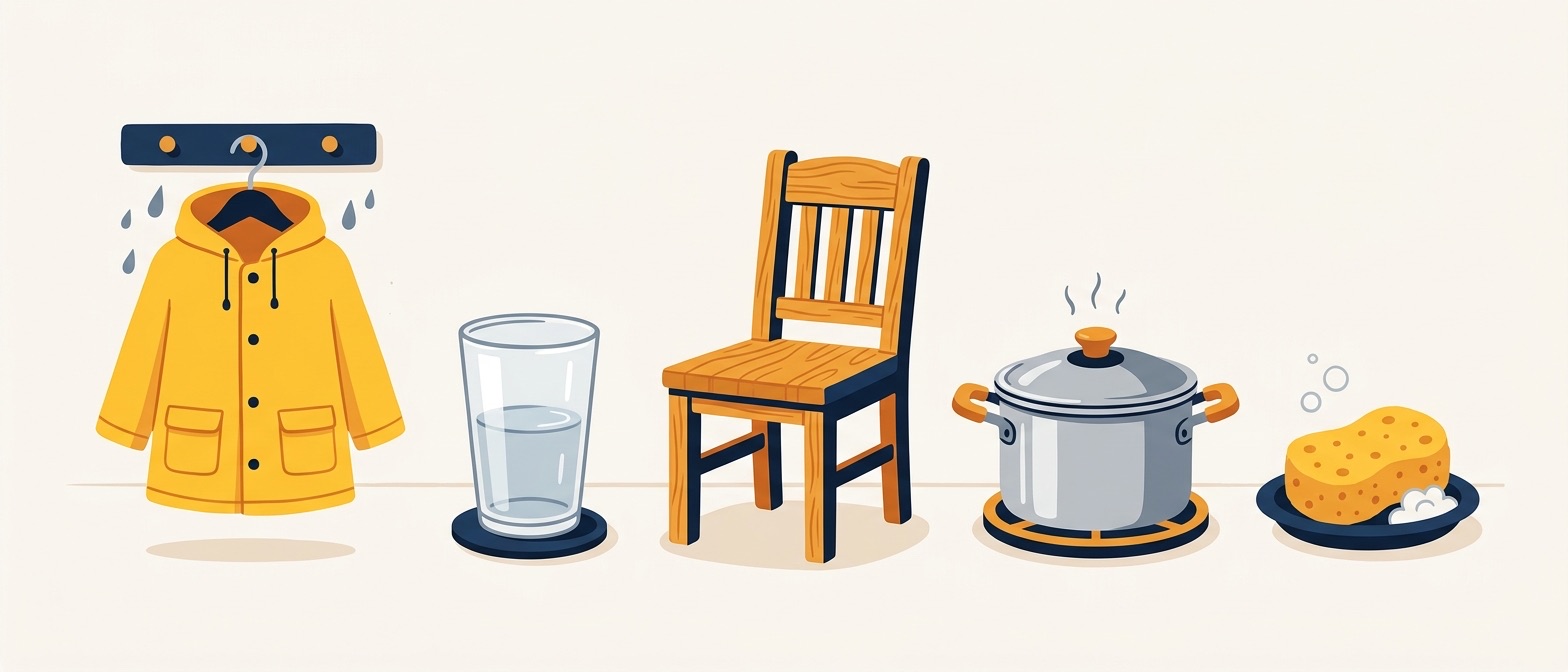
Why is a raincoat made of plastic and a window made of glass? Nobody picks these on accident. Every material has its own set of properties — the special things it can and cannot do — and people choose a material because its properties fit the job. A raincoat keeps you dry on a rainy walk to the MRT, so it must be made of something water cannot soak through. A window lets you see outside, so it must be made of something you can see through. In this note you will try the science yourself, and then learn the exact word your PSLE marker is waiting to read.
Parents: each section has a tiny experiment your child can tap through — let them predict first, then reveal. The blue dotted words are tappable definitions, and the "Teacher's tip" boxes name the precise keyword the PSLE marker awards. Doing it together for 15 minutes beats reading it for an hour.
By the end you'll be able to look at any object and name the property that makes it right for its job. The five we'll master are: float or sink, absorbency, flexibility, strength, and degree of transparency. Let's go.
Float or Sink
Drop a coin into your water bottle and it drops straight to the bottom. Drop in a small piece of foam and it stays on top. Why? It is not just about heavy and light — a huge wooden log floats, but a tiny steel nail sinks. The real reason is .
Here is the rule. Water has its own density. If a material is less dense than water, it floats. If it is more dense than water, it sinks. Wood is packed loosely, so it is less dense than water and floats. Steel is packed very tightly, so it is more dense than water and sinks — even a tiny piece.
Try it. Predict whether each object floats or sinks before you reveal the answer.
Drop it in water — float or sink?
Predict first: Will a cork float or sink?
Absorbency
Spill some water on your study table. Wipe it with a tissue and the water disappears into the tissue. Now try wiping it with a plastic ruler — the water just smears around. The tissue soaked the water up; the plastic did not. That difference is absorbency.
A material that soaks up water is . A material that does not let water pass through or soak in is . A sponge mopping the kitchen floor is absorbent. The raincoat keeping you dry is waterproof. The towel you use after a swim? Absorbent — that is exactly why it works.
Test a few materials in the experiment below. Predict first.
Drip water on it — absorb or repel?
Predict first: Does a plastic sheet soak up water or repel it?
Flexibility
Hold a rubber band and stretch it — it bends easily and springs back. Now try to bend a wooden chopstick — it barely moves, and if you force it, it snaps. Materials behave very differently when you try to bend them, and that property is flexibility.
A material that bends easily without breaking is . A material that does not bend is (we also say rigid). A material that snaps instead of bending is . A skipping rope is flexible. A wooden chopstick is stiff. A stick of chalk is brittle — press it and it crumbles.
Bend the materials in the experiment and watch what happens.
Bend test — flexible or stiff?
Predict first: Does a rubber band bend or break?
Strength
Hang your full school bag on a single thread and the thread snaps. Hang the same bag on a thin metal hook and it holds with no problem. The metal can take a big pulling or pressing force without breaking; the thread cannot. That property is strength.
A material can hold a heavy load without breaking. A material breaks under a small load. The steel beams holding up an HDB block are strong. A single strand of cotton thread is weak. Strength is about how much force or load a material can take before it breaks.
Load up the materials below and find out which ones hold.
Pile on the load — strong or weak?
Predict first: Will a wooden plank hold a heavy load or give way?
Now go further — keep adding weight and find the exact breaking point for each material.
How much weight can it hold?
Predict first: Which beam holds the MOST weight before snapping?
Degree of Transparency
Stand a glass cup, a sheet of tracing paper, and a metal spoon in front of a torch. Through the glass you see the torch clearly. Through the tracing paper you see only a blurry glow. Through the spoon you see nothing at all. Materials let different amounts of light pass through, and that property is the degree of transparency.
A material that lets (almost) all light through, so you can see clearly, is . A material that lets some light through but you cannot see clearly is . A material that lets no light through is . A clean window is transparent. Frosted bathroom glass is translucent. A wooden door is opaque.
Shine light through different materials and see what reaches the other side.
Shine light through a material
Predict first: Will frosted (translucent) glass make a dark or a faint shadow?
Watch out — these are easily mixed up
These three pairs trip up many students every year. Learn the difference now and you'll catch easy marks.
Quick recap
🎯 Mastery check
Answer all 7 — your progress is saved on this device.
A wooden log floats on a river even though it is very heavy. Why does it float?
You spill water and want to dry it fast. Which material would you choose, and what property makes it right?
A stick of chalk crumbles and snaps the moment you press it. The chalk is best described as…
Steel beams are chosen to hold up an HDB block. Which property is most important here, and why?
Frosted bathroom glass lets some light through, but you cannot see clearly through it. The glass is…
Which material casts the darkest shadow when light shines on it?
A student writes that glass is "strong" because it is hard to scratch. Why is this wrong?