Plant Transport System
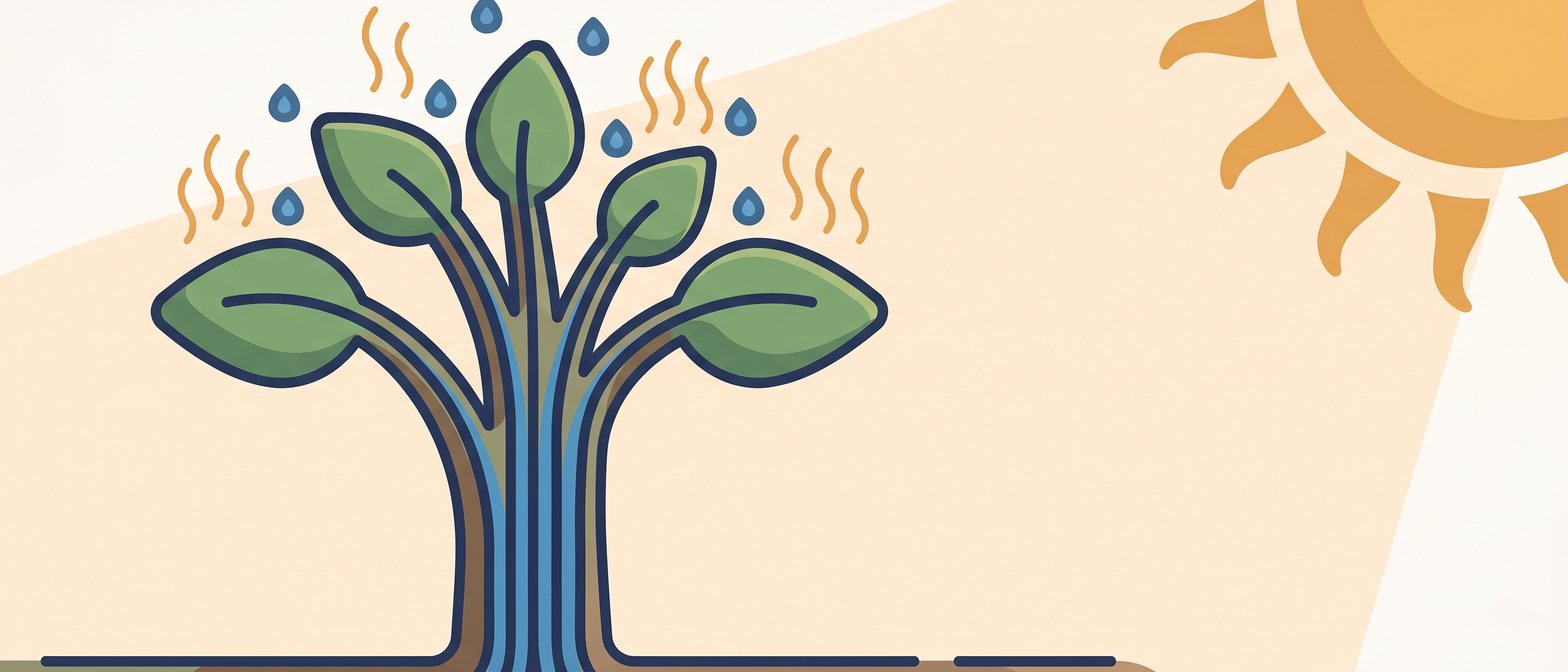
How water travels from the roots up the stem to the leaves, and how transpiration pulls more water up as it evaporates.
⏱ 9 min · 🎯 5 things to master
Have you ever watered a potted plant in the morning and come back to find the soil dry by afternoon? The plant did not spill it — it drank every drop and then pushed it out through its leaves. Plants run a non-stop delivery system inside their stems, moving water from the roots all the way to the leaf tips, and then sending food made in the leaves back down to every part of the plant. Once you understand how this system works, the word transpiration will feel as obvious as turning on a tap.
Parents: let your child set the weather conditions in the experiment before revealing the outcome — the "predict first" step is the key to remembering the word transpiration. Tapping through together and reading each result aloud takes about 10 minutes.
By the end you will be able to explain how a plant absorbs, transports, and uses water and food. The four P5 support ideas are: roots absorbing water and mineral salts, water moving up the stem, transpiration from the leaves, and food transport from the leaves. Named xylem, phloem and transpiration pull are optional enrichment. Let's work through them one by one.
Roots Absorb Water and Mineral Salts
The journey of water in a plant starts underground. A plant's roots spread out through the soil like a net, and tiny root hair cells cover those roots like thousands of fine bristles. These root hair cells are the entry points. They absorb from the soil.
Two things make root hair cells good at this job: they have very thin walls that water passes through easily, and there are huge numbers of them, giving the root a large surface area to absorb more in less time. Without healthy roots in moist soil, the rest of the plant cannot get the water and minerals it needs to grow.
🤔 Predict first: Why do roots have many tiny root hair cells instead of one thick tube?
Water Travels Up the Stem
Once water enters the roots, it moves upward through tubes inside the stem to the leaves. In optional enrichment, these water-carrying tubes are called . Think of them as the plant's water pipes.
As optional enrichment, water evaporating from the leaves can be described as creating a "pull" that helps draw more water up the stem. The P5 support idea is simply that water moves from the roots, up the stem, to the leaves.
Transpiration: Water Leaves Through the Leaves
Here is the part that surprises most students. Water does not stay in the leaves — most of it escapes into the air as water vapour through tiny pores called . This process of water evaporating from the leaf surface is called .
Transpiration is the loss of water vapour from the leaves. As optional enrichment, this evaporation can be described as helping draw more water up from the stem and roots. The P5 support idea is that water leaves the plant through the leaves as water vapour.
The rate of transpiration changes with the weather. On a hot, sunny day the water evaporates faster. Wind carries the water vapour away and keeps the air dry, so even more evaporates. On a cool, still day very little evaporates, so the whole system slows down.
Try the experiment below. Predict first, then set the weather condition and run it. The visual "pull" language in the experiment is optional enrichment; the P5 core is water loss from leaves by transpiration and water movement from roots through the stem to leaves.
How fast does water travel up the plant?
Predict first: On a hot, windy day, does a plant pull up water faster or slower?
Food Made in the Leaves Is Transported to the Rest of the Plant
Water often moves upward from the roots. Food made in the leaves moves to the parts that need it, including roots, stems, flowers and fruits; it is not limited to one direction. Leaves are the plant's food factory. Using sunlight, carbon dioxide from the air, and water from the stem, the leaves make their own food through a process called .
This food — a type of sugar — is then transported from the leaves to the rest of the plant. In optional enrichment, the food-carrying tubes are called .
In optional enrichment, these two named transport systems are described as working together:
- Xylem — carries water and mineral salts upward from roots to leaves.
- Phloem — carries dissolved food from the leaves to the rest of the plant.
🤔 Predict first: A leafy stem is placed in red-dyed water. After a few hours, red colour appears in the leaf veins. What does this observation show?
Watch out — these are easily mixed up
Quick recap
🎯 Mastery check
Answer all 8 — your progress is saved on this device.
Which part of the plant absorbs water and mineral salts from the soil?
What is the name of the process by which water evaporates from the leaves of a plant?
On a hot and windy day, how does the rate of transpiration change compared to a cool still day?
After roots absorb water, where does most of that water move next?
A plant makes food in its leaves. Where is that food transported?
A student covers a plant with a plastic bag in bright sunlight. After one hour the inside of the bag is wet. What caused the water to appear?
Why do plants wilt more quickly on a hot, windy afternoon than on a cool, calm morning?
What happens to water during transpiration?