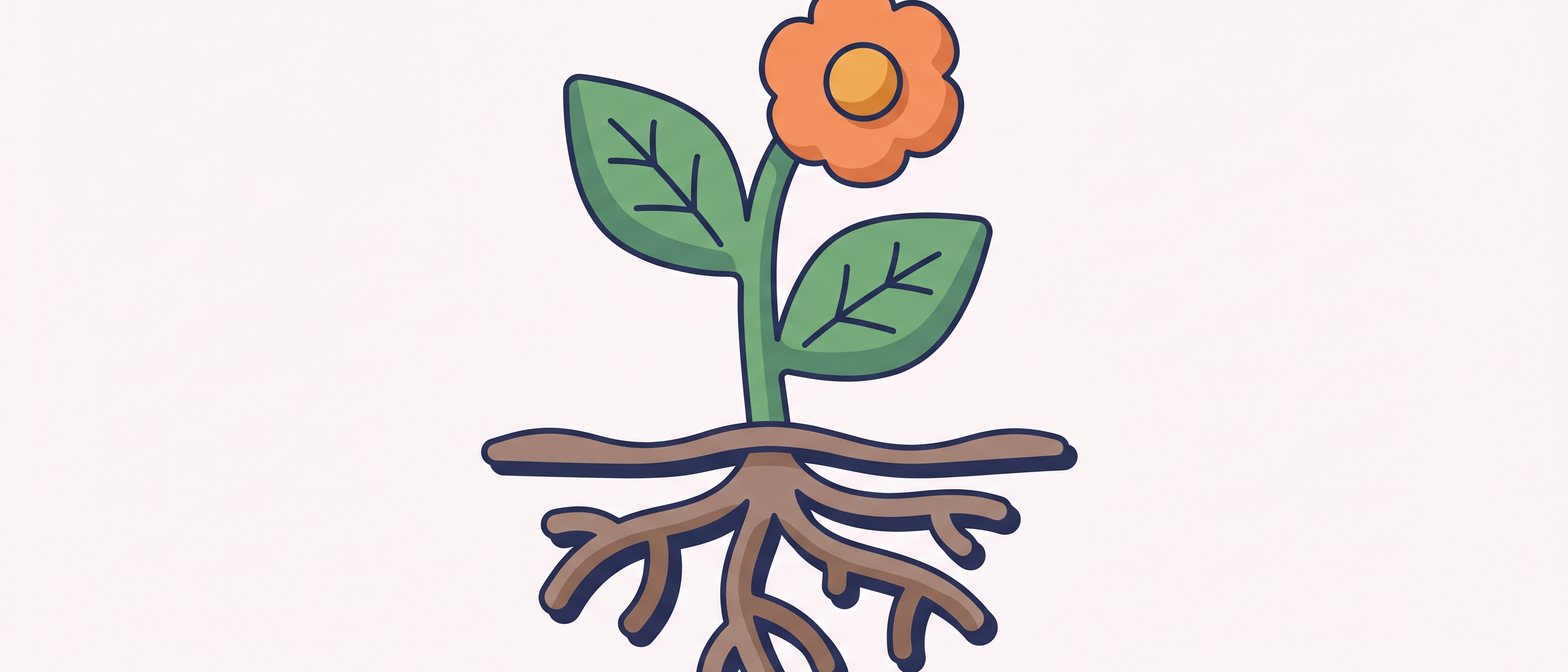
Plant System
The four main parts of a plant — roots, stem, leaves and flowers — and the job each one does for the whole plant.
⏱ 10 min · 🎯 4 things to master
You have watered a potted plant on your HDB corridor many times. But have you ever wondered exactly what each part of that plant is actually doing for the whole thing to stay alive and grow? Every part has one clear job — and the PSLE marker is waiting to see the exact word that names it.
Parents: let your child predict which plant part makes food before you reveal the answer below. Asking "why do you think that?" before clicking anything is the single habit that locks in the concept.
By the end you will be able to name the job of every main plant part and use the exact words your marker rewards. The four parts we will look at are: roots, stem, leaves, and flowers. Let's go.
Roots
Push your finger into the soil in a flower pot and you will feel the roots gripping tightly all around the inside. Roots have two jobs that work together: they hold the plant firmly in the ground, and they take in the water and minerals the plant needs to grow.
Water cannot float up into a plant by itself — the roots have to it. Mineral salts are tiny dissolved substances in the soil that the plant uses to make new leaves and grow strong. Without roots the plant would topple over in the first breeze and starve of water at the same time.
🤔 Predict first: A plant is pulled out of the ground. It wilts and falls over almost immediately. Which two root functions are lost?
Stem
Snap a large leaf off a leafy plant and hold it up to the light. You will notice tiny lines running through the leaf all the way from the stalk. Those lines are the end of a long transport network that starts in the stem.
The stem has two jobs. It , so the leaves can catch as much sunlight as possible. It also acts like a set of pipes, water (absorbed by the roots) upward to the leaves, and food (made in the leaves) down to the roots, flowers, and fruits that need it.
🤔 Predict first: Water absorbed by the roots needs to reach the leaves at the top of a tall tree. What carries it there?
Leaves
Hold a leaf up to a bright window. It is thin and flat and almost the same colour as fresh grass. That shape is not an accident — a wide, thin, green surface catches a huge amount of sunlight, and the green colour comes from a substance that traps that light to make food.
Leaves make food for the whole plant through a process called . In plain terms: leaves take in sunlight and carbon dioxide from the air, combine them with water transported up from the roots, and turn them into sugar that the plant uses as energy. The oxygen released in this process is what keeps the air in your classroom breathable.
This is the most important function of the leaf in the PSLE, and the exact word is photosynthesis.
Flowers
A flower is the most colourful part of the plant for a reason. Bright colours and sweet scents attract insects and birds. But the flower is not there to look pretty — its one job is to carry out .
Inside the flower are the parts that make pollen (the male cell) and ovules (the female cells). When pollen travels from one flower to the stigma of another — by wind, by insects, or by other animals — pollination happens. After that, fertilisation joins the male and female cells, the ovule develops into a seed, and the ovary around it becomes a fruit. Every mango at the supermarket started as a flower that reproduced successfully.
🤔 Predict first: A farmer removes all the flowers from his durian trees to keep the orchard tidy. What problem will this cause?
The match-part-to-job experiment
Now try it yourself. Tap a plant part on the diagram below, then tap its correct function. See if you can match all four before revealing the answer.
Match the plant part to its job
Predict first: Which part of the plant makes its food?
Watch out — these are easily mixed up
Quick recap
🎯 Mastery check
Answer all 8 — your progress is saved on this device.
A potted plant on your corridor looks healthy. Which part absorbs the water you pour in?
After heavy rain, a tall tree stays standing while the shallow-rooted pot plant next to it tips over. Which root function explains why the tree stays upright?
Scientists dye the water in a vase red and place a white flower in it. A few hours later, red streaks appear in the stem. Which function does this show?
Which part of a plant makes food, and what is the name of the process?
A student says: "I covered all the leaves of my plant with black tape to keep it tidy. The plant should be fine because the roots still supply water." Why is the student wrong?
A durian tree produces hundreds of flowers every year. What is the main purpose of these flowers?
Look at this list of jobs: (1) absorb water, (2) transport food, (3) make food, (4) reproduction. Match each job to the correct plant part.
You want to grow new mango trees from the ones in your garden. Which part of the plant must you allow to develop for this to happen?