Photosynthesis
How green plants make their own food using light, water and carbon dioxide, how chlorophyll helps leaves capture light, and what the process produces.
⏱ 10 min · 🎯 5 things to master
You eat rice, noodles, bread — food that someone or something else made. But a green plant never goes to the canteen. It makes its own food, right inside its leaves, using sunlight, water, and the air around it. This is one of the most remarkable things in science, and it has its own PSLE keyword: photosynthesis. Get that word right on the exam and you'll collect marks that many students miss.
Parents: each section has an interactive experiment your child can tap through. Let them predict first, then reveal. The blue dotted words are tappable definitions. The Teacher's tip boxes name the exact keyword the PSLE marker wants.
By the end you will be able to explain what a plant needs to make its own food, name what it produces, and say where photosynthesis mostly happens. The four ideas to master are: the process itself (photosynthesis), the investigation requirements (light energy, water and carbon dioxide), the products (food and oxygen), and where it happens (mainly in the leaves). Chlorophyll is a useful explanation for why green leaves capture light.
Plants make their own food — by photosynthesis
Most living things have to find or eat their food. A cat eats fish. A bird eats worms. But a green plant is different — it is a . It builds its own food using ingredients it collects from the world around it.
The name for this food-making process is . "Photo" means light, and "synthesis" means making something new — so photosynthesis literally means "making something using light."
Here is the predict step before you try the experiment.
🤔 Predict first: A gardener covers a healthy plant with a thick black bag for two weeks. What happens to the plant?
What does the plant need? Three investigation requirements
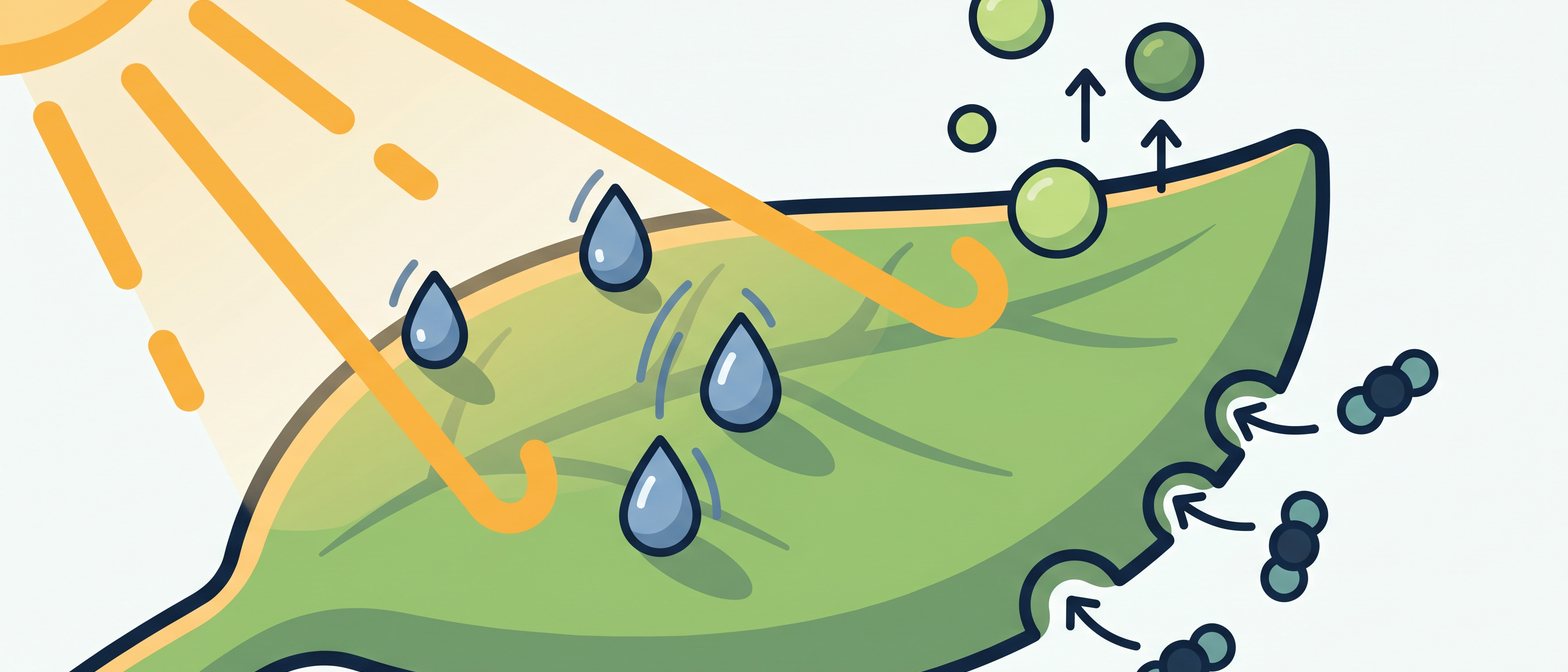
For the P6 investigation, test three requirements: light energy, water and carbon dioxide. Without any one of them, the plant cannot make food by photosynthesis. Think of it like a recipe — you cannot bake a cake if you leave out an important ingredient.
The three requirements are:
- — provides the energy to drive the whole process. A plant in a dark cupboard cannot make food.
- — taken in through the roots and sent up to the leaves.
- — a gas from the air that enters the leaf through tiny holes called stomata.
Green plants need to capture light. It is a useful scientific explanation, but not a fourth investigation variable in the P6 outcome.
Try the experiment below. Toggle each ingredient on and off, and watch what happens to the plant.
Make food — can the plant do photosynthesis?
Predict first: Can a plant in a dark cupboard still make its own food?
What does the plant produce?
When the three investigation requirements are present in a green part containing chlorophyll, photosynthesis makes two things:
- — this is the plant's main energy source. It is used for growth, repair, and reproduction. Any extra is stored as starch. This is the whole point of photosynthesis: the plant feeds itself.
- — a gas that is released through the tiny holes in the leaves. This is the same oxygen that humans and animals breathe. Every breath you take owes something to plants.
🤔 Predict first: Which gas does a plant release during photosynthesis?
Where does photosynthesis happen?
The most important organ for photosynthesis is the . Leaves are the plant's food factories.
Leaves are designed for this job in three ways. They are broad and flat so they can catch as much sunlight as possible. They are thin so that gases like carbon dioxide can move in and out quickly. And their cells are packed with chlorophyll, which is what traps the light energy. Photosynthesis can happen in any green part of the plant — a green stem also has chlorophyll — but the leaves do most of the work.
🤔 Predict first: A student removes all the leaves from a healthy pot plant and leaves it in bright sunlight with plenty of water and carbon dioxide. Will the plant still carry out photosynthesis at the same rate?
Watch out — these are easily mixed up
Quick recap
🎯 Mastery check
Answer all 8 — your progress is saved on this device.
A green plant makes its own food using sunlight, water and carbon dioxide. What is the name of this process?
Which set gives a green plant what it needs to make food by photosynthesis?
Which gas does a plant release during photosynthesis?
A plant is kept in a completely dark cupboard for two weeks with regular watering. What will most likely happen?
Where does most photosynthesis take place in a green plant?
What is the food that a plant produces during photosynthesis stored as?
A student says: "The plant gets energy from the sun." Why is this answer incomplete?
Which of these would you choose to speed up photosynthesis in a classroom plant, and why?