Measuring Mass and Volume
How to measure the mass of an object with a balance and the volume of an irregular object by water displacement, with the right units.
⏱ 10 min · 🎯 4 things to master
Your school bag, your water bottle, a handful of marbles — they all take up space and they all contain matter. But how would you measure the space a marble takes up, or tell exactly how much matter is in a stone? You cannot wrap a ruler around a lumpy rock. Scientists solved this problem long ago, and once you see it, you will never forget it. Let us find out how.
Parents: each section has a "predict first" step — please let your child make their guess before tapping the reveal. The interactive experiment in the Volume section is the heart of this note; doing it together takes about ten minutes and really locks in the keyword.
By the end you will be able to explain how to measure the volume of regular shapes and suitable irregular solids, find the mass of an object using a balance, and write the correct units. The four ideas to master are: volume, water displacement, mass, and the correct units for each.
Volume — the space something takes up
Place a table-tennis ball beside a basketball. The basketball fills more three-dimensional space, so it has a greater . Volume is the space an object takes up.
For a neat shape like a rectangular block, you can measure its length, width, and height with a ruler, then multiply them together. But what about a stone? Or a key? Or a crumpled ball of foil? You cannot get a ruler to measure all their bumpy edges. There is a clever trick for that — and it uses water.
🤔 Predict first: You want to find the volume of a small stone. You have a measuring cylinder filled with water. What would you do?
Water displacement — measuring irregular shapes
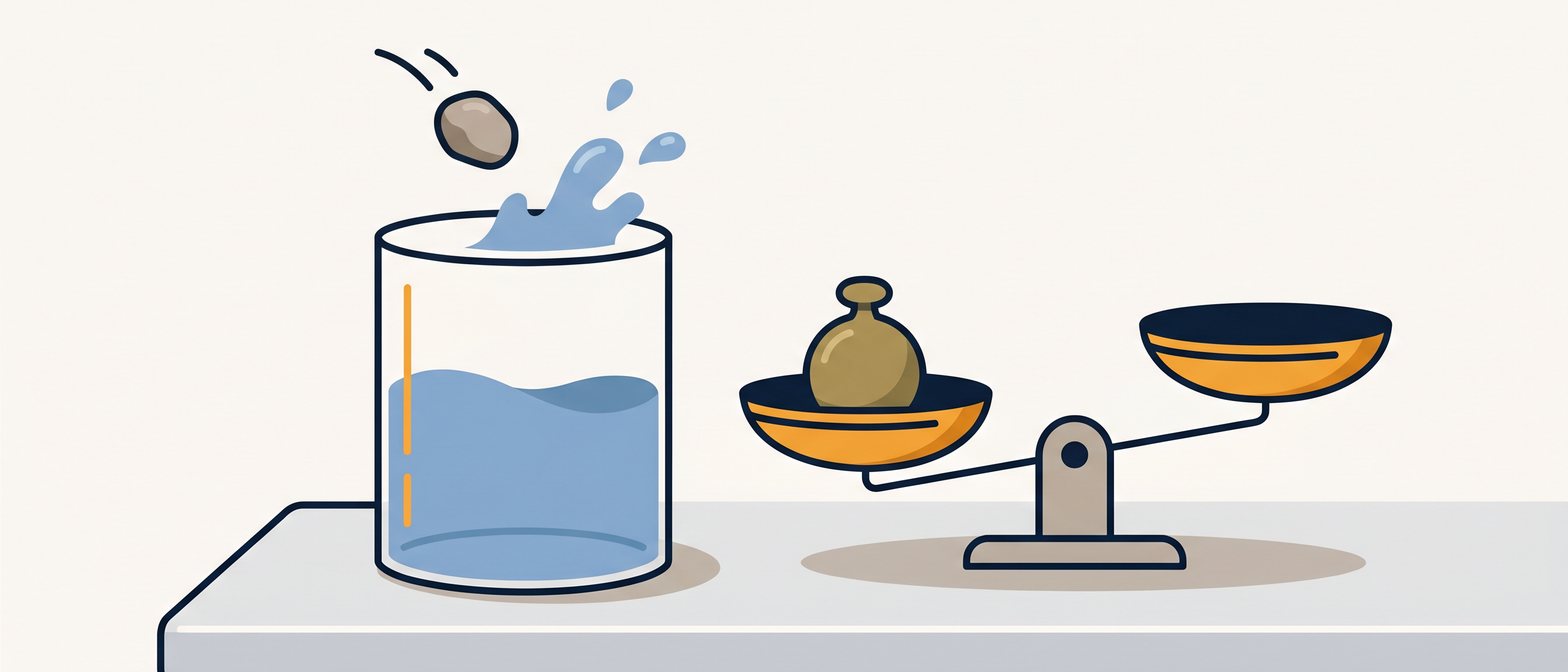
Here is the experiment your science teacher would set up on the lab bench. Fill a with water to a known level — say, 50 ml. Now carefully lower a suitable irregular solid until it is completely under the water. It must not dissolve or absorb water, and there should be no trapped air on its surface. The water level rises by the volume of the object because the object pushes aside (displaces) that amount of water.
This method is called . It works for a solid object that can be completely submerged, does not dissolve or absorb water, and has no trapped air. A stone, a key, or a coin can be suitable examples when those conditions are met.
Try it yourself below. Pick a different object each time and read off the rise.
Water displacement — measure any irregular object
Predict first: How can you measure the volume of a stone that has no neat shape?
Mass — the amount of matter inside
Pick up an empty crisp packet. Now pick up a full packet. The full one feels heavier — it contains more matter. The amount of matter in an object is its . Mass is not decided by an object's size alone.
Mass is not the same as size. A small piece of lead has far more mass than a large piece of foam, because lead has more matter packed into a smaller space. Two objects can look the same size but have very different masses.
We measure mass with a . A balance has two pans. You place the object on one pan and add known (sometimes called weights) to the other pan until both sides are level. The total of the standard masses equals the mass of the object.
🤔 Predict first: A student wants to find the mass of a mango. She places it on the left pan of a balance. What goes on the right pan?
Units — getting the numbers right
Measurements are clearer when the right unit is written next to the number.
| What you are measuring | Unit | Symbol |
|---|---|---|
| Volume (liquid or solid) | millilitre or centimetre cubed | ml or cm³ |
| Mass (small object) | gram | g |
| Mass (heavy object) | kilogram | kg |
Remember that 1 ml = 1 cm³ as volume units. In a displacement reading, a 20 cm³ rise means that 20 ml of water was pushed aside; the method works because a fully submerged object displaces water equal to its own volume.
🤔 Predict first: A student measures the volume of a pebble and writes '15'. Is this a complete answer?
Watch out — these are easily mixed up
Quick recap
🎯 Mastery check
Answer all 8 — your progress is saved on this device.
A student places a stone in a measuring cylinder. The water level rises from 40 ml to 55 ml. What is the volume of the stone?
Which instrument is used to measure the mass of an object?
A student writes that a marble has a volume of "8". Why is this answer incomplete?
You want to find the volume of a metal key. You cannot measure it with a ruler because of its irregular shape. What is the best method?
A large sponge and a small iron nail are placed on a balance. The nail tips the pan. Which object has more mass?
The correct unit for the volume of an irregular solid measured by water displacement is…
A student places an apple on one pan of a balance and adds 150 g and 50 g standard masses to the other pan to make it level. What is the mass of the apple?
Why can water displacement NOT be used to find the volume of a sugar cube?