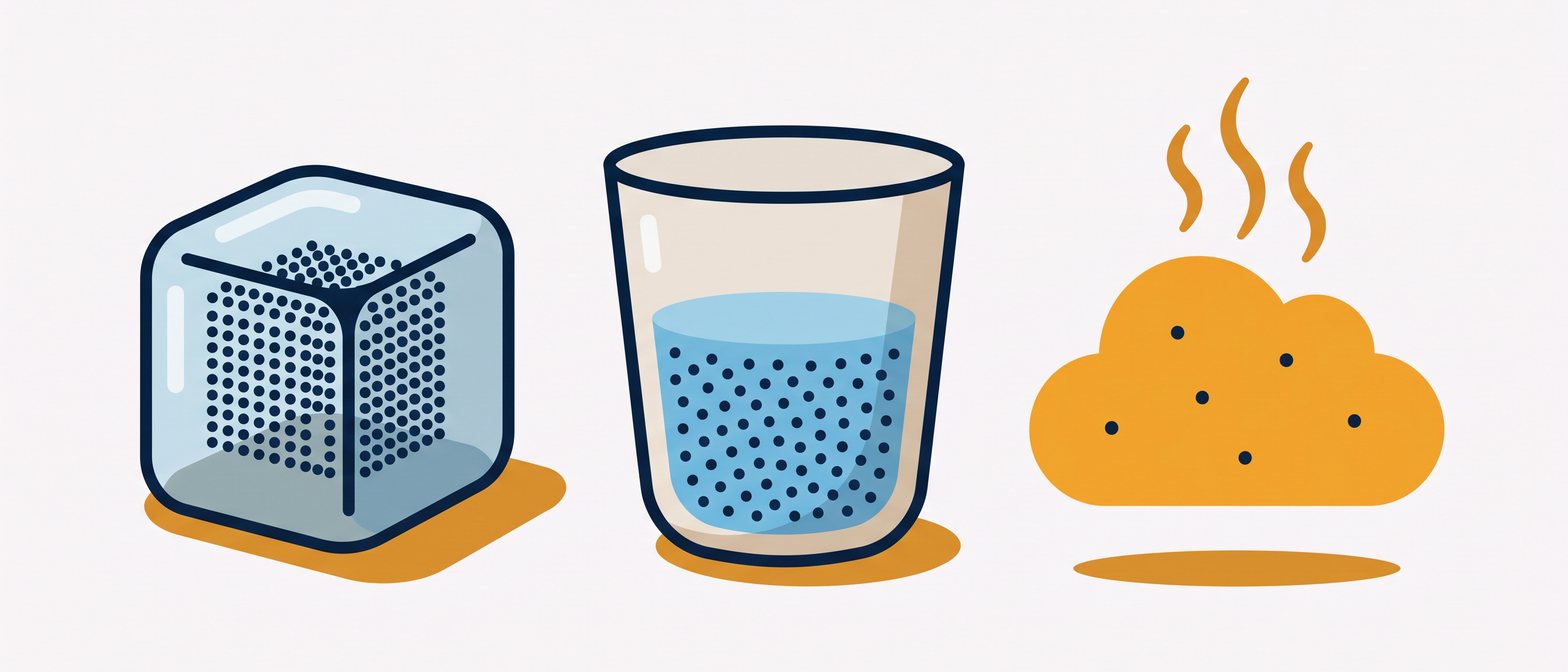
Matter and Its Three States
The observable properties of solids, liquids and gases, with an optional particle-model look-ahead and a guide to named state changes.
⏱ 8 min · 🎯 4 things to master
Put your water bottle in the freezer overnight and the water turns hard. Pull it out and it melts back into water. Leave a puddle in the sun and it slowly disappears into the air. The water has not changed into something new — it is still water, just in a different state. Everything around you — your school bag, the air you breathe, and the juice in your cup — is matter.
Parents: the state-change material below is an optional look-ahead. Let your child describe the observable state first, then use the sim to explore the particle model and named changes if they are ready.
By the end you will be able to describe the observable properties of the three states of matter. The optional look-ahead explores the particle model and the names of state changes when matter is heated or cooled.
Solid — fixed shape, fixed volume
Think about your wooden ruler. You can hold it upside down, put it on your desk, or drop it in your bag — and it keeps the same shape every time. That is what makes something a . A solid has a fixed shape and a fixed volume (it takes up the same amount of space no matter which container you put it in).
Ice, rock, glass, your pencil, the HDB wall — these are all solids.
Liquid — fixed volume, no fixed shape
Pour water into a cup, then pour it into a bowl. The shape changes to match the container, but the amount of water stays the same. That is a . A liquid has a fixed volume (same amount) but no fixed shape (it takes the shape of its container).
Water, juice, cooking oil, and even liquid mercury are all liquids.
Gas — no fixed shape, no fixed volume
Open a bottle of your mother's perfume in one corner of the room and within seconds you can smell it everywhere. Some of the liquid perfume evaporates into the air; its vapour spreads through the room. A has no fixed shape and no fixed volume — it spreads out to fill whatever container or space is available. The air around you and the carbon dioxide in a fizzy drink are gases. Water vapour is also a gas, but it is invisible; the white cloud above a boiling pot is made of tiny liquid droplets that people often call steam.
Optional look-ahead — heating and cooling change the state
Heating and cooling can make matter move from one state to another. The names below are an optional look-ahead beyond the core P4 state properties.
Try the optional particle experiment. Predict what you will observe when you heat or cool the sample, then check.
Heat it up or cool it down — watch the particles!
Predict first: When you heat ice, the particles…
Here is a map of the common state changes:
🤔 Predict first: Water is heated strongly until it bubbles. What is the name of this change of state?
🤔 Predict first: Invisible water vapour cools on a cold window and forms visible water droplets. What is this change of state called?
Watch out — these are easily mixed up
Quick recap
🎯 Mastery check
Answer all 8 — your progress is saved on this device.
Which observation best shows that ice is a solid?
You pour orange juice from a round cup into a square cup. The shape of the juice changes but the amount stays the same. What state is orange juice?
You spray air freshener in one corner of the classroom and soon everyone can smell it. Which property of a gas explains this?
Optional look-ahead: ice is left on a warm void deck for an hour and turns into water. What is the name of this change of state?
Optional look-ahead: water in a pot bubbles strongly and changes into an invisible gas. What is the name of this change of state?
Optional look-ahead: invisible water vapour in the air cools and forms droplets on the outside of a glass of iced water. What caused this?
Optional look-ahead: a student says "the juice dissolved when I put it in the freezer." What is wrong with this statement?
Which of the following correctly describes a gas?