Man's Impact on the Environment
How human actions harm the environment through pollution, deforestation and over-hunting — and the conservation actions that help protect it.
⏱ 12 min · 🎯 4 things to master
Here is a question that might surprise you: the most powerful force shaping nature on Earth right now is not a storm, a volcano, or a disease. It is us — people. The things we do every day, from how we travel to how we throw away rubbish, add up into massive changes for the plants and animals around us. Some of those changes harm the environment badly. But the good news is that the things people do to help are just as powerful. In this note you will try an ecosystem experiment yourself, see what breaks and what heals, and learn the exact words your PSLE marker wants to read.
Parents: let your child pick actions in the experiment first and predict what happens before reading the explanations — predicting out loud, even wrongly, is what makes the keywords stick. The blue dotted words are tappable definitions.
By the end you will be able to explain harmful and helpful human actions, name the effects on habitats and food chains, and use the key word conservation correctly. The four ideas we will master are: harmful human actions, their effects on living things, good human actions, and how everyone can help.
Harmful Human Actions
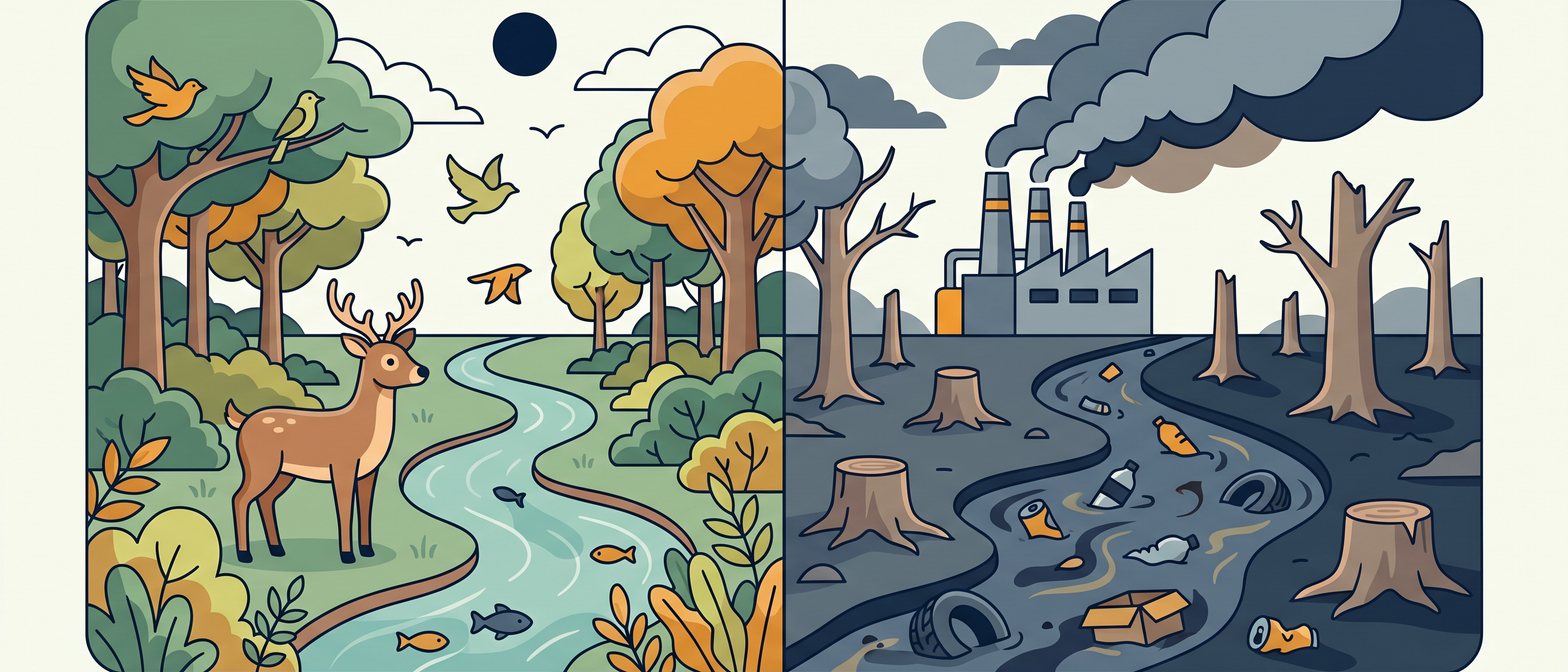
Every time a forest is cleared, a factory pipe pours smoke into the air, or a bag of rubbish is tossed into a drain, the environment takes a hit. Three of the biggest harmful actions are , , and .
Pollution comes in three forms. Air pollution happens when vehicle fumes and factory smoke fill the air with harmful gases. Water pollution happens when rubbish, chemicals, or untreated sewage flow into rivers, lakes, and the sea. Land pollution happens when people dump solid waste — plastic bags, old batteries, broken electronics — on the ground. Each type damages the habitat where living things live, grow, and find food.
Deforestation means cutting down trees on a large scale — to clear land for farms, roads, or buildings. Trees are not just nice to look at: they are habitat for hundreds of animals, they hold the soil in place, and they are part of many . Remove the trees and you remove the home and the food supply of every creature that depended on them.
Over-hunting removes so many animals of one type that the food chain loses a link. If all the eagles in an area are hunted, the rabbits they ate will multiply out of control, eating all the grass. Removing one animal can unravel the whole chain.
🤔 Predict first: A housing estate is built where a forest used to stand. What happens to the animals that lived in the forest?
Effects on Habitats and Food Chains
The damage from harmful human actions ripples through the whole environment. When a habitat is destroyed, every living thing that depended on it is affected — not just the ones we can see. Let us trace one example through a Singapore nature context.
Imagine a patch of mangrove forest along the coast. A developer cuts it down to build a resort. Here is what follows:
- The mangrove trees — the — are gone.
- Mud skippers and crabs that ate algae in the mangrove roots lose their feeding ground.
- Herons and kingfishers that ate those mud skippers have nothing to eat.
- The food chain has three broken links in one action.
The same pattern applies to water and air pollution. When rivers are polluted, fish die — and every animal that fed on the fish loses its food source too. When soil is polluted, plants cannot grow — and the animals that fed on those plants go hungry.
Good Human Actions
People can make things better just as powerfully as they can make them worse. The key idea is . There are several ways to put conservation into practice.
puts trees back where forests were cleared. When trees return, food chains can also recover as insects, birds, and mammals find habitat and food again. Reforestation programmes in Singapore show how restoring habitat can support wildlife.
reduces the amount of waste we create and lowers land and water pollution. The blue bins around your HDB block collect paper and cardboard so the material can become new packaging rather than rubbish in a drain.
Setting up and wildlife parks gives animals a safer home where activities such as hunting or habitat clearing are restricted. Sungei Buloh Wetland Reserve is a real Singapore example: migratory birds that travel from Siberia to Australia stop here to rest and feed each year.
Reducing waste — using a reusable bag instead of a plastic one, choosing products with less packaging, fixing broken things instead of throwing them away — keeps land and water cleaner for all living things.
The Ecosystem Health Experiment
Now it is your turn. You are the decision-maker for an ecosystem. Pick actions — harmful or helpful — and watch what happens to the environment. Can you heal it back to full health after causing damage?
Heal or Harm? — The Ecosystem Health Experiment
Predict first: Does cutting down a forest help or harm the animals living there?
Everyone Can Help
You do not need to be a scientist or a government minister to protect the environment. Students in P5 and P6 have already made a real difference through simple actions: picking up litter at Labrador Nature Reserve, joining schools' recycling programmes, or convincing their families to use reusable bags. These actions matter because they add up.
Is this a harmful or a helpful action?
Predict first: Is building a factory next to a river a harmful or a helpful action?
Watch out — these are easily mixed up
Quick recap
🎯 Mastery check
Answer all 8 — your progress is saved on this device.
A factory near a river dumps chemical waste into the water. What type of pollution is this, and what is one likely effect?
A large forest is cleared to build a shopping mall. How does this affect the animals that lived in the forest?
Eagles in a forest are over-hunted until almost none remain. Rabbits in that same forest then multiply out of control. Why does this happen?
Which of the following is the best definition of conservation?
Your school sets up a recycling programme for paper and plastic. Which harmful action does this help to reduce?
A government sets up a nature reserve in a mangrove forest. Which animals are most likely to benefit, and why?
Marcus uses a reusable water bottle instead of buying a new plastic bottle every day. What type of conservation action is this, and what is one benefit?
A wildlife organisation plants 10,000 trees on a hillside that was cleared for farming 20 years ago. Name this action and explain one benefit for animals.